Nouvelles diverses | Page 17
actualités internationales Gouvernance mission et composition du conseil d'administration
What The Director Of The Future Will Need To Succeed
Ivan Tchotourian 8 juillet 2020 Ivan Tchotourian
Board Member vient de publier une étude sur les CA du futur : « What The Director Of The Future Will Need To Succeed ». Intéressant dans le monde post COVID-19.
Merci à Louise Champoux-Paillé de l’information !
Extrait :
“The future of business will be different,” surmised a director on a recent virtual board roundtable hosted by RSR Partners, “in ways we can’t anticipate in this moment. Our board is focused on assessing whether all our directors are truly ready for what’s coming.”
Over the past few months, RSR Partners hosted more than a dozen roundtables for sitting directors, providing a forum for the participants to share what their boards are learning as they navigate the current crisis and pivot into the “new normal.” While tackling topics as diverse as commercial strategy, operations, health and safety, and the future of business, one theme was pervasive throughout the discussions: leadership and stakeholders will be looking to the boardroom for guidance, and board members not only need to have the requisite experience and skills to confidently provide direction, but the leadership characteristics that will allow them to be effective.
Fundamentally, the global business disruption and current uncertainty has created a need for a higher level of involvement from board members. “This is a time to have board members who have experienced really tough issues, such as major ecessions, difficult mergers, major cost cutting, insolvency and bankruptcy, and top management departures, along with experience in reinventing companies, including supply chain, product engineering and simplification, digital transformation, offshore manufacturing and procurement, sale of subsidiaries, and comprehensive refinancing,” stated Edward A. Kangas, former Chairman and CEO of Deloitte Touche. “This is not a time for deep thinking. It’s time for people with real experience who know how to oversee and support management in a time of crisis and reinvention.” (Mr. Kangas currently serves on the following boards: Deutsche Bank USA Corp., Intelsat SA, VIVUS, Inc., and Hovnanian Enterprises, Inc.).
Characteristics of Directors Who Succeed in the “New Normal”
From a practical perspective, there is now a higher premium placed on a director’s proven ability to navigate a business through a crisis while mitigating risk and understanding how and when to pull the levers that will impact balance sheets. The demand to optimize results, sustain business, and adapt to changes in a regional and global market has increased alongside the time commitment and attention to detail required of directors to address these issues. Normal requirements for sound governance, audit oversight, compensation strategies, business performance goals, and succession of key leadership have continued to be paramount during the crisis. However, what the current crisis has forced boards to recognize is that a combination of specialized and diversified skillsets and characteristics will produce good corporate governance in and after 2020.
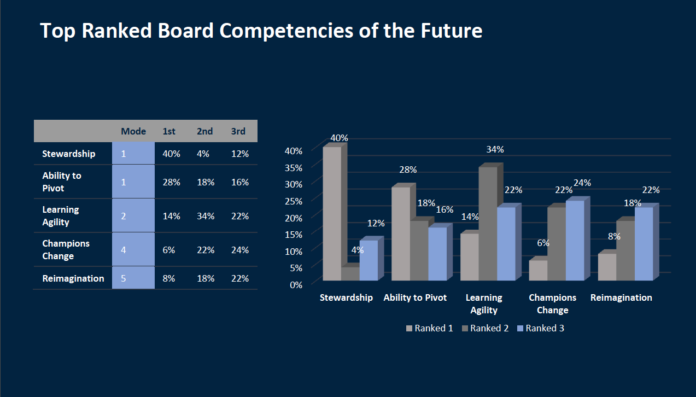
In addition to listening to the characteristics discussed in the recent roundtables, RSR Partners polled more than 250 public company board members of Fortune 50-1000 companies to identify the traits they hope to see emerge in this generation of board members. The results indicated that stewardship, the ability to pivot and learn agility, to be a champion of change, and to be capable of reimagination will be most needed by the directors charged with steering their boards in the “new normal.”
1. Stewardship
2. Ability to Pivot
3. Learning Agility
4. Champions of Change
5. Reimagination
À la prochaine…
Gouvernance Nouvelles diverses
COVID-19 et gouvernance : et l’éthique ?
Ivan Tchotourian 7 juillet 2020 Ivan Tchotourian
Le 26 juin 2020, Deloitte a publié une étude intéressante : « Global businesses divided on implications of COVID-19 crisis for company ethics ».
Extrait :
As businesses start to look beyond the COVID-19 crisis, the EY Global Integrity Report 2020 reveals divisions on the repercussions for company ethics as a result of the pandemic.
The findings are part of a survey of almost 3,000 respondents from 33 countries up to February 2020, analyzing the ethical challenges companies face in turbulent times. An additional 600 employees across all levels of seniority were surveyed at the height of the COVID-19 crisis in April in companies across six countries – China, Germany, Italy, the UK, India and the US.
The majority (90%) of respondents surveyed during the crisis believe that disruption, as a result of COVID-19, poses a risk to ethical business conduct, but there is a concerning disparity between boards, senior management and employees on the implications for compliance. While 43% of board members and 37% of senior managers surveyed believe the pandemic could lead to change and better business ethics, only 21% of junior employees appear to agree.
The survey highlights that signs of an integrity disconnect at different levels within organizations were evident even before the pandemic with more than half of board members (55%) believing management demonstrate professional integrity, but only 37% of junior employees sharing the same sentiment. In addition, over half of board members (55%) believe there are managers in their organization who would sacrifice integrity for short term gain.
À la prochaine…
actualités internationales Gouvernance Normes d'encadrement
German corporations — and regulation — are in the dock
Ivan Tchotourian 7 juillet 2020 Ivan Tchotourian
Intéressant article du Financial Times du 1er juillet 2020 qui revient sur le modèle allemand « German corporations — and regulation — are in the dock ».
Extrait :
Now the consensual German model of business has suffered multiple mechanical failures. Wirecard, the payments group that bolstered German tech credentials, has imploded in fraud. Bayer is taking up to $11bn in charges mostly triggered by a disastrous US takeover. Once-proud conglomerates Siemens and Thyssenkrupp are shrinking. Volkswagen’s service life shortens each time Tesla’s outlook improves.
(…) Germany, can we talk? “Sure. I’m driving but I’m German so that’s second nature,” jokes an economist via his hands-free, “I don’t think there is any common thread between Wirecard and these other examples.” According to him, the worst accidents occur when German business adopts US ways. Wirecard had a two-tier board structure, like most German businesses. But its supervisory board was seemingly full of corporate yespersons, not vigilant workers as governance rules dictate. And the group was led by a bossy entrepreneur. Kenneth Amaeshi, a professor of business at Edinburgh university, disagrees with such exceptionalism. He believes the Wirecard scandal puts German stakeholder capitalism “in the dock”. It points to a structural weakness of regulation, he says. He is right.
(…) Corporate governance must be overhauled this time.
Supervisory boards must shrink, meet more often and include more independent directors. Regulators must adopt the adversarial approach of US peers. Industrial giants should unbundle further to create a new tier of focused medium-sized businesses. Siemens’ 2018 flotation of Healthineers, a healthcare equipment unit, shows what can be done. Germany’s biggest challenge is spurring investment in disruptive technology. Business has depended on debt finance from risk-averse investors. But there is no lack of equity, as Guntram Wolff of Bruegel, a think-tank, points out. It features as retained corporate earnings rather than footloose investment capital. This is reflected in total equity of some €1.2tn on the balance sheets of Germany’s top 100 quoted companies, according to S&P Global data. Tax breaks are needed to chivvy more of this capital into start-ups and electric vehicle development. It would be a shame to waste two good crises — the meltdown of the German model plus coronavirus. Moreover, support is growing worldwide for stakeholder capitalism, in which social and environmental goals rank alongside profits. Germany just needs to reduce its emphasis on safe jobs for workers and well-networked managers. A little less consensus can make the German model roadworthy again.
À la prochaine…
actualités internationales Gouvernance normes de droit parties prenantes place des salariés Responsabilité sociale des entreprises
Bulletin Joly Travail : deux articles à lire
Ivan Tchotourian 7 juillet 2020 Ivan Tchotourian
Dans le dossier Droit du travail et droit des sociétés : questions d’actualité réalisé sous la coordination scientifique de Jérôme Chacornac et Grégoire Duchange, je signale deux articles intéressants touchant les thématiques du blogue :
À la prochaine…
Gouvernance Normes d'encadrement Nouvelles diverses
Regret des dividendes de 2019 ?
Ivan Tchotourian 7 juillet 2020 Ivan Tchotourian
Le journaliste Philippe Escande publie une tribune pertinente dans Le Monde : « Quand les dividendes de 2019 compromettent la survie des entreprises en 2020 » (7 juillet 2020). Une belle réflexion…
Extrait :
Selon une étude révélée par le Financial Times, peu suspect d’anticapitalisme primaire, les dividendes de 2019 pourraient compromettre la survie de bien des entreprises en 2020. 37 % des sociétés qui composent l’indice américain S&P 500 ont versé, en 2019, des dividendes (ou procédé à des rachats d’actions, ce qui est équivalent) pour un montant supérieur à l’ensemble de leurs bénéfices nets de l’année. C’est un peu moins en Europe, autour de 29 %.
Or, un tiers des entreprises a versé en 2019 plus que ce qu’elles ont gagné. Elles payent maintenant d’avoir cédé au court terme, note Philippe Escande, éditorialiste économique au « Monde ».
À la prochaine…
actualités canadiennes Base documentaire Divulgation doctrine Gouvernance Normes d'encadrement rémunération Responsabilité sociale des entreprises
Pour un ratio d’équité au Canada
Ivan Tchotourian 5 juillet 2020 Ivan Tchotourian
Bonjour à toutes et à tous, voici une intéressante tribune parue dans The Globe and Mail : « Why Canada should adopt pay ratio disclosures » (19 avril 2020).
Extrait :
In particular, securities regulators should make pay ratio disclosures mandatory to improve transparency of executive pay packages at public companies. Pay ratio disclosures reveal the difference in the total remuneration between a company’s top executives and its rank and file workers….
À la prochaine…
actualités internationales engagement et activisme actionnarial Gouvernance normes de droit
Activisme actionnarial : l’AMF France prend position
Ivan Tchotourian 4 juillet 2020 Ivan Tchotourian
Le 28 avril 2020, l’Autorité des marchés financiers a proposé des mesures ciblées pour améliorer la transparence vis-à-vis du marché et le dialogue entre les émetteurs et les actionnaires.
Pour en savoir plus : ici.
Extrait :
L’engagement actif des actionnaires dans la vie des sociétés cotées est une condition de leur bon fonctionnement et d’une saine gouvernance. A cet égard, l’AMF considère qu’il doit être encouragé. Pour le régulateur, la problématique n’est donc pas d’empêcher l’activisme mais d’en fixer les limites et de se donner la capacité à en maîtriser les excès.
En l’état de la réglementation, l’AMF considère qu’il n’est pas nécessaire de faire évoluer de manière importante le cadre juridique applicable.
Les propositions de l’AMF visent à :
- améliorer l’information sur la montée au capital et la connaissance de l’actionnariat, en abaissant le premier seuil légal de déclaration et en rendant publiques les déclarations faites à la société sur le franchissement des seuils fixés dans ses statuts ;
- assurer une meilleure information au marché sur l’exposition économique des investisseurs, en complétant les déclarations de positions courtes par une information sur les instruments de dette également détenus (obligations, credit defaults swaps par exemple). L’AMF soutiendra ces propositions au niveau européen ;
- promouvoir un dialogue ouvert et loyal entre les sociétés cotées et leurs actionnaires : l’AMF complètera son guide sur l’information permanente et la gestion de l’information privilégiée afin d’y ajouter des développements sur le dialogue actionnarial. Elle complètera également sa doctrine afin de préciser que les émetteurs peuvent apporter toute information nécessaire au marché en réponse à des déclarations publiques les concernant, même en cours de périodes de silence, sous réserve du respect des règles sur les abus de marché. Elle recommandera, par ailleurs, à tout actionnaire qui initie une campagne publique de communiquer sans délai à l’émetteur concerné les informations importantes qu’il adresserait aux autres actionnaires ;
- accroître les capacités d’analyse et de réaction de l’AMF afin de lui permettre d’apporter des réponses rapides et adaptées lorsque les circonstances l’exigent : via, par exemple, l’instauration d’un pouvoir d’astreinte en matière d’injonction administrative et d’une faculté d’ordonner à tout investisseur, et non plus seulement à un émetteur, de procéder à des publications rectificatives ou complémentaires en cas d’inexactitude ou d’omission dans ses déclarations publiques.
À la prochaine…