Dans le cadre du cours DRT-7022 Gouvernance de l’entreprise du Professeur Ivan Tchotourian, nos étudiants ont eu l’opportunité de réfléchir sur un sujet pendant toute une session. Voici le fruit de leur réflexion !
Irresponsabilité fiscale des grandes entreprises : la solution de la taxe française ?
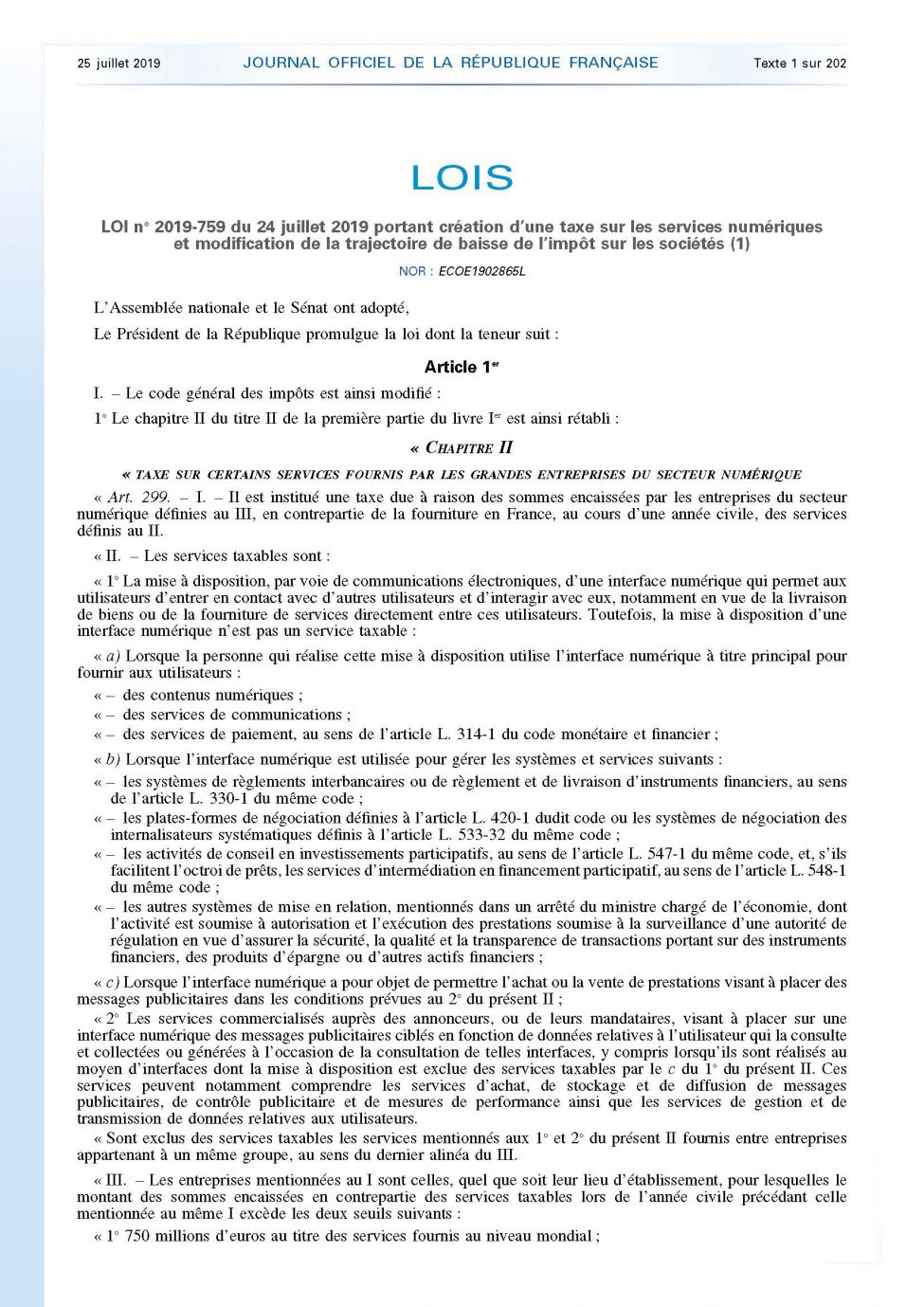
Ce papier a pour objectif de revenir sur la taxe sur les services numériques adoptée par la France le 11 juillet 2019 pour tenter de lutter contre l’optimisation fiscale des grandes entreprises du numérique. Sa création s’explique par un contexte économique nouveau qui a remis en cause le système fiscal traditionnel. Critiquable à plusieurs titres, cette nouvelle taxe a pour intérêt de démontrer une volonté de donner une responsabilité fiscale aux entreprises à l’égard de la société. Sans faire une revue des solutions alternatives, il s’agit donc de montrer la prise de conscience internationale des États à réévaluer leur politique fiscale. Cette nouvelle réglementation ne vise pas à traiter la fiscalité à l’égard de la responsabilité sociale de l’entreprise (RSE) en tant que moyen, mais bien traiter la fiscalité comme un élément et une fin de la RSE.
The purpose of this paper is to review the digital services tax adopted by France on 11 July 2019 in an attempt to combat tax optimisation for large digital companies. Its creation is explained by a new economic context that has challenged the traditional tax system. This new tax is criticizable in several respects, and has the advantage of demonstrating a desire to give companies fiscal responsibility towards society. Without reviewing alternative solutions, it is therefore a question of showing the international awareness of States to reassess their tax policy. This new regulation does not aim to consider taxation of CSR as a means, but rather to see it as an element and an end of CSR.
Le Code civil chinois a été adopté le 28 mai 2020. Il ne rentrera en vigueur qu’au 1er janvier 2021. Deux articles ont attirés mon attention dans une perspective de responsabilité sociétale, articles qui concerne le régime des For-Profit Legal Person (section 2). En substances, voici ce que précisent lesdits articles :
Les actionnaires ne doivent pas intenter à l’intérêt de la personne morale ou à celui des créanciers.
Les entreprises assument une responsabilité sociale.
Order of the President of the People’s Republic of China (No. 45) The Civil Code of the People’s Republic of China, as adopted at the 3rd Session of the Thirteenth National People’s Congress of the People’s Republic of China on May 28, 2020, is hereby issued, and shall come into force on January 1, 2021. President of the People’s Republic of China: Xi Jinping May 28, 2020 Civil Code of the People’s Republic of China (Adopted at the 3rd Session of the Thirteenth National People’s Congress of the People’s Republic of China on May 28, 2020)
Extrait :
Article 83
An investor of a for-profit legal person shall not damage the interests of the legal person or any other investor by abusing the rights of an investor. If the investor abuses the rights of an investor, causing any loss to the legal person or any other investor, the investor shall assume civil liability in accordance with the law. An investor of a for-profit legal person shall not damage the interests of a creditor of the legal person by abusing the independent status of the legal person and the limited liability of the investor. If the investor abuses the legal person’s independent status or the investor’s limited liability to evade debts, causing serious damage to the interests of a creditor of the legal person, the investor shall be jointly and severally liable for the legal person’s debts.
Article 86
In business activities, a for-profit legal person shall comply with business ethics, maintain the safety of transactions, receive government supervision and public scrutiny, and assume social responsibilities.
Merci à mon collègue, le professeur Bjarne Melkevik, de cette information.
La richesse créée par les entreprises du CAC 40 représentait 389 milliards d’euros en 2019. Elle a bénéficié en priorité aux salariés, aux Etats puis aux actionnaires. Elle a progressé de 16 % depuis 2016, ce qui a profité avant tout aux Etats.
Extrait :
L’Institut économique Molinari publie la 3ème édition de la Contribution sociale et fiscale des entreprises du CAC 40. Cette étude apporte un éclairage sur la contribution des entreprises et son partage entre les salariés, les Etats et les actionnaires. Elle dissèque la fiscalité sur la création de richesse, avec des fiscalités conséquentes sur la production et les dividendes. Elle éclaire le rôle et le partage des dividendes.
L’étude montre que les entreprises du CAC 40 ont créé 389 milliards d’euros de richesse pour la collectivité française et mondiale en 2019. Cette contribution sociale et fiscale :
a bénéficié avant tout aux 5,1 millions de salariés des entreprises du CAC 40, avec 267 milliards d’euros de dépenses de personnels, suivis par les États, avec 80 milliards de fiscalités, puis les actionnaires, avec 42 milliards de dividendes après impôts.
a progressé de 16 % en 3 ans. Les États ont été les premiers gagnants avec +31 %, liés au dynamisme de l’impôt sur les sociétés (+34 %) et des impôts de production (+27 %).
Lorsqu’on se focalise sur le seul partage des résultats distribués, soit 97 milliards d’euros :
les États ont été les premiers bénéficiaires avec 49 milliards d’euros, devant les actionnaires (42 milliards) et les salariés (6 milliards).
les résultats distribués ont progressé de 16 % entre 2016 et 2019. Les États ont été les premiers gagnants avec +32 % de recettes, liées au dynamisme des fiscalités sur les bénéfices (+34 %) et les dividendes (+20 %).
La question est assurément délicate et amène à s’interroger sur le rôle de l’État dans l’économie et aussi comme investisseur dans les entreprises. La réponse est délicate à apporter même si on ne peut être mal à l’aise que cette aide soit octroyée dans le même temps que l’annonce de 2500 emplois supprimés (ici).
Québec pourrait aider l’entreprise, mais pas de la même façon que dans le dossier de la CSeries.Explications avec Isabelle Dostaler de l’Université Memorial de Terre-Neuve.
La pandémie actuelle peut aboutir à une prise de conscience collective et à un renforcement de la lutte contre les causes du dérèglement climatique, ou bien, au contraire, à une mise entre parenthèses des initiatives en ce sens, car l’attention ainsi que toutes les ressources financières seront consacrées à des mesures de relance économique. La cause climatique passerait alors au second plan face à l’urgence, avec, à terme, des conséquences désastreuses.
Le rôle des gouvernants est majeur. Mais pour orienter correctement les flux financiers, publics comme privés, améliorer l’information environnementale des investisseurs doit également devenir une priorité. Le sujet est peu connu du grand public car d’apparence technique. Pourtant, les enjeux sont considérables.
Corporate social responsibility (CSR) is a concept that notoriously evades definition. Some have said that companies should act in socially responsible ways in their daily operations while charitable donations have historically been brought under this umbrella. The former understanding of CSR is often preferred because simply making charitable donations while doing business in an irresponsible manner causing harm to various stakeholders is clearly undesirable.
India’s company law has a CSR provision requiring companies to donate 2% of their profits from the preceding three years on activities designated by the government. (You can read a detailed analysis of the law in an article by Sandeep Gopalan and me here.) One criticism of such an understanding of CSR is that the meaning restricts itself to charitable donations without venturing into how companies conduct their day to day business.
The coronavirus has given us an unpleasant jolt with which to test if companies are happy to simply comply with the CSR provision and do nothing else to accommodate various stakeholders that are suffering in this crisis. Yet many big businesses in India (Bajaj Auto, Tata Sons, Vedanta Group) promised not to cut salaries of staff during the pandemic. Instead, some companies suggested that they were considering a pay cut for CEOs and other members of the promoter group (the controlling shareholder group in India, typically a family).
(…) When viewed from the perspective of the epidemic, charitable contribution seems like a perfectly valid form of CSR. This is not only because the company is addressing an urgent need at the moment but also because the initiatives have come from individual companies rather than as a response to a forced government mandate of requiring a certain amount of expenditure on CSR activities. The Ministry of Corporate Affairs (MCA) issued an order stating that companies’ responses to the covid crisis could be classified as CSR. The companies Act only allows spending on designated categories to be classified as CSR. Since one of the designated categories is ‘combating human immunodeficiency virus, acquired immune deficiency syndrome, malaria and other diseases’, the order from the MCA was not too surprising. Obviously, India’s rigid definition of CSR means that innovative responses from companies that offered their resorts to be used as temporary care facilities will not be considered CSR.
The lesson to take beyond the pandemic is for the Indian government to resist the urge to intervene in how companies comply with the CSR provision in the law. Allowing companies to be creative and using their CSR activities to gain reputational capital is not a bad idea. In fact, this should be further encouraged by letting companies disclose their social activities along with the CSR disclosures (relating to the required spending) required by the law.
It is not the first time a leader with a fiduciary responsibility waded into the public discourse. In January, Michael McCain, chief executive of Maple Leaf Foods Inc., used Twitter to criticize the White House for creating geopolitical conditions that led to Iran’s military destroying a Ukrainian airliner carrying more than 170 people, including 55 Canadian citizens and 30 permanent residents.
(…) Corporate stances on environmental, social and political issues are becoming more common. And in Canada, a change to corporate law last year freed executives of some companies to expand their mandates beyond simply maximizing shareholder returns without fear of legal reprisal.
(…) “Companies and investors are beginning to recognize that what happens out there in the real world is arguably even more important than what happens on their spreadsheets and terminals,” said Kevin Thomas, chief executive of the Shareholder Association for Research and Education, a not-for-profit group focused on responsible investing.
The responses by the heads of some of Canada’s biggest companies to the protests in the United States, as well as their various attempts to assist customers during the coronavirus pandemic, come as companies are also embracing more “stakeholder” capitalism, wherein the raison d’être for firms is more than just returning cash to shareholders.
(…) Stakeholder capitalism was the theme of this year’s World Economic Forum’s gathering in Davos, Switzerland, where one of Masrani’s peers, Royal Bank of Canada chief executive Dave McKay, was in attendance.
“As trust in governments wanes, and the complexity of society’s problems grows, companies are charting their own course on environment, social and governance issues, to maintain public confidence in business and ensure the prosperity of communities that business serves,” McKay wrote in January.
On Tuesday, McKay published a post on LinkedIn stating he was “personally outraged at the senseless and tragic deaths in the U.S., which are clearly symptomatic of ongoing racial discrimination and injustice, and I know we are not immune to it in Canada.”
A year ago, Parliament passed legislation that amended the Canada Business Corporations Act (CBCA), which lays out the legal and regulatory framework for thousands of federally incorporated firms, to spell out in greater detail how directors and company officers could meet their legal responsibility to “act honestly and in good faith with a view to the best interests of the corporation.”
The updated law states that directors and officers may consider shareholders, as well as employees, retirees, creditors, consumers and governments when setting corporate strategy. The law also now states that both the environment and “the long-term interests of the corporation” can be taken into consideration.