autres publications Nouvelles diverses Structures juridiques
Le non-financier est important pour les institutions financières
Ivan Tchotourian 16 août 2016
Excellent document produit par McKinsey & Company : « Nonfinancial risk: A growing challenge for the bank » (juillet 2016). Ce document rappelle que l’extra-financier est devenu un facteur à gérer par les institutions financières…
Yet the direct financial consequences of non Financial risk (NFR) are not the only concern. The reputational damage wrought can hit a bank hard at a time when customers, shareholders, and public stakeholders are questioning banks’ business models. And there are also the personal consequences for senior managers, whom regulators increasingly hold accountable for misconduct or failure to comply with laws and regulations. All of this, and the prospect of still tighter regulation, puts considerable pressure on banks to manage NFR better.
(…) Against this backdrop, many institutions seek a more integrated NFR-management approach in order to reduce the risk of further failures, meet stakeholders’ requirements and expectations, and limit costs. This article describes the three key components of such an integrated approach: an enhanced governance framework, a set of enablers, and changes in the front office’s approach and mind-set. It is based on our work with many financial institutions globally and an informal survey of 15 global and regional banks. Some of the structures and ideas we outline here are familiar to banks from their work on financial risk; many are newly conceived for the management of nonfinancial risk. Taken together, a full implementation of these concepts represents a paradigm shift in the NFR-management practices of many banks today.
À la prochaine…
Ivan Tchotourian
autres publications Nouvelles diverses
Cartographie des risques 2016 : une photo de l’AMF France
Ivan Tchotourian 16 août 2016
Dans son Risques et tendances n° 17 de juillet 2016, l’AMF France offre une belle cartographie des risques auxquels font face les entreprises et les marchés.
L’AMF a publié sa cartographie 2016 qui constitue un panorama de l’évolution sur un an des risques liés à l’actualité économique, financière et réglementaire. Elle analyse le financement de l’économie, les marchés ainsi que l’épargne des ménages et la gestion collective. Pour sa dixième édition, sa publication intervient quelques jours seulement après le référendum ayant conclu à la sortie du Royaume-Uni de l’Union Européenne qui constitue une décision sans précédent et ouvre une période de fortes incertitudes.
À la prochaine…
Ivan Tchotourian
autres publications Nouvelles diverses
Nouvel ouvrage : « Economics of corporate law »
Ivan Tchotourian 4 août 2016
Bonjour à toutes et à tous, je vous signale la parution de ce nouvel ouvrage liant droit des sociétés par actions et analyse économique : « Economics of Corporate Law – Economic Approaches to Law series » (Edward Elgar Publishing, 2016).
Scholarly analysis of corporate law in the United States has come to be dominated by an economic approach. Professor Hill and Professor McDonnell here draw together seminal articles which represent major milestones along the road that economics has traveled in coming to play this central role in corporate law scholarship. The focus is on the analysis of corporate law, drawing mainly upon legal scholarship and particularly on US scholarship, which is the originator of the application of modern economic analysis to corporate law and has had much influence in other countries.
À la prochaine…
Ivan Tchotourian
autres publications Gouvernance normes de droit Nouvelles diverses
Rapport 2016 de PWC sur le crime économique
Ivan Tchotourian 3 août 2016
Belle étude annuelle de Pwc consacrée à la criminalité économique : « Global Economic Crime Survey 2016 – Adjusting the Lens on Economic Crime: Preparation brings opportunity back into focus ».
Today more than ever before, a passive approach to detecting and preventing economic crime is a recipe for disaster. To underscore this fact, our survey uncovered a widespread lack of confidence in local law enforcement – a phenomenon that is not limited to regions or level of economic development. The message is clear: the burden of preventing, protecting and responding to economic crime rests firmly with organisations themselves. Our survey this year focuses on three key areas – Cybercrime, Ethics and compliance programmes and Anti-Money Laundering – and explores certain common themes, including managing the risks associated with the pervasion of technology; what it means to conduct business responsibly across a widening business landscape; and integrating ethical conduct into decision-making.
In addition to highlighting specific areas of economic crime worth focusing on, we emphasise the things you can do better to tackle them – implementing more sophisticated and effective measures that can not only reduce these risks, but also bring the benefits of a more threat-aware business, confident of its defences in a changing world.
À la prochaine…
Ivan Tchotourian
conférences Nouvelles diverses
Colloque en Norvège : intéressé ?
Ivan Tchotourian 3 août 2016
Ma collègue Beate Sjåfjell (qu’on ne présente plus) de la Faculté de droit d’Oslo organise un beau colloque international et interdisciplinaire à Oslo les 29 et 30 novembre 2016 sur le thème suivant : « Life-cycle based management and reporting for sustainable business ».
Meeting the grand challenge of securing a social foundation for all people today and for future generations without destroying the very basis of our existence, is arguably not possible without the contribution of business. What this requires of business in aggregate may be denoted corporate sustainability, which can be defined as when businesses (or more broadly, private, public and hybrid economic actors) in aggregate create value in a manner that is (a) environmentally sustainable in the sense that it ensures the long-term stability and resilience of the ecosystems that support human life, (b) socially sustainable in the sense that it facilitates the respect and promotion of human rights, and (c) economically sustainable in the sense that it satisfies the economic needs necessary for stable and resilient societies. The new UN Sustainable Development Goals with national integration have also given corporate sustainability a new and stronger momentum.
A life-cycle based approach to business, where environmental, social and governance impacts are integrated, is a possible approach towards achieving corporate sustainability. It also has the potential of transcending the barriers between legal entities, both public and private, and across global supply chains and contractual networks.
À la prochaine…
Ivan Tchotourian
autres publications engagement et activisme actionnarial Nouvelles diverses
Exit, Voice and Loyalty from the Perspective of Hedge Funds Activism in Corporate Governance
Ivan Tchotourian 3 août 2016
Bonjour à toutes et à tous, en voilà un bel article ! « Exit, Voice and Loyalty from the Perspective of Hedge Funds Activism in Corporate Governance » d’Alessio Pacces (Law Working Paper No. 320/2016) revient sur les thématiques de l’activisme des hedge funds, du court-termisme et des multiples classes d’actions.
This article discusses the policy response to hedge funds activism in corporate governance based on Hirschman’s classic: Exit, Voice and Loyalty. From that perspective, the article argues that hedge funds do not create the loyalty concerns underlying the usual short-termism critique of hedge funds activism, because the arbiters of such activism are typically indexed funds, which cannot choose short-term exit. Nevertheless, the voice activated by hedge funds can be excessive for a particular company.
Furthermore, this article claims that the short-termism debate cannot shed light on the desirability of hedge funds activism. Neither theory nor empirical evidence can tell whether hedge funds activism systematically leads to short-termism or whether its absence lead management to the opposite bias, namely long-termism. The real issue with activism is a conflict of entrepreneurship, namely a conflict between the opposing views of the activists and the incumbent management regarding in how long an individual company should be profitable. Leaving the choice between these views to institutional investors is not efficient for every company at every point in time.
Consequently, this article argues that regulation should enable individual companies to choose whether to encourage or to curb hedge funds activism depending on the efficient time-horizon given the firm’s lifecycle. The recent European experience reveals that loyalty shares enable such choice, even in the midstream, operating as dual-class shares in disguise. However, loyalty shares can often be introduced without institutional investors’ consent. This outcome could be improved by allowing dual-class recapitalizations, instead of loyalty shares, but only with a majority of minority vote. This solution would screen for the companies for which temporarily curbing activism is efficient, and induce these companies to negotiate sunset clauses with institutional investors.
À la prochaine…
Ivan Tchotourian
autres publications Nouvelles diverses
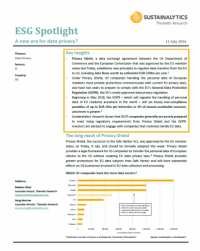
ESG Spotlight : A new era for data privacy? (billet de Julie Bernard)
Julie Bernard30 juillet 2016
Bonjour à toutes et à tous, l’agence de notation extrafinancière Sustanalytics vient tout juste de sortir un nouveau rapport dans le cadre de la série ESG Spotlight : « ESG Spotlight | A new era for data privacy? ».
En voici un résumé :
Sustainalytics’ new ESG Spotlight Series report, A New Era for Data Privacy?, considers the impacts of the new Privacy Shield agreement, which was approved by the EU member states last Friday, on US IT companies. Our research shows that US IT companies generally are poorly prepared to meet rising regulatory requirements from Privacy Shield and the General Data Protection Regulation (GDPR).
Bonne lecture !
Julie Bernard, MAP, Adm.A
Étudiante au doctorat (PhD) en sciences de l’administration (Management)
Faculté des sciences de l’administration
Université Laval