autres publications Nouvelles diverses
An Effective Compliance and Ethics Program is key
Ivan Tchotourian 30 juillet 2016
Intéressant document de la Securities and Exchange Commission en matière de criminalité économique : « 2014 GUIDELINES MANUAL – CHAPTER EIGHT – SENTENCING OF ORGANIZATIONS ».
These guidelines of the U.S. Sentencing Commission (Chapter 8) offer incentives to organizations to reduce and ultimately eliminate criminal conduct by providing a structural foundation from which an organization may self-police its own conduct through an effective compliance and ethics program. The prevention and detection of criminal conduct, as facilitated by an effective compliance and ethics program, will assist an organization in encouraging ethical conduct and in complying fully with all applicable laws.
In regard to ‘economic criminality’, however defined, it is equally crucial that regulators across the globe push and pull robustly and cooperatively for effective compliance and ethics programs within industries. Without regulatory/supervisory efforts (a situation that is a systemic risk by itself), ‘economic criminality’ will be nothing more than an academic subject of theoretical interest without any consumer protection values whatsoever. That may well be where the next financial crisis lies. Only the future will tell.
À la prochaine…
Ivan Tchotourian
autres publications Gouvernance Nouvelles diverses
Strong managers, strong owners : un ouvrage pour cet été ?
Ivan Tchotourian 28 juillet 2016
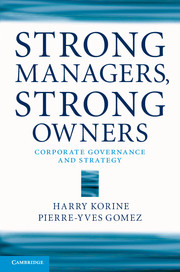
Harry Korine et Pierre-Yves Gomez ont publié un ouvrage qui vient de rejoindre ma bibliothèque : « Strong Managers, Strong Owners: Corporate Governance and Strategy » (Cambridge University Press, décembre 2013).
The family firm preparing generational change, the partnership that welcomes new partners, and the shareholders of a firm that chooses to go public are making decisions that will have an impact on strategy and management. Conversely, a change in strategy such as a move to diversify or a decision to take on more risk in a business can make the firm more attractive to some shareholders and less attractive to others and is therefore not ownership neutral. Opening the black box of agency theory, Korine and Gomez show how management and ownership interact to shape the strategy of the firm. In their view, the critical question to ask is not what is the best strategy, but rather, who is the strategy for? With numerous detailed examples, Strong Managers, Strong Owners is an invaluable resource for company owners, board members and executives, as well as their advisors in strategy and governance.
Voici la table des matières :
Part I. Changes in the Identity of Ownership and Management:
1. Change in ownership
2. Change in management
Concluding remarks
Part II. Changes in the Form of Ownership and Organization:
3. Change of legal structure
4. Change of organizational structure
Concluding remarks
Part III. Changes in Strategy:
5. Corporate and business strategies
6. Despite failure, NO change in ownership, management, or strategy
7. Because of success, reinforcement of ownership, management, and strategy
Concluding remarks
Part IV. Implications for Corporate Governance:
8. The board of directors
Conclusion – strategy for whom?
À la prochaine…
Ivan Tchotourian
autres publications Nouvelles diverses
Bientôt un nouvel ouvrage : The Oxford Handbook of Corporate Law and Governance
Ivan Tchotourian 27 juillet 2016
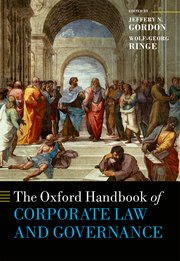
Voilà un ouvrage que tous les spécialistes vont bientôt s’arracher : « The Oxford Handbook of Corporate Law and Governance » (Oxford University Press, à paraître dans quelque temps).
Corporate law and corporate governance have been at the forefront of regulatory activities across the world for several decades now, and are subject to increasing public attention following the Global Financial Crisis of 2008. The Oxford Handbook of Corporate Law and Governance provides the global framework necessary to understand the aims and methods of legal research in this field.
Written by leading scholars from around the world, the Handbook contains a rich variety of chapters that provide a comparative and functional overview of corporate governance. It opens with the central theoretical approaches and methodologies in corporate law scholarship in Part I, before examining core substantive topics in corporate law, including shareholder rights, takeovers and restructuring, and minority rights in Part II. Part III focuses on new challenges in the field, including conflicts between Western and Asian corporate governance environments, the rise of foreign ownership, and emerging markets. Enforcement issues are covered in Part IV, and Part V takes a broader approach, examining those areas of law and finance that are interwoven with corporate governance, including insolvency, taxation, and securities law as well as financial regulation.
The Handbook is a comprehensive, interdisciplinary resource placing corporate law and governance in its wider context, and is essential reading for scholars, practitioners, and policymakers in the field.
À la prochaine…
Ivan Tchotourian
Normes d'encadrement Nouvelles diverses
OPA en panne ?
Ivan Tchotourian 24 juillet 2016
Pays très ouvert aux acquéreurs étrangers – pour peu qu’ils payent le bon prix –, le Royaume-Uni n’avait pas été habitué à ce rang. En 2015, il représentait plus de 10 % des opérations de fusions-acquisitions à travers la planète. Le record avait même été de 18 % en 2000. Selon Thomson Reuters, les achats d’entreprises britanniques par des étrangers ont totalisé 43,8 milliards de dollars (39 milliards d’euros) entre le 1er janvier et le 16 juin, en recul de 74 %.
À la prochaine…
Ivan Tchotourian
autres publications mission et composition du conseil d'administration Normes d'encadrement Nouvelles diverses place des salariés
Système allemand de codétermination : un modèle exportable ?
Ivan Tchotourian 22 juillet 2016
Alors que Theresa May a fait part de son intérêt d’importer en Grande-Bretagne le système allemand, MM. Horst Eidenmüller, Mathias Habersack, Caspar Behme et Lars Klöhn reviennent sur la pertinence de cette proposition en jetant un regard prudent (de chercheurs !) sur ce système : « Corporate Co-Determination German-Style as a Model for the UK? » (18 juillet 2016).
On 13 July 2016, Theresa May took up office as Prime Minister of the United Kingdom. Only shortly before, she had made headlines when she proposed to adopt European-style worker representation on the boards of leading companies.
Corporate co-determination hence seems to gain a certain degree of popularity with the British government – which is highly astonishing, considering that it was the UK which most fiercely fought against co-determination on a European level. It was mainly the diverging views of the UK and Germany on co-determination which have thwarted projects like the Draft Fifth Company Law Directive or the establishment of a European Private Company (Societas Privata Europaea, SPE). It is downright ironic that while the UK now shows an interest in co-determination, the concept is being questioned in Germany after decades of lying dormant. The reason for the new German discussion of co-determination are doubts regarding the compatibility of its specific form of co-determination with higher-ranking Union law. This post provides a brief overview of the most recent developments in German co-determination law that were the focus of a joint Oxford/Munich conference at the Ludwig-Maximilians-Universität (LMU) in Munich in March 2016.
À la prochaine…
Ivan Tchotourian
engagement et activisme actionnarial Gouvernance Nouvelles diverses
Le Japon à l’heure d’une gouvernance nord-américaine
Ivan Tchotourian 20 juillet 2016
Les entreprises japonaises feraient-elles l’objet d’une gouvernance de type anglo-américaine ? C’est ce qu’il semble à la lecture de cet article : « Shareholders put Japan’s corporate governance to the test » (Nikkei Asian Review, 25 juin 2016).
Voici quelques extraits :
Many stockholders at security company Secom’s annual meeting Friday demanded explanations over why then-Chairman Shuji Maeda and then-President Hiroshi Ito were fired in May, despite the company’s strong performance last fiscal year. (…) Secom voluntarily created an executive nomination and compensation committee, but has not made the members’ names public. Attendees raised questions over the effectiveness of the company’s governance structure. « There’s still room for improvement in the selection process for executives, » one said.
Shareholders at Mitsubishi Chemical Holdings’ meeting the same day focused on earnings power and dividends. The chemical company had logged extraordinary losses from restructuring its petrochemical business, while return on equity fell under 5% for the year ended in March. Shareholders demanded more details over the loss, and urged the company to try to raise its stock price. (…)
Kobe Steel logged a group net loss last fiscal year, and its ROE has long remained low. Just 87.3% of shareholders voted for the proposal to retain Chairman and President Hiroya Kawasaki, down 8 percentage points from last year. (…)
Toshiba came under harsh criticism at its Wednesday meeting, with shareholders blaming the company’s top-down culture and the lack of independence at its accounting department for its bookkeeping scandal. Only 87.06% of shareholders voted to reappoint President Satoshi Tsunakawa,
À la prochaine…
Ivan Tchotourian
normes de marché Nouvelles diverses
ISR : quel type de gestion pour le promouvoir ?
Ivan Tchotourian 15 juillet 2016
« Qui de la gestion active ou passive luttera le plus efficacement contre le réchauffement climatique ? » : excellente question que pose l’économiste David Allouche sur L’Agefi (relayé par LinkedIn). Cet article interpelle directement l’ISR et le rôle des acteurs de la finance pour le promouvoir.
L’enjeu crucial du maintien du réchauffement climatique sous le seuil de 2°C met les investisseurs des marchés financiers en pole position pour une économie décarbonnée.
Nombre de gérants actifs, soucieux du risque climatique, désinvestissent les actions exposées aux énergies fossiles et choisissent d’investir dans les énergies renouvelables et la transition énergétique. A l’inverse, la gestion passive, sur la base des indices classiques pondérés par la capitalisation boursière, est inopérante dans le cadre d’un investissement « bas carbone », puisqu’elle reconduit le monde tel qu’il est. En effet, la gestion indicielle conduirait à investir 20 à 30% de son portefeuille sur les secteurs « Carbo-intensifs » à Londres ou en Australie, selon le rapport de 2012 de Carbon Tracker Initiative.
La gestion passive ne peut-elle rien pour façonner un monde post COP21 ?
À la prochaine…
Ivan Tchotourian