actualités internationales | Page 15
actualités internationales devoir de vigilance Normes d'encadrement normes de marché Responsabilité sociale des entreprises
Devoir de vigilancve : bilan en France
Ivan Tchotourian 7 avril 2020 Ivan Tchotourian
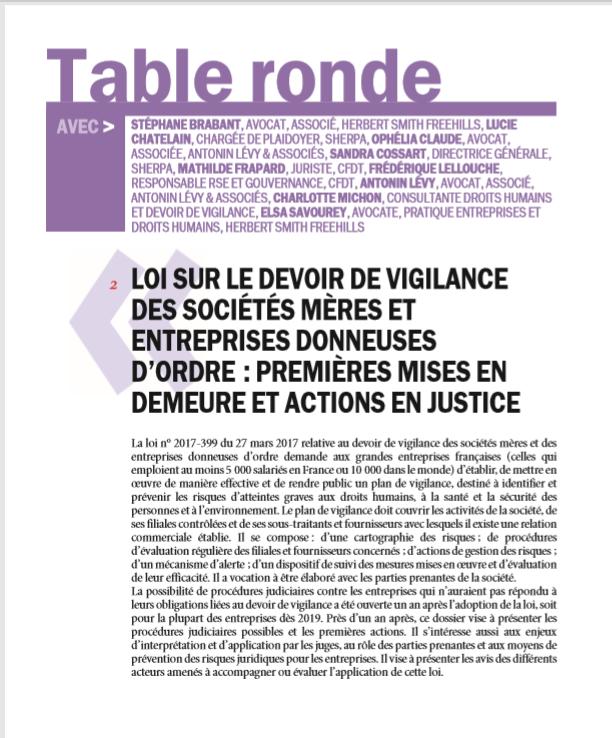
Les Cahiers de Droit de l’Entreprise (Lexisnexis) (avril 2020) viennent de publier un numéro consacré à la loi française sur le devoir de vigilance. C’est à lire ! Merci à tous les auteurs pour leur éclairage : Elsa Savourey, Stéphane Brabant, Ophélia Claude, Antonin Lévy, Sandra Cossart, Lucie Chatelain, Mathilde Frapard, Frédérique Lellouche
Résumé :
Loi sur le devoir de vigilance – les premières mises en demeure et contentieux : notre table-ronde sur les enjeux juridiques et regards des parties prenantes !
À la prochaine…
actualités internationales Gouvernance Normes d'encadrement normes de droit Nouvelles diverses
Espagne : un droit des sociétés modifié aussi
Ivan Tchotourian 5 avril 2020 Ivan Tchotourian
Comme d’autres pays, l’Espagne vient de modifier son droit des sociétés par actions pour donner plus de souplesse notamment dans la tenue des assemblées annuelles : « Coronavirus Spain · Royal Decree-Law 8/2020 of 17 March – Measures Applicable to Companies » (20 mars 2020).
Extrait :
On 18 March, Royal Decree-Law 8/2020, of 17 March, on urgent, extraordinary measures to deal with the economic and social impact of Covid-19 was published. Below we briefly explain the extraordinary measures applicable to companies and other legal persons in private law (associations, cooperatives and foundations).
These measures can be broken down into three categories depending on their scope of application: (i) measures relative to the adoption of resolutions, (ii) measures relative to the annual accounts and (iii) other measures.
i. Measures relative to the adoption of resolutions:
Although no specific regulation exists in the bylaws, during the state of alarm the following is permitted:
• The holding of meetings by videoconference of:
-The General Shareholders’ Meeting and the governing body of mercantile companies;
-The General Assembly and the Governing Board (Junta Directiva) of associations;
-The Governing Council (Consejo Rector) of cooperatives;
-The Governing Council (Patronato) of foundations;
-The delegate committees, whether obligatory or voluntary, that the above bodies have established.
The videoconference must be carried out by some means that ensures the authenticity and the real-time connection with image and sound of those in attendance.
• The adoption of resolutions by the abovementioned bodies by written vote and without a meeting, if so decided by the President or when requested by at least two of the members of the body.
ii. Measures relative to the annual accounts:
• The term for the governing or management body to prepare the annual accounts is suspended. From the date on which the state of alarm ends, a new term of three months is granted for their preparation.
• If the annual accounts have already been prepared and when the audit of said accounts is mandatory, entities will have two months from the end of the state of alarm to audit the accounts.
• The meeting of the Ordinary General Shareholders’ Meeting to approve the annual accounts shall be held obligatorily within three months of the end of the period in which to prepare the accounts. Consequently, the General Shareholders’ Meeting must meet within six months of the end of the state of alarm to approve the annual accounts.
• If the call to a meeting of the General Shareholders’ Meeting was published prior to the declaration of the state of alarm, and the meeting should be held after said declaration, the governing body may choose between the following two options (i) change the place and time of the meeting or (ii) revoke the resolution to call the meeting; in either case, it must be done at least 48 hours before the meeting is held. Furthermore, if the call to a meeting is revoked, a new call must be made within a month of the end of the state of alarm.
À la prochaine…
actualités internationales Gouvernance Normes d'encadrement Nouvelles diverses parties prenantes Responsabilité sociale des entreprises
Le Forum économique mondial envoie un message
Ivan Tchotourian 4 avril 2020 Ivan Tchotourian
En ce début d’avril 2020, le Forum Économique Mondial vient de publier une déclaration sur les principes parties prenantes qu’il entend promouvoir durant la crise du COVID-19 : « Stakeholder Principles in the COVID Era ».
Extrait :
To this end, we endorse the following Stakeholder Principles in the COVID Era:
− To employees, our principle is to keep you safe: We will continue do everything we can to protect your workplace, and to help you to adapt to the new working conditions
− To our ecosystem of suppliers and customers, our principle is to secure our shared business continuity: We will continue to work to keep supply chains open and integrate you into our business response
− To our end consumers, our principle is to maintain fair prices and commercial terms for essential supplies
− To governments and society, our principle is to offer our full support: We stand ready and will continue to complement public action with our resources, capabilities and know-how
− To our shareholders, our principle remains the long-term viability of the company and its potential to create sustained value
Finally, we also maintain the principle that we must continue our sustainability efforts unabated, to bring our world closer to achieving shared goals, including the Paris climate agreement and the United Nations Sustainable Development Agenda. We will continue to focus on those long-term goals.
À la prochaine…
actualités internationales Gouvernance Normes d'encadrement rémunération Responsabilité sociale des entreprises
Des rémunérations à la baisse ?
Ivan Tchotourian 4 avril 2020 Ivan Tchotourian
Très intéressant article du Financial Times au titre très clair : « Investors and politicians demand coronavirus pay cuts » (4 avril 2020). L’Angleterre démontre un changement de perspective dans le domaine de la rémunération de la haute direction… Un exemple à suivre ?
À la prochaine…
actualités internationales engagement et activisme actionnarial Gouvernance Normes d'encadrement Nouvelles diverses Responsabilité sociale des entreprises
COVID-19 : l’ICGN prend position sur ce qui devrait être fait
Ivan Tchotourian 31 mars 2020 Ivan Tchotourian
L’influent ICGN a pris récemment position sur les conséquences du COVID-19 pour la gouvernance d’entreprise, sachant que ce réseau international fait de cette pandémie un risque systémique (rien de moins !). Vous pourrez lire les préconisation de l’ICGN dans le document suivant : ICGN Viewpoint, « Coronavirus as a new systemic risk: implications for corporate governance and investor stewardship », 12 mars 2020.
Extrait concernant les investisseurs
Despite these negative economic events investors should avoid focusing on the crisis in terms of its short-term shareholder value implications. It is here where a long-term perspective, and perhaps a grounding ethics and values more generally, should also guide investor responses. In the language of modern finance, this may be less an opportunity for investors seeking alpha generation in individual companies than it is a question of addressing ‘beta’ issues—the volatility/stability of the markets and financial system as a whole. This may be fiendishly complicated, but an important guiding principle for investors relates to their fundamental fiduciary duty of care to their beneficiaries. This confirms the importance of taking a long-term perspective, since most ICGN Members, and large institutional investors more generally, are managing assets for pension plans or retirement saving plans, where the investment horizon is intrinsically long-term, or in theory infinite.
It is beyond the scope of this Viewpoint to suggest specific investment or trading strategies for investors in addressing the impacts of COVID-19. There is no generic solution. These will differ depending on individual investor mandates and beneficiary requirements. But from the perspective of investor stewardship and fiduciary duty — and consistent with ICGN’s Global Stewardship Principles and Policy Priorities3 — it is fair to suggest that in reacting to this crisis investors should generally seek to maintain an approach that promotes long-term investment horizons and sustainable value creation for individual companies and markets.
As a practical matter this requires investors to appreciate that companies will be facing difficult questions in response to the impacts of COVID-19. The first priority for managers and boards will be to ensure the company’s own financial sustainability. Investors must also understand that capital allocation questions may surface where compromise is required. Companies may have to choose between cutting dividend payments, cutting capital spending or cutting costs, possibly leading to redundancies. Investors should demonstrate support for companies as they navigate potentially acute financial threats and market pressures. Investors should also avoid encouraging companies to undertake undue risks that might provide a short-term investor benefit but could also jeopardise a company’s financial stability or the sustainability of its business model. This reflects not only some level of enlightened self-interest, but also the moral imperative to contribute positively to the broader threats to public health and social stability.
À la prochaine…
actualités internationales Gouvernance normes de droit place des salariés
Un panel et des actions pour faire participer plus les salariés
Ivan Tchotourian 29 mars 2020 Ivan Tchotourian
Telles sont les propositions des professeurs Konstantinos Sergakis et Andreas Kokkinis dans leur article intitulé « Employee Advisory Panels: A New Paradigm for Shareholder-based Governance? » (25 mars 2020). À découvrir…
Extrait :
Employee participation in corporate governance refers to a range of institutions, voluntary or legally mandated, that engage employees in corporate decision-making, such as works councils with co-decision powers on labour matters, advisory panels, information and consultation committees, employee share ownership schemes and board representation. Corporate contractarian literature dismisses employee participation as inefficient on the grounds that, if it were efficient, it would be voluntarily adopted widely. In our paper, we argue that the scarcity of employee participation in the UK can be attributed to shareholder short-termism and behavioural biases and, therefore, that the question of its efficiency remains open for companies that want to explore this possibility. We thus propose a flexible approach that companies can follow to implement employee participation. Our approach takes into account the broader UK institutional framework by creating adaptable and long-term solutions for both listed and large private companies. Nevertheless, it can be adopted in any other national context where employee board representation has not been mandated by company law provisions.
We argue that the most pragmatic way to encourage efficient employee participation is through the introduction of formal and permanent employee advisory panels and, in the longer term, the proliferation of employee share ownership schemes coupled with special rights to appoint a number of directors in tandem with the size of employee share ownership. Our approach relies on an incremental participation model, whereby employees should first be given a dialogue channel through advisory panels to gain adequate experience before appointing board members.
À la prochaine…
actualités internationales engagement et activisme actionnarial Gouvernance Normes d'encadrement normes de droit
Vote sur les rémunérations : tout un défi en France
Ivan Tchotourian 29 mars 2020 Ivan Tchotourian
Intéressant article de L’Agefi portant sur le vote des actionnaires en matière de rémunération des hauts dirigeants : « Le nouveau vote sur les rémunérations reste un défi pour les sociétés » (17 février 2020). Si la loi impose une seule résolution sur la politique de vote, l’Association des sociétés par actions laisse toute liberté aux sociétés. L’AMF recommande plusieurs résolutions.
Extrait :
En revanche, les investisseurs sont de plus en plus attentifs aux résolutions contestées – celles adoptées à moins de 80% – et surtout aux réponses apportées par les sociétés. L’Association française de la gestion financière (AFG) a donné le ton en début d’année et demande désormais dans ses recommandations sur le gouvernement d’entreprise que «le conseil d’administration examine attentivement et prenne position en conséquence sur toute résolution adoptée avec plus de 20% d’opposition» de la part des minoritaires. «Nous voulons que les émetteurs aient la volonté de comprendre cette opposition et en tirent les conséquences, précise Michael Herskovich, responsable de la gouvernance d’entreprise chez BNP Paribas AM. C’est déjà une recommandation au Royaume-Uni. En France, l’attention donnée par les émetteurs au dialogue avec les investisseurs en amont des AG permet de progresser. Sur les 125 grandes entreprises occidentales avec lesquelles nous dialoguons, près d’un tiers ont accepté de modifier certaines de leurs pratiques, contre seulement un quart il y a deux ans. En particulier, les sociétés contrôlées s’ouvrent beaucoup plus au dialogue, à l’instar de Kering.»
De son côté, l’Association nationale des sociétés par actions (Ansa) vient de publier sur son site un avis de son comité juridique sur les nouvelles règles concernant la rémunération des dirigeants. «Le législateur a voulu unifier la procédure sur les rémunérations mais il a mis en place un régime qui reste terriblement lourd, étendu maintenant aux commandites par actions, et le plus exigeant en Europe, avec deux votes contraignants, ‘ex ante’ et ‘ex post’, chaque année, explique Muriel de Szilbereky, déléguée générale de l’Ansa. La suppression de la procédure des conventions réglementées est sans doute une simplification et il nous semble important de ne pas multiplier les votes, même si beaucoup d’émetteurs auraient souhaité par sécurité maintenir le régime des conventions réglementées.»
Les engagements post-emploi (indemnités de départ, de non-concurrence, retraites chapeau…), autrefois dans les conventions réglementées, sont maintenant intégrés à la politique de rémunération. «Cette réforme élimine le risque juridique d’une politique de rémunération adoptée et d’une convention rejetée, ou inversement», précise Muriel de Szilbereky.
À la prochaine…