Responsabilité sociale des entreprises | Page 34
actualités internationales Gouvernance Normes d'encadrement parties prenantes Responsabilité sociale des entreprises
Pour un comité social et éthique en matière de gouvernance
Ivan Tchotourian 17 septembre 2020 Ivan Tchotourian
Dans BoardAgenda, Gavin Hinks propose une solution pour que les parties prenantes soient mieux pris en compte : la création d’un comité social et éthique (déjà en fonction en Afrique du Sud) : « Companies ‘need new mechanism’ to integrate stakeholder interests » (4 septembre 2020).
Extrait :
While section 172 of the Companies Act—the key law governing directors’ duties—has been sufficiently flexible to enable companies to re-align themselves with stakeholders so far, it provides no guarantee they will maintain that disposition.
In their recent paper, MacNeil and Esser argue more regulation is needed and in particular a mandatory committee drawing key stakeholder issues to the board and then reporting on them to shareholders.
Known as the “social and ethics committee” in South Africa, a similar mandatory committee in the UK considering ESG (environmental, social and governance) issues “will provide a level playing field for stakeholder engagement,” write MacNeil and Esser.
Recent evidence, they concede, suggests the committees in South Africa are still evolving, but there are advantages, with the committee “uniquely placed with direct access to the main board and a mandate to reach into the depths of the business”.
“As a result, it is capable of having a strong influence on the way a company heads down the path of sustained value creation.”
Will stakeholderism stick?
The issue of making “stakeholder” capitalism stick has vexed others too. The issue was a dominant agenda item at the World Economic Forum’s Davos conference this year, as well as becoming a key element in the presidential campaign of Democrat candidate Joe Biden.
Others worry that stakeholderism is a talking point only, prompting no real change in some companies. Indeed, when academics examined the practical policy outcomes from the now famous 2019 pledge by the Business Roundtable—a group of US multinationals—to shift their focus from shareholders to stakeholders, they found the companies wanting.
In the UK, at least, some are taking the issue very seriously. The Institute of Directors recently launched a new governance centre with its first agenda item being how stakeholderism can be integrated into current governance structures.
Further back the Royal Academy, an august British research institution, issued its own principles for becoming a “purposeful business”, another idea closely associated with stakeholderism.
The stakeholder debate has a long way to run. If the idea is to gain traction it will undoubtedly need a stronger commitment in regulation than it currently has, or companies could easily wander from the path. That may depend on public demand and political will. But Esser and MacNeil may have at least indicated one way forward.
À la prochaine…
autres publications Publications Responsabilité sociale des entreprises Structures juridiques
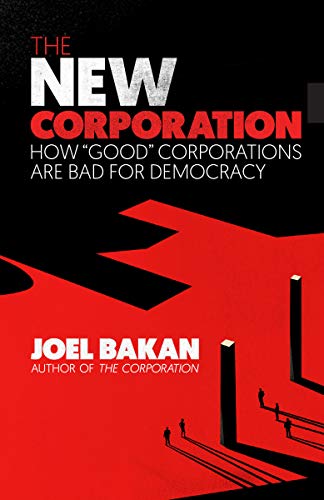
Nouvel ouvrage : The New Corporation: How « Good » Corporations Are Bad for Democracy
Ivan Tchotourian 16 septembre 2020 Ivan Tchotourian
Le professeur de UBC Joel Bakan nous gâte avec un nouvel ouvrage intitulé : « The New Corporation: How « Good » Corporations Are Bad for Democracy » (Allen Lane).
Résumé :
From the author of The Corporation: The Pathological Pursuit of Profit and Power comes this deeply informed and unflinching look at the way corporations have slyly rebranded themselves as socially conscious entities ready to tackle society’s problems, while CEO compensation soars, income inequality is at all-time highs, and democracy sits in a
precarious situation.
Over the last decade and a half, business leaders, Silicon Valley executives, and the Davos elite have been calling for a new kind of capitalism. The writing was on the wall. With income inequality soaring, wages stagnating, and a
climate crisis escalating, it was no longer viable to justify harming the environment and ducking taxes in the name of shareholder value. Business leaders realized that to get out in front of these problems, they had to make
social and environmental values the very core of their messaging. Their essential pitch was: Who could be better suited to address major societal issues than efficiently run corporations? There is just one small problem with their
doing well by doing good pitch. Corporations are still, ultimately, answerable to their shareholders, and doing well always comes first.
This essential truth lies at the heart of Joel Bakan’s argument. In lucid and engaging prose, Bakan lays bare a litany of immoral corporate actions and documents corporate power grabs dressed up as social initiatives. He makes
clear the urgency of the problem of the corporatization of society itself and shows how people are fighting back and making gains on a grassroots level.
À la prochaine…
autres publications Publications Responsabilité sociale des entreprises
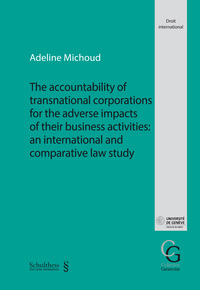
Nouvel ouvrage : The accountability of transnational corporations for the adverse impacts of their business activities
Ivan Tchotourian 16 septembre 2020 Ivan Tchotourian
Mme Adeline Michoud vient de publier sa thèse chez Schulthess Verlag dans la collection Genevoise sous le titre : « The accountability of transnational corporations for the adverse impacts of their business activities: an international and comparative law study ». Nul doute que cet ouvrage intéressera nos lectrices et lecteurs du blogue !
Résumé :
In the last decades, transnational corporate activities have given rise to serious human rights abuses. In this doctoral thesis, the author provides an exhaustive account of the obstacles preventing the implementation of an effective corporate social responsibility system. The first chapter analyses the mechanisms developed in public international law to introduce corporate regulation. The second chapter explains the inadequacies of both American and European private international law systems to receive victims’ claims. Finally, the third chapter elaborates a comparative study of the different national law mechanisms to establish the responsibility of transnational corporations. The present book is addressed to all lawyers and more generally to all readers interested in the question of business and human rights.
À la prochaine…
Gouvernance normes de droit Responsabilité sociale des entreprises
Raison d’être ou entreprise à mission, le faux débat
Ivan Tchotourian 16 septembre 2020 Ivan Tchotourian
C’est sous ce titre (« Raison d’être ou entreprise à mission, le faux débat », La Tribune, 2 septembre 2020) que M. Patrick d’Humières propose une lecture de la raison d’être et du statut d’entreprise à mission qui, selon lui, vont se rejoindre dans une trajectoire commune.
Extrait :
En apparence, le statut d’entreprise à mission rencontre un succès d’estime avec une cinquantaine d’entreprises très différentes, d’agences conseils à des sociétés mutuelles, qui l’ont adopté. Ce n’est pas le cas du statut de raison d’être, au bilan beaucoup plus mitigé, car les démarches que l’on connaît expriment des positionnements déclaratifs dans la veine de « la RSE de bonne volonté » qui ne s’accompagnent pas de mécanisme de mesure, de pression et de transparence garantissant de vrais changements d’orientation des modèles.
À la décharge des entreprises qui ont fait preuve d’initiative en la matière, il faut dire que le dispositif légal proposé comporte de considérables faiblesses. L’essentiel du changement juridique porté par la loi réside dans la modification de l’article 1833 du Code civil qui enjoint à toutes les entreprises de « prendre en considération les enjeux sociaux et environnementaux » au côté de l’intérêt social de l’entreprise, dont on n’a pas tiré les implications fondamentales. Les organisations professionnelles concernées ont fait preuve d’un souci défensif, pour limiter la mise en cause conséquente de cette assertion fondamentale, qui acte la nouvelle mission de l’entreprise, à savoir créer de la valeur dans le respect des enjeux sociétaux ; mais ni les juges, ni la puissance publique n’ont eu encore le souci d’accompagner ce cadre, cherchant plutôt à le minimiser, alors même que c’est une innovation majeure : il articule l’économie de marché avec la stratégie nationale de développement durable (ODD) et il crée le socle de ce qu’on appelle désormais « l’économie responsable », consacrée par la nomination pertinente d’une ministre en charge du sujet, qu’on aurait pu ou du appeler aussi « l’économie durable » dans un souci de cohérence politique.
Le texte de loi appelle des transformations de fond dans la gouvernance des entreprises qui devrait se poser des questions à cet effet, sans attendre qu’une jurisprudence fasse le travail pour dire qu’un Conseil d’administration ou une direction générale a mesestimé les enjeux sociaux et environnementaux, définis désormais de façon claire et objective (cf. indicateurs des ODD, incluant l’alignement sur l’Accord de Paris etc.).
L’entreprise dispose de tous les éléments pour établir son niveau de durabilité qui reconnaît cette prise de considération attendue des enjeux communs ; le travail de fond engagé parallèlement en Europe afin de standardiser l’information extra-financière ne pourra qu’encourager les Conseils à débattre et à décider de l’état de leur trajectoire économique au regard de leurs impacts acceptables qui sera la règle en 2025, à n’en pas douter.
Certaines entreprises ont tenu à disposer d’un cadre formel beaucoup plus structuré pour assumer cette responsabilité élargie à la Société, celui de « l’entreprise à mission » ; il constitue une facilité juridique et une aide technique qui a le plus grand intérêt pour accélérer la mutation d’un « capitalisme a-moral » vers « un capitalisme « parties prenantes ». Ce choix implique le vote par les actionnaires, le comité de suivi, l’audit de contrôle etc.. Les actionnaires n’ont pas à craindre pour autant une démission de l’engagement fiduciaire, à leur détriment, car le contrat est explicite, même s’il gagnerait encore à ce que les objectifs de rendement financier soient précisés au regard des objectifs d’amélioration de la création et de la répartition de la valeur globale et de leurs ROI. Ceci afin de ne pas glisser vers « le non profit » : une attention déséquilibrée en faveur de la dimension sociétale de la mission marginaliserait le dispositif, alors que les statuts coopératif, mutualiste ou solidaire sont là pour ça.
Coincé entre le droit général et le cadre précis de « la mission », « la raison d’être » aura du mal à trouver sa place, d’autant que la loi Pacte ne dit rien sur le comment, laissant l’entreprise libre de son engagement, de son inclusion ou non dans les statuts, ce qui en fait un process au mieux pédagogique et au pire de communication ; les parties prenantes ne voient pas les conclusions qu’on en tire sur les conditions nouvelles de production et de répartition de la valeur – objectifs et indicateurs à l’appui- pour exclure ce qui n’est pas « durable » dans l’offre et équilibrer l’allocation des résultats, voire la négocier, s’il existe un mécanisme ad hoc en amont de « l’arbitraire » des conseils. On voit bien qu’une Raison d’Etre bien posée conduit à terme au mécanisme de l’entreprise à mission et que dans le cas contraire l’entreprise ne fait que s’exposer à des critiques et frustrations qui mettent sa stratégie au défi de la cohérence et de la constance d’une gouvernance qui voudrait avancer sans oser le demander à ses actionnaires…
Cette décantation se fera inévitablement dans le temps, au détriment des entreprises « superficielles » et à l’avantage des entreprises authentiques. Le dispositif de Raison d’Etre va devenir un statut intermédiaire, de transition vers « l’entreprise à mission » ; il pousse à la construction d’un droit des sociétés qui recherche le changement profond de la gouvernance actionnariale, comme vient de le proposer la Commission Européenne dans un rapport très critique sur l’engagement insuffisant des gouvernances qui s’abritent derrière des intentions pour répondre aux pressions, rendant leur projet illisible ! Mais rien n’empêche les gouvernances d’accélérer par elles-mêmes sans attendre un règlement européen et éviter les malentendus autour d’une « raison d’être incantatoire » qui mine la crédibilité des initiatives sociétales des entreprises ; dans un monde périlleux, les gouvernances doivent « choisir leur camp » !
À la prochaine…
actualités internationales Gouvernance Normes d'encadrement normes de droit objectifs de l'entreprise Responsabilité sociale des entreprises Valeur actionnariale vs. sociétale
50 years later, Milton Friedman’s shareholder doctrine is dead
Ivan Tchotourian 16 septembre 2020 Ivan Tchotourian
Belle tribune dans Fortune de MM. Colin Mayer, Leo Strine Jr et Jaap Winter au titre clair : « 50 years later, Milton Friedman’s shareholder doctrine is dead » (13 septembre 2020).
Extrait :
Fifty years ago, Milton Friedman in the New York Times magazine proclaimed that the social responsibility of business is to increase its profits. Directors have the duty to do what is in the interests of their masters, the shareholders, to make as much profit as possible. Friedman was hostile to the New Deal and European models of social democracy and urged business to use its muscle to reduce the effectiveness of unions, blunt environmental and consumer protection measures, and defang antitrust law. He sought to reduce consideration of human concerns within the corporate boardroom and legal requirements on business to treat workers, consumers, and society fairly.
Over the last 50 years, Friedman’s views became increasingly influential in the U.S. As a result, the power of the stock market and wealthy elites soared and consideration of the interests of workers, the environment, and consumers declined. Profound economic insecurity and inequality, a slow response to climate change, and undermined public institutions resulted. Using their wealth and power in the pursuit of profits, corporations led the way in loosening the external constraints that protected workers and other stakeholders against overreaching.
Under the dominant Friedman paradigm, corporations were constantly harried by all the mechanisms that shareholders had available—shareholder resolutions, takeovers, and hedge fund activism—to keep them narrowly focused on stockholder returns. And pushed by institutional investors, executive remuneration systems were increasingly focused on total stock returns. By making corporations the playthings of the stock market, it became steadily harder for corporations to operate in an enlightened way that reflected the real interests of their human investors in sustainable growth, fair treatment of workers, and protection of the environment.
Half a century later, it is clear that this narrow, stockholder-centered view of corporations has cost society severely. Well before the COVID-19 pandemic, the single-minded focus of business on profits was criticized for causing the degradation of nature and biodiversity, contributing to global warming, stagnating wages, and exacerbating economic inequality. The result is best exemplified by the drastic shift in gain sharing away from workers toward corporate elites, with stockholders and top management eating more of the economic pie.
Corporate America understood the threat that this way of thinking was having on the social compact and reacted through the 2019 corporate purpose statement of the Business Roundtable, emphasizing responsibility to stakeholders as well as shareholders. But the failure of many of the signatories to protect their stakeholders during the coronavirus pandemic has prompted cynicism about the original intentions of those signing the document, as well as their subsequent actions.
Stockholder advocates are right when then they claim that purpose statements on their own achieve little: Calling for corporate executives who answer to only one powerful constituency—stockholders in the form of highly assertive institutional investors—and have no legal duty to other stakeholders to run their corporations in a way that is fair to all stakeholders is not only ineffectual, it is naive and intellectually incoherent.
What is required is to match commitment to broader responsibility of corporations to society with a power structure that backs it up. That is what has been missing. Corporate law in the U.S. leaves it to directors and managers subject to potent stockholder power to give weight to other stakeholders. In principle, corporations can commit to purposes beyond profit and their stakeholders, but only if their powerful investors allow them to do so. Ultimately, because the law is permissive, it is in fact highly restrictive of corporations acting fairly for all their stakeholders because it hands authority to investors and financial markets for corporate control.
Absent any effective mechanism for encouraging adherence to the Roundtable statement, the system is stacked against those who attempt to do so. There is no requirement on corporations to look after their stakeholders and for the most part they do not, because if they did, they would incur the wrath of their shareholders. That was illustrated all too clearly by the immediate knee-jerk response of the Council of Institutional Investors to the Roundtable declaration last year, which expressed its disapproval by stating that the Roundtable had failed to recognize shareholders as owners as well as providers of capital, and that “accountability to everyone means accountability to no one.”
If the Roundtable is serious about shifting from shareholder primacy to purposeful business, two things need to happen. One is that the promise of the New Deal needs to be renewed, and protections for workers, the environment, and consumers in the U.S. need to be brought closer to the standards set in places like Germany and Scandinavia.
But to do that first thing, a second thing is necessary. Changes within company law itself must occur, so that corporations are better positioned to support the restoration of that framework and govern themselves internally in a manner that respects their workers and society. Changing the power structure within corporate law itself—to require companies to give fair consideration to stakeholders and temper their need to put profit above all other values—will also limit the ability and incentives for companies to weaken regulations that protect workers, consumers, and society more generally.
To make this change, corporate purpose has to be enshrined in the heart of corporate law as an expression of the broader responsibility of corporations to society and the duty of directors to ensure this. Laws already on the books of many states in the U.S. do exactly that by authorizing the public benefit corporation (PBC). A PBC has an obligation to state a public purpose beyond profit, to fulfill that purpose as part of the responsibilities of its directors, and to be accountable for so doing. This model is meaningfully distinct from the constituency statutes in some states that seek to strengthen stakeholder interests, but that stakeholder advocates condemn as ineffectual. PBCs have an affirmative duty to be good corporate citizens and to treat all stakeholders with respect. Such requirements are mandatory and meaningful, while constituency statutes are mushy.
The PBC model is growing in importance and is embraced by many younger entrepreneurs committed to the idea that making money in a way that is fair to everyone is the responsible path forward. But the model’s ultimate success depends on longstanding corporations moving to adopt it.
Even in the wake of the Roundtable’s high-minded statement, that has not yet happened, and for good reason. Although corporations can opt in to become a PBC, there is no obligation on them to do so and they need the support of their shareholders. It is relatively easy for founder-owned companies or companies with a relatively low number of stockholders to adopt PBC forms if their owners are so inclined. It is much tougher to obtain the approval of a dispersed group of institutional investors who are accountable to an even more dispersed group of individual investors. There is a serious coordination problem of achieving reform in existing corporations.
That is why the law needs to change. Instead of being an opt-in alternative to shareholder primacy, the PBC should be the universal standard for societally important corporations, which should be defined as ones with over $1 billion of revenues, as suggested by Sen. Elizabeth Warren. In the U.S., this would be done most effectively by corporations becoming PBCs under state law. The magic of the U.S. system has rested in large part on cooperation between the federal government and states, which provides society with the best blend of national standards and nimble implementation. This approach would build on that.
Corporate shareholders and directors enjoy substantial advantages and protections through U.S. law that are not extended to those who run their own businesses. In return for offering these privileges, society can reasonably expect to benefit, not suffer, from what corporations do. Making responsibility in society a duty in corporate law will reestablish the legitimacy of incorporation.
There are three pillars to this. The first is that corporations must be responsible corporate citizens, treating their workers and other stakeholders fairly, and avoiding externalities, such as carbon emissions, that cause unreasonable or disproportionate harm to others. The second is that corporations should seek to make profit by benefiting others. The third is that they should be able to demonstrate that they fulfill both criteria by measuring and reporting their performances against them.
The PBC model embraces all three elements and puts legal, and thus market, force behind them. Corporate managers, like most of us, take obligatory duties seriously. If they don’t, the PBC model allows for courts to issue orders, such as injunctions, holding corporations to their stakeholder and societal obligations. In addition, the PBC model requires fairness to all stakeholders at all stages of a corporation’s life, even when it is sold. The PBC model shifts power to socially responsible investment and index funds that focus on the long term and cannot gain from unsustainable approaches to growth that harm society.
Our proposal to amend corporate law to ensure responsible corporate citizenship will prompt a predictable outcry from vested interests and traditional academic quarters, claiming that it will be unworkable, devastating for entrepreneurship and innovation, undermine a capitalist system that has been an engine for growth and prosperity, and threaten jobs, pensions, and investment around the world. If putting the purpose of a business at the heart of corporate law does all of that, one might well wonder why we invented the corporation in the first place.
Of course, it will do exactly the opposite. Putting purpose into law will simplify, not complicate, the running of businesses by aligning what the law wants them to do with the reason why they are created. It will be a source of entrepreneurship, innovation, and inspiration to find solutions to problems that individuals, societies, and the natural world face. It will make markets and the capitalist system function better by rewarding positive contributions to well-being and prosperity, not wealth transfers at the expense of others. It will create meaningful, fulfilling jobs, support employees in employment and retirement, and encourage investment in activities that generate wealth for all.
We are calling for the universal adoption of the PBC for large corporations. We do so to save our capitalist system and corporations from the devastating consequences of their current approaches, and for the sake of our children, our societies, and the natural world.
À la prochaine…
Gouvernance rémunération Responsabilité sociale des entreprises
Rémunération et COVID-19 : étude américaine sur les impacts de la pandémie
Ivan Tchotourian 2 septembre 2020
Dans un article intitulé « The Pandemic and Executive Pay », Aniel Mahabier, Iris Gushi, and Thao Nguyen reviennent sur les conséquences de la COVID-19 en termes de niveaux de rémunération des CA et des hauts-dirigeants. Portant sur les entreprises du Russell 3000, cet article offre une belle synthèse et est très parlante.
Extrait :
Is Reducing Base Salary Enough?
While salary reductions for Executives are greatly appreciated in this difficult time and are meant to show solidarity with employees, the fact is that base salary is only a fraction of the often enormous compensation packages granted to CEO’s and other Executives. Compensation packages predominately consist of cash bonuses and equity awards. Even though 80% of the Russell 3000 companies have disclosed 2019 compensation for Executives, we have not witnessed any companies making adjustments to these figures in light of the crisis, even for companies in hard-hit industries.
Edward Bastian, CEO of Delta Airlines, has agreed to cut 100% of his base salary for 6 months, [1] which equals USD 714,000, but still holds on to his 2019 cash and stock awards of USD 16 million, which were granted earlier in 2020. [2] Another interesting case is MGM Resorts International, where CEO Jim Murren was supposed to stay through 2021 to receive USD 32 million in compensation, including USD 12 million in severance. According to the terms of his termination agreement, he would not receive the compensation package if he left before 2021. [3] However, days after he resigned voluntarily in March, MGM announced that his resignation would be treated as a “termination without good cause”, which would qualify him to receive the full USD 32 million package. [4] In the meantime, 63,000 employees of MGM have been furloughed and will possibly be fired. [5]
Furthermore, activist investors have begun to feel unhappy about some executive pay actions amid the pandemic. CtW Investment Group, an investor of Uber, urged shareholders to reject Uber’s compensation package at the Annual General Meeting since it includes a USD 100 million equity grant to the CEO. [6]
While the ride-hailing company has suffered from a USD 2.9 billion first quarter net loss in 2020 [7] and planned to lay off 6,700 employees [8] (about 30% of its workforce), its CEO Dara Khosrowshahi only took a 100% base salary cut from May until the end of 2020, [9] which totals USD 666,000, and took home a USD 42.4 million pay package for 2019.
The same investor also urged shareholders of McDonald’s to vote against the USD 44 million+ exit package, including USD 700,000 in cash severance, for former CEO Stephen Easterbrook, who was fired last year over violation of company policies due to his relationship with an employee. [10]
The investor’s efforts failed in both instances and the CEO’s took home millions of dollars while their companies are struggling.
Since the COVID-19 outbreak, a number of public companies have gone bankrupt. Nevertheless, large sums of compensation were paid out to their Executives. Retailer J. C. Penney paid almost USD 10 million in bonuses to top executives [11] and oil company Whiting Petroleum issued USD 14.6 million in bonuses for its C-suite, [12] just days before both companies filed for bankruptcy.
Another school of thought is that the practice of issuers deferring executive salary cuts into RSUs will give rise to huge payouts in the future when the market eventually recovers and share value increases. This means that Executives who deferred their base salary have made a sacrifice that ultimately will benefit them, defeating the purpose of pay cuts.
Although the economic impacts of the pandemic on businesses are still on-going, the number of pay cuts announced has slowed since the end of May. As the effects continue to unfold over the next months, we expect companies to continue to re-evaluate their executive compensation policies. COVID-19 has changed daily lives, business operations, and the economy. Even though we will only know the full extent of impact in the second half of 2020, COVID-19 will certainly change executive pay and corporate governance practices in the future.
À la prochaine…
Gouvernance parties prenantes Responsabilité sociale des entreprises
Vers le stakeholderism
Ivan Tchotourian 29 août 2020 Ivan Tchotourian
Article à lire sur l’Harvard Law School Forum on Corporate Governance : « An Inflection Point for Stakeholder Capitalism » (de Seymour Burchman et Seamus O’Toole).
Extrait :
From the Business Roundtable to BlackRock, there’s growing pressure on companies to respect all major stakeholders—employees, customers, suppliers and local communities, as well as investors. Meanwhile, a variety of innovations are effectively making these stakeholders central to long-term company success. Digital technologies, new ways of organizing work and transactions, and the shift to the service economy have forced businesses to prioritize the interests of all stakeholders—adding significant opportunities and risks.
As a result, unless the company’s survival is in question, stakeholder-centricity is becoming essential to its overall management. Even under short-term pressures such as pandemics, executives and directors will need to view the company as operating within an integrated ecosystem. Only by supporting all major stakeholders, through calibrated and balanced incentives, will companies achieve sustained success.
(…)
Reinforcing stakeholder-centricity through compensation
Through trial and error, Acme has been fine-tuning its approach. In our work with the boards of Acme, and of other companies, we’ve found four principles for making it all work.
Emphasize the long-term. It’s impossible to attend to all stakeholders equally in the short term. Companies are constantly making near-term trade-offs while still optimizing outcomes for all over the long-run. Investments in customer experience today might squeeze suppliers or reduce profitability in the near-term, for example, but boost the value proposition and expand revenues and margins in the future.
Any pay program tied to short-term outcomes will subconsciously influence how leaders balance these trade-offs. Accordingly, Acme has emphasized an ownership culture with greater equity compensation, broad participation, and policies that promote longer employee holding periods. It also steered clear of the usual practice of overlapping three-year performance cycles, as the overlaps effectively create a series of one-year cliffs that emphasize short-term thinking. While Acme has continued to use a short-term, cash-based bonus, it reduced that element’s weight relative to the rest of executive compensation. (Although a clear minority, some companies looking to prioritize long-term, balanced stakeholder outcomes have eliminated bonuses entirely.)
Explicitly tie pay to outcomes for all stakeholders. Acme wanted to keep the cash-based bonus tied to short-term profit and revenue goals, but was concerned that these would keep employees from weighing the stakeholder tradeoffs discussed above. So the company balanced the investor-focused metrics for the bonus with stakeholder-oriented goals such as employee engagement, customer retention, and supplier satisfaction. The simple act of ‘naming’ the priorities and directly tying them to compensation boosted buy-in across the organization.
Balance metrics with discretion. Acme believed that stakeholder dynamics were too fluid to be captured in a typical bonus construct, where ‘hard’ goals were established at the beginning of the year and performance measured formulaically twelve months later. The board set specific priorities and definitions of success, but allowed for discretion in the actual assessments and payouts. They also allowed for the updating of priorities frequently to ensure continued alignment with the strategy.
Stick to your guns. Finally, and perhaps most difficult, boards need to build up the resolve to align compensation outcomes with the stakeholder model. That means letting cash-based incentive awards follow stakeholder outcomes even when short-term financials are weak. And conversely, it means pulling back on pay when stakeholder priorities weren’t achieved, even if financial performance was strong. Note that executives will still be motivated to respect investor interests, as much of their pay will be in stock.
Boards must build the credibility to diverge from the “one-size-fits-all” status quo on pay for today’s U.S. public companies. They have to stand firm in the face of external pressure from impatient investors and shareholder advisory groups to align with their guidelines, most of which are anchored in and promote a shareholder-centric perspective. Some investors won’t agree with this philosophy and decide to select out, but others will take their place if they find the company’s mission, strategy, and execution compelling and in shareholders’ interests long-term. This will require boards to be consistent, symmetrical, proportional, and transparent in their compensation decisions. If the tie always goes to the executive, or if the company applies its philosophy selectively, the board will lose credibility and struggle to operate outside the typical investor-centric norms.
Finally, to sustain and optimize incentives that align with the stakeholder-centric model, boards must be relentless about communication, internal and external. They need to dialogue continually with investors and employees. They can emphasize the mission and strategy, how they’re balancing stakeholder needs over the long-term (even as they make trade-offs in the short term), and how the incentives align.
À la prochaine…