mission et composition du conseil d'administration
Et le risque lié à la culture d’entreprise ?
Ivan Tchotourian 20 septembre 2015
Matteo Tonello du The Conference Board a publié le 13 juillet 2015 un très intéressant billet sur le blogue The Harvard Law School Forum on Corporate Governance and Financial Regulation consacré au risque d’appréhension par le CA du risque de culture de l’entreprise : « The Next Frontier for Boards, Oversight of Risk Culture ».
Over the past 15 years expectations for board oversight have skyrocketed. In 2002 the Sarbanes-Oxley Act put the spotlight on board oversight of financial reporting. The 2008 global financial crisis focused regulatory attention on the need to improve board oversight of management’s risk appetite and tolerance. Most recently, in the wake of a number of high-profile personal data breaches, questions are being asked about board oversight of cyber-security, the newest risk threatening companies’ long term success. This post provides a primer on the next frontier for boards: oversight of “risk culture.” (…)
This global regulatory storm has culminated in a series of papers from the Financial Stability Board (FSB), a global regulatory advisory body formed following the onset of the global financial crisis. Its main objective is to provide guidance to national financial sector and securities regulators around the world. In its most recent paper, issued in 2014, the FSB called on national regulators to actively assess the “risk appetite framework” and “risk culture” of systemically important financial institutions (SIFI), including assessing boards’ effectiveness in overseeing their company’s risk culture. The FSB summarized the new expectations of national financial sector regulators as follows:
“…efforts should be made by financial institutions and by supervisors to understand an institution’s culture and how it affects safety and soundness. While various definitions of culture exist, supervisors are focusing on the institution’s norms, attitudes and behaviour related to risk awareness, risk taking and risk management, or the institutions’ risk culture.”
The Financial Reporting Council (FRC), the United Kingdom’s national securities regulator, reacted to the FSB’s recommendations by updating The UK Corporate Governance Code that applies to all UK public companies. Provision C.2.3 of the Code mandates that the board should annually review and report on the effectiveness of their company’s risk management and internal control systems. Specifically, Item 43 in Section 5 of the guidance requires the board, in its annual review of effectiveness, to consider the company’s “willingness to take on risk (its ‘risk appetite’), the desired culture within the company and whether this culture has been embedded.”
The FRC, recognizing that there is little tangible guidance available to boards on how to oversee a company’s culture, stated that, in 2015, the initial year of implementation of the new board oversight requirements, it will focus on “company culture: how best to assess culture and practices and embed good corporate behaviour throughout companies.”
Financial regulators globally, including the SEC, are expected to follow the UK’s lead and significantly increase their focus on board oversight of corporate culture generally, and risk culture in particular. In a global survey conducted by KMPG, 1,500 audit committee members ranked government regulation second among risks that pose the greatest challenge for their company. Oversight of risk culture may be one of those areas of new government regulation.
À la prochaine…
Ivan Tchotourian
mission et composition du conseil d'administration
Le CA et la fusion-acquisition
Ivan Tchotourian 16 septembre 2015
Quel rôle doit jouer le CA lors des opérations de fusions et acquisitions (F&A) ainsi que dans la mise en œuvre d’un CA efficace résultant des deux entités ? C’est sur quoi se penche un article intitulé « Advice for Effective Board Mergers » de Johanne Bouchard et de Ken Smith (NACD Directorship, September/October 2014, p. 60).
Morceaux choisis :
The board may be least effective post-deal, at the very time when its oversight may be most important.
The proposed board composition would ideally be part of the merger proposal put to shareholders for approval.
Many boards surprise themselves with what they didn’t know about each other… until they put these things on the table in the context of a big challenge such as an acquisition.
The organization structure and culture should be aligned with the overall strategy and facilitate the deal logic.
À la prochaine…
Ivan Tchotourian
devoirs des administrateurs mission et composition du conseil d'administration
Prêt pour les risques associés à siéger dans un CA ?
Ivan Tchotourian 16 septembre 2015
Le magazine fei Daily propose un article d’Ann Longmore au titre évocateur : « Prepared for the Risks Associated With Serving on Boards? » (28 juillet 2015). L’auteure résume très bien les choses : « Serving on the board of a company has never been so risky and the stakes for directors have never been higher, which is why this is such an important time to explore in-depth the range of risks and responsibilities that accompany the role of a global director today ».
Directors are practical people, looking for practical advice. The sea change in corporate governance that began around the globe roughly 10 years ago, kicked off with the collapse of WorldCom Inc. and Enron Corp. in the United States, and the proliferation of local examples around the world has been further fueled by the global financial crisis, which has put investments and boards of directors further at risk.
Against a backdrop of almost unparalleled financial instability, corporate crises, increasing regulation and public resentment over the perceived power of big business, directors of large companies (especially in the financial-services sector) are the subject of intense scrutiny.
Serving on the board of a company has never been so risky and the stakes for directors have never been higher, which is why this is such an important time to explore in-depth the range of risks and responsibilities that accompany the role of a global director today.
Je vous laisse découvrir la suite…
À la prochaine…
Ivan Tchotourian
mission et composition du conseil d'administration
Mission du CA vis-à-vis du président
Ivan Tchotourian 14 septembre 2015
Karen Higginbottom offre un bel article dans le magazine Forbes intitulé « The Role Of The Board In Appointing And Dismissing The CEO ». À cette occasion, l’auteure revient sur l’un des rôles les plus importants du conseil d’administration : nommer et révoquer le président du conseil (mission sur laquelle le droit et les codes de gouvernance ne précisent peu de choses).
On July 8 this year, Barclays announced that Anthony Jenkins, who had been brought into the bank as chief executive three years before to instigate a culture change was being sacked. The non-executive directors led by Sir Michael Rake, deputy Chairman and senior independent director explained that “new leadership was required to accelerate the pace of executive going forward and that John McFarlane was ideally qualified in this respect until a permanent successor was appointed.” Barclays denied that Jenkins’s sacking signaled any major change in strategy.
The whole incident brings into question the role of the board and Chairman (and on rare occasions, Chairwoman) in selecting and dismissing the CEO. The U.K. Corporate Governance Code sets out a code of conduct for the Chairman and non-executive directors of publicly listed companies in the UK. However, this code isn’t legally binding and is based on a “comply or explain” approach. The code by the Financial Reporting Council states that the board should “set the company’s strategic aims, ensure that the necessary financial and human resources are in place for the company to meet its objectives and review management performance.”
The most important job of the board is to decide whether a CEO’s time is up or not, remarks Andrew Campbell, director at Ashridge strategic management center. “Inevitably, one goes down a slippery slope as you have more discussions with directors as to whether the time is right for them to go and somebody calls a vote of no confidence and you either vote for or against the person.
À la prochaine…
Ivan Tchotourian
autres publications mission et composition du conseil d'administration normes de marché
Femmes et CA : les statistiques canadiennes qui tuent !
Ivan Tchotourian 13 septembre 2015
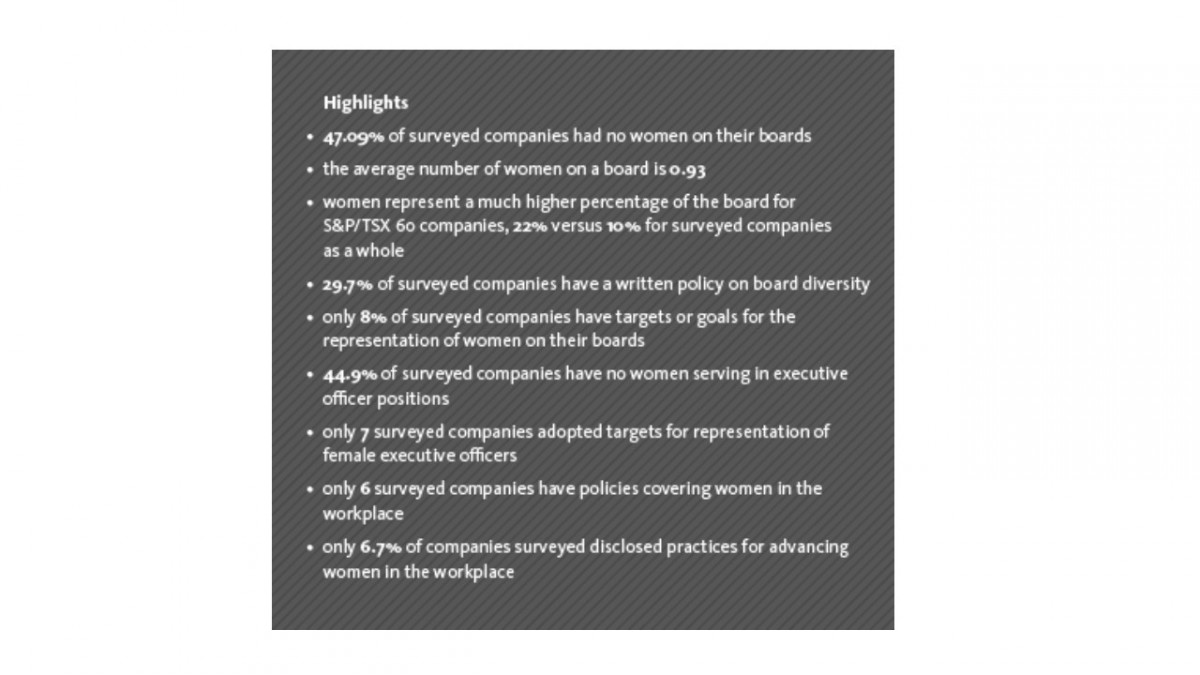
Depuis le 31 décembre 2014, les émetteurs des provinces participantes, à l’exception des émetteurs de la TSX croissance et des fonds d’investissement, sont assujettis à de nouvelles exigences en matière de divulgation de la représentation des femmes dans les conseils d’administration et les postes de cadres supérieurs. Or, que nous apprend la première année d’application du dispositif ?
Le cabinet d’avocats Osler vient de publier les résultats d’une étude au bilan peu glorieux : « Le portrait global est décevant » pouvons-nous lire (ici). Vous trouverez en image ci-dessus un résumé de l’étude.
Cette première année d’application des nouvelles exigences en matière de divulgation reflète d’importants exemples de non-conformité, la faible représentation des femmes dans les conseils d’administration et les postes de cadres au sein d’entreprises cotées à la principale Bourse canadienne, et la quasi-inexistence d’objectifs ou de cibles à atteindre en ce qui a trait au nombre de femmes cadres supérieures.
Pour accéder au rapport « Diversity Disclosure Practices » : cliquez ici.
À la prochaine…
Ivan Tchotourian
mission et composition du conseil d'administration
Le mentoring : what else ?
Ivan Tchotourian 13 septembre 2015
Bonsoir à toutes et à tous, en ce dimanche soir gris et pluvieux à Québec, je vous invite à parcourir cet article de Les Échos du 4 septembre intitulé « Le « mentoring » : un sésame pour entrer au conseil d’administration ». Voilà un instrument original pour faciliter la féminisation des CA !
Il n’y a pas que Télémaque, le fils d’Ulysse parti en guerre, qui a besoin d’un Mentor. Tout le monde peut en ressentir la nécessité. Surtout les femmes, pour pouvoir accéder à des postes d’administratrices. C’est en partant de cette conviction que le programme BoardWomen Partners (BWP) a été lancé en 2007, avant la loi Copé-Zimmermann. A sa tête, deux femmes : Véronique Préaux-Cobti, spécialiste de la conduite en changement, et Marie-Claude Peyrache, ancienne de France Télécom et première femme à être entrée dans son comité exécutif.
Le principe du programme de « mentoring » est le suivant : il met en relation présidents de grandes entreprises et femmes seniors. Chaque président qui le souhaite propose le nom d’une ou de plusieurs femmes de son entreprise (elles deviendront alors des « mentees »). BWP mettra ces dernières en contact avec le président d’une autre entreprise participant également au programme. Chaque président s’engage à rencontrer une femme venant d’une autre entreprise, pour l’aider, la coacher, ou bien éventuellement lui faire « la courte échelle ». Une tâche qu’il ne peut, dans aucun cas, déléguer .
À la prochaine…
Ivan Tchotourian
mission et composition du conseil d'administration normes de droit
Féminisation des CA : bons et mauvais élèves en France
Ivan Tchotourian 8 septembre 2015
Bonjour à toutes et à tous, pour faire suite aux billets consacrés récemment à la féminisation des CA des grandes entreprises françaises, vous pourrez consulter l’article suivant publié par Mme Laurence Boisseau dans le quotidien Les Échos : « Ceux qui ont atteint l’objectif, ceux qui en sont loin ».
Certaines entreprises sont plus en avance que d’autres sur la féminisation de leurs conseils de surveillance… Ainsi, GDF Suez, devenue Engie, compte 63 % de femmes dans son conseil d’administration, Peugeot et Publicis, 55 % ; Vinci, Alstom et Michelin, 43 %. A l’inverse, le Crédit Agricole, Carrefour et LVMH sont loin de l’objectif de 40 % fixé pour 2016 ou 2017 (selon que l’on se réfère au code de gouvernance ou à la loi), mais ils remplissent l’objectif intermédiaire de 20 % pour 2014.
Pour lire la suite, cliquez ici.
À la prochaine…
Ivan Tchotourian