Gouvernance normes de droit Nouvelles diverses
Réforme britannique de la gouvernance d’entreprise : qu’en pensent les PDG et la haute-direction ?
Ivan Tchotourian 2 février 2017
Dans un article paru le 2 février 2017 (« CEOs share their views on corporate governance reform », The Telegraph), des PDG et des chefs de la haute-direction partage leur analyse de la réforme proposée par Theresa May.
So what changes, in what could be the most significant reform of corporate governance since the 2005 Greenbury report, is the paper proposing to make – and how are business leaders responding?
Morceaux choisis :
- “Unions are angry that the proposal to have workers on boards has been dropped, in favour of advisory panels for workers and consumers, and the allocation of special responsibilities to non-executives. Large private companies will be dismayed about proposals about new rules for them. They may argue that this has been based on the poor behaviour of a small minority.”
- “The paper toes a very careful line – raising important questions – and then delivering fairly watered-down recommendations. For example, the paper suggests a binding annual shareholder vote on executive pay, but excludes some elements of executive pay packages from the vote.
- “I welcome any effort that encourages business to do the right thing, but corporate governance is about so much more than regulating executive pay. The boardroom sets the standard for the whole of the business and must be accountable for that ».
- « For reform to be taken forward, business leaders should be encouraged to focus on changes that drive long-term prospects ».
À la prochaine…
Ivan Tchotourian
engagement et activisme actionnarial Gouvernance normes de droit Nouvelles diverses rémunération
Futures assemblées annuelles : que va changer le say on pay ?
Ivan Tchotourian 26 janvier 2017
Dans un article de Le Revenu (24 janvier 2017), Alain Chaigneau propose une intéressante synthèse des implications du vote de la loi Sapin II sur la rémunération des hauts dirigeants (et l’adoption du fameux say on pay) : « Un contrôle encore plus serré de la rémunération des dirigeants ».
Cette année, lors des assemblées générales, le contrôle de la rémunération des entreprises cotées en Bourse va encore se durcir. Les actionnaires avaient déjà leur mot à dire en la matière, sous forme du fameux « say on pay ».
Mais la loi dite Sapin 2 (transparence, lutte contre la corruption, modernisation de l’économie), adoptée dans sa forme définitive le 8 novembre dernier, va encore resserrer les mailles du filet.
La place attend avec impatience les décrets d’application de ces textes, d’ici la fin mars. Mais l’essentiel du nouveau dispositif est maintenant connu, comme l’a écrit Stéphanie de Robert Hautequere, avocat expert au cabinet Fidal : « Avec la loi Sapin 2, tant le mode de calcul que le montant des rémunérations des dirigeants seront désormais soumis à un vote contraignant – et non plus simplement consultatif – des actionnaires. Ce double vote s’appliquera à toutes les entreprises cotées sur Euronext ».
À la prochaine…
Ivan Tchotourian
Gouvernance normes de droit Nouvelles diverses
Enron : tout change, rien ne change
Ivan Tchotourian 17 janvier 2017
Bel article sur le
Harvard Law School Forum on Corporate Governance and Financial Regulation montrant que le scandale Enron (et ses leçons) sont toujours d’actualité :
« Why Enron Remains Relevant » (de Michael W. Peregrine, 2 décembre 2016).
Morceaux choisis :
But a 2016 Enron board briefing would be much more than a financial history lesson. For the continuing relevance of Enron is at least two-fold.
First, it provides jaw-dropping examples of problematic governance conduct from which no board, at any time, is safely immune.
Second, it provides a clear explanation for the corporate accountability environment along with the enactment of Sarbanes Oxley. In essence, Enron is the “root” of the modern corporate governance “tree.” The emphasis on director-independence; governance principles; “best practices”; codes of corporate ethics; financial transparency; whistleblower access; informed decision-making; enhanced board oversight; conflicts and compensation sensitivity and ”constructive skepticism” can be directly traced to the perceived and admitted failures of the Enron board. Finally, the Enron circumstances should provide a little “ping” in the back of the brain, that “the smartest guys in the room” have a nasty habit of popping up again, and again, in executive suites across industry sectors, year after year.
À la prochaine…
Ivan Tchotourian
Base documentaire doctrine Gouvernance normes de droit Nouvelles diverses
Différends entre actionnaires : en savoir plus
Ivan Tchotourian 16 janvier 2017
Bonjour à toutes et à tous, la Revue du Barreau canadien publie un bel article sur le thème riche des différends entre actionnaires sous la plume de Me Nadeau et Desalliers : « L’impasse (deadlock) en matière de différends entre actionnaires au Québec ». Une belle étude qui rejoint certains thèmes qui sont abordés dans le cours DRT-2006 Droit des sociétés par actions
Pour en savoir plus, rendez-vous sur le site de la Revue du barreau canadien : https://cbaapps.org/cba_barreview/Search.aspx?VolDate=12/01/2016
Les sociétés qui ont un petit nombre d’actionnaires font parfois face à des situations lors desquelles un différend risque de perturber, voire même d’interrompre le fonctionnement de la société. Ce scénario, connu en tant qu’« impasse », présente un défi particulier pour ces sociétés et pourrait nécessiter l’intervention des tribunaux. Cet article envisage les deux recours principaux permettant de résoudre l’impasse, soit la dissolution et le recours en redressement pour cause d’abus, et examine les critères utilisés par les tribunaux pour déterminer laquelle de ces mesures doit être appliquée. Il discute également des diverses ordonnances provisoires et définitives à la disposition des tribunaux.
À la prochaine…
Ivan Tchotourian
autres publications engagement et activisme actionnarial Gouvernance normes de droit Nouvelles diverses
Hedge fund et activisme : un ouvrage
Ivan Tchotourian 10 janvier 2017
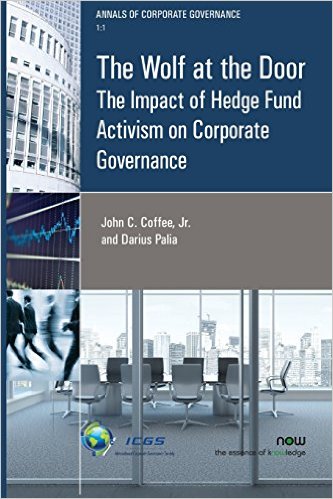
Bonjour à toutes et à tous, je signale cet ouvrage de John C Coffee Jr et Darius Palia sur l’activisme des fonds de couverture : « The Wolf at the Door: The Impact of Hedge Fund Activism on Corporate Governance ». Un bel ouvrage pour compléter une bibliothèque.
The Wolf at the Door: The Impact of Hedge Fund Activism on Corporate Governance has three basic aims: (1) to understand and explain the factors that have caused the recent explosion in hedge fund activism; (2) to examine the impact of this activism, including whether it is shortening investment horizons and discouraging investment in research and development; and (3) to survey and evaluate possible legal interventions with an emphasis on the least restrictive alternative. Although there have been other lengthy surveys, the landscape of activism is rapidly changing and this brings into doubt the relevance of empirical papers that study hedge fund activism in earlier decades. The authors suspect that the recent success of such activism may be fueling a current « hedge fund bubble » under which an increasing number of activist funds are pursuing a decreasing, or at least static, number of companies that have overinvested. This monograph is particularly focused on those markets and the legal forces that may be driving this bubble. After an introduction, Section 2 begins with an analysis of those factors that have spurred greater activism on the part of hedge funds. Section 3 considers evidence suggesting that as the composition of a firm’s shareholder population shift towards more « transient » holders, its investment horizon shortens. Section 4 surveys recent studies to reach assessments about who the targets of hedge fund activism are; the stock price returns from hedge fund activism and the distribution of those returns; the degree to which wealth transfers explain the positive stock price returns to activism; the post-intervention evidence about changes in operating performance of hedge fund targets; and the holding periods and exit strategies of hedge fund activists. Section 5 evaluates some policy options looking for the least drastic means of accomplishing policy goals. Finally, Section 6 offers a brief conclusion that surveys how the changing structure of shareholder ownership and the recent appearance of temporary shareholder majorities complicate corporate governance, both empirically and normatively.
À la prochaine…
Ivan Tchotourian
normes de droit Nouvelles diverses objectifs de l'entreprise Valeur actionnariale vs. sociétale
Primauté actionnariale et Benefit corporation
Ivan Tchotourian 9 janvier 2017
Le Harvard Law School Forum on Corporate Governance and Financial Regulation propose un bel article sous la plume de Frederick Alexander : « Moving Beyond Shareholder Primacy: Can Mammoth Corporations Like ExxonMobil Benefit Everyone? ». Une belle occasion de revenir sur le thème de la Benefit Corporation et de la remise en cause de la primauté actionnariale dont elle peut être la cause…
The New York Times recently took issue with Rex Tillerson, the President-elect’s nominee for Secretary of State, and the current CEO of ExxonMobil. Why? “Tillerson Put Company’s Needs Over U.S. Interests,” accused the front page headline. The article details how the company puts shareholders’ interests before the interests of the United States and of impoverished citizens of countries around the world.
In response, a company spokesman insisted that all laws were followed, and that “‘[a]bsent a law prohibiting something, we evaluate it on a business case basis.’” As one oil business journalist puts it in the article: “‘They are really all about business and doing what is best for shareholders.’” Thus, as long as a decision improves return to shareholders, its effect on citizens, workers, communities or the environment just doesn’t rank.
Unfortunately, this idea—evaluate the “business” case, without regard to collateral damage, permeates the global capital system. Corporations are fueled by financial capital, which ultimately comes from our bank accounts, pension plans, insurance premiums and mutual funds, and from foundations and endowments created for public benefit—in other words, our money. And yet when that capital is invested in companies that ignore societal and environmental costs, we all suffer: Corporations use our savings to drive climate change, increase political instability, and risk our future in myriad ways.
The good news is that structures like “benefit corporations” can help us repair our broken system of capital allocation—but the clock is ticking.
À la prochaine…
Ivan Tchotourian
normes de droit Nouvelles diverses responsabilisation à l'échelle internationale
Régime fiscal des sociétés aux Etats-Unis : réforme adoptée
Ivan Tchotourian 18 décembre 2016
Bonjour à toutes et à tous, le règlement réformant le paradis fiscal du Delaware a été publié par le président américain Barack Obama (« Le règlement réformant le paradis fiscal du Delaware a été publié », 7 décembre 2016). Ce nouveau texte met fin à l’opacité des sociétés offshore immatriculées dans cet État.
Comme l’avait annoncé Le Monde daté du 7 décembre, l’administration Obama a adopté le règlement qui aura pour effet de réformer le régime fiscal opaque du Delaware, du Wyoming et du Nevada. Le texte a été publié le 13 décembre au Federal register– l’équivalent du Journal officiel- et entre aussitôt en vigueur.
A un peu plus d’un mois désormais de son départ de la Maison blanche, le président des Etats-Unis, Barack Obama, tient donc sa promesse de contribuer à la lutte contre la fraude fiscale dans les paradis fiscaux, en poussant la transparence sur son propre territoire.
(…) Ce nouveau règlement de l’Internal Revenue Service (IRS), le fisc américain, et du Trésor vise les sociétés à actionnaire unique et à responsabilité limitée, dites « single LLCs ». Il imposera à leurs propriétaires de s’identifier auprès des services fiscaux, ce qui constitue une véritable avancée en termes de transparence.
À la prochaine…
Ivan Tchotourian