autres publications Gouvernance Normes d'encadrement
Comparer la gouvernance d’entreprise : étude de Martin Gelter
Ivan Tchotourian 4 août 2016
Martin Gelter (professeur à Fordham) nous offre un très bel article « Comparative Corporate Governance: Old and New » pour le compte de l’ECGI (Law Working Paper No. 321/2016). Si vous vous intéressez à la comparaison en matière de gouvernance d’entreprise, c’est un incontournable !
The most fundamental comparative corporate governance debates have often focused on two issues.
The first one concerns ownership structure: Why are large corporations in some corporate governance system owned by a multitude of disempowered shareholders, thus effectively giving management free rein? Why are corporations typically governed by a controlling shareholder or a coalition of controlling shareholders in other systems?
The second issue is the role of other ‘constituencies’ of the corporation besides shareholders, of which labor is most central to the debate. Some jurisdictions explicitly give labor an influential voice in corporate affairs, whereas in others its influence is developed through factual power or unintended consequences of legislation.
This chapter explores the interactions between firm ownership and labor, focusing on the United States on the one hand and Continental Europe, particularly Germany, on the other. It distinguishes between ‘old’ and ‘new’ comparative corporate governance, the former referring to the dichotomy studied by scholars of comparative corporate law up to the early 2000s. Recent changes, heralded by intermediated, but widespread share ownership are leading us to a new equilibrium whose contours have only begun to emerge.
Over the past decades, outside investors have gained power both in the United States and in Continental Europe. However, neither in the US nor in Continental Europe has the traditional corporate governance system been completely superseded by a new one. The US remains to a large extent manager-centric. Continental Europe retains powerful large shareholders, and labor as an independent force has remained more important than in the United States. Outside institutional investors – sometimes from the US – have become a player to be reckoned with, thus adding an additional layer of complexity to the system.
À la prochaine…
Ivan Tchotourian
autres publications Gouvernance normes de droit Nouvelles diverses
Rapport 2016 de PWC sur le crime économique
Ivan Tchotourian 3 août 2016
Belle étude annuelle de Pwc consacrée à la criminalité économique : « Global Economic Crime Survey 2016 – Adjusting the Lens on Economic Crime: Preparation brings opportunity back into focus ».
Today more than ever before, a passive approach to detecting and preventing economic crime is a recipe for disaster. To underscore this fact, our survey uncovered a widespread lack of confidence in local law enforcement – a phenomenon that is not limited to regions or level of economic development. The message is clear: the burden of preventing, protecting and responding to economic crime rests firmly with organisations themselves. Our survey this year focuses on three key areas – Cybercrime, Ethics and compliance programmes and Anti-Money Laundering – and explores certain common themes, including managing the risks associated with the pervasion of technology; what it means to conduct business responsibly across a widening business landscape; and integrating ethical conduct into decision-making.
In addition to highlighting specific areas of economic crime worth focusing on, we emphasise the things you can do better to tackle them – implementing more sophisticated and effective measures that can not only reduce these risks, but also bring the benefits of a more threat-aware business, confident of its defences in a changing world.
À la prochaine…
Ivan Tchotourian
autres publications Gouvernance Normes d'encadrement
Une politique ambitieuse de Vigeo
Ivan Tchotourian 3 août 2016
Alors que le changement climatique est sur le devant de la scène et que les entreprises et les investisseurs ne peuvent l’ignorer, l’agence de notation extra-financière Vigeo a publié le 12 janvier 2016 une politique ambitieuse intitulé « Post COP21: How well companies & investors are positioned to respond to climate change » (Policy Briefing, Climate Change & Transition to a Low Carbon Economy). Ce document rappelle haut et fort que le changement climatique est une affaire d’entreprise et d’investisseur !
Investors have already played a key role in bringing about COP21, and in the post COP21 landscape, investors are vital to ensure meaningful results.
No doubt initiatives such as the Montreal Pledge, the RE100 investor initiative, investor campaigns on stranded assets, and the plethora of events both before and during COP21, demonstrated to governments investor will and thought-leadership here. The growing corporate-investor-government nexus whereby some companies are calling for a credible carbon price/tax is significant.
The importance of incentives for emissions reduction activities are recognised in the Agreement preamble, including domestic policies and carbon pricing.16 These calls to action will drive forward collective performance on climate change, in addition to the ongoing pressure investors can put on companies through the investment process.
Responsible investment plays a leading role in highlighting companies’ exposure to the risks of climate change and evaluating their capacity to mitigate them. Analyses from research intermediaries such as Vigeo Eiris can help investors to understand and better manage these mounting climate change risks.
At present, only a small proportion of companies are found to have an advanced response to climate change and energy transition. To drive forward performance, companies could be encouraged to tie Board-level remuneration to climate change targets. Corporate reporting could be improved, particularly through use of quantitative assessments, and companies should be encouraged to report on the impact of the whole product lifecycle on emissions. There is also room for much greater corporate acknowledgement of the policy context.
À la prochaine…
Ivan Tchotourian
autres publications mission et composition du conseil d'administration Normes d'encadrement Nouvelles diverses place des salariés
Système allemand de codétermination : un modèle exportable ?
Ivan Tchotourian 22 juillet 2016
Alors que Theresa May a fait part de son intérêt d’importer en Grande-Bretagne le système allemand, MM. Horst Eidenmüller, Mathias Habersack, Caspar Behme et Lars Klöhn reviennent sur la pertinence de cette proposition en jetant un regard prudent (de chercheurs !) sur ce système : « Corporate Co-Determination German-Style as a Model for the UK? » (18 juillet 2016).
On 13 July 2016, Theresa May took up office as Prime Minister of the United Kingdom. Only shortly before, she had made headlines when she proposed to adopt European-style worker representation on the boards of leading companies.
Corporate co-determination hence seems to gain a certain degree of popularity with the British government – which is highly astonishing, considering that it was the UK which most fiercely fought against co-determination on a European level. It was mainly the diverging views of the UK and Germany on co-determination which have thwarted projects like the Draft Fifth Company Law Directive or the establishment of a European Private Company (Societas Privata Europaea, SPE). It is downright ironic that while the UK now shows an interest in co-determination, the concept is being questioned in Germany after decades of lying dormant. The reason for the new German discussion of co-determination are doubts regarding the compatibility of its specific form of co-determination with higher-ranking Union law. This post provides a brief overview of the most recent developments in German co-determination law that were the focus of a joint Oxford/Munich conference at the Ludwig-Maximilians-Universität (LMU) in Munich in March 2016.
À la prochaine…
Ivan Tchotourian
autres publications normes de droit responsabilisation à l'échelle internationale
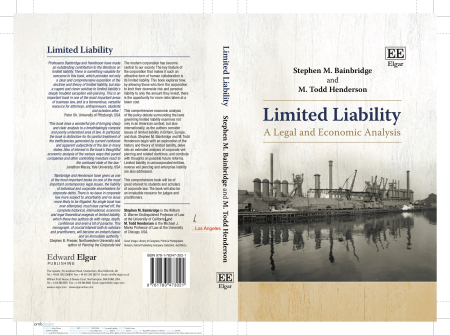
Nouvel ouvrage sur la responsabilité limitée : « Limited Liability: A Legal and Economic Analysis »
Ivan Tchotourian 17 juillet 2016
Stephen Bainbridge et Todd Henderson vont publier au mois de septembre 2016 leur dernier ouvrage portant sur la responsabilité limitée des actionnaires : « Limited Liability: A Legal and Economic Analysis » . Assurément un ouvrage à avoir dans une bibliothèque de droit des affaires !
The modern corporation has become central to our society. The key feature of the corporation that makes it such an attractive form of human collaboration is its limited liability. This book explores how allowing those who form the corporation to limit their downside risk and personal liability to only the amount they invest allows for more risks to be taken at a lower cost.This comprehensive economic analysis of the policy debate surrounding the laws governing limited liability examines limited it not only in an American context, but internationally, as the authors consider issues of limited liability in Britain, Europe and Asia. Stephen Bainbridge and M. Todd Henderson begin with an exploration of the history and theory of limited liability, delve into an extended analysis of corporate veil piercing and related doctrines, and conclude with thoughts on possible future reforms. Limited liability in unincorporated entities, reverse veil piercing and enterprise liability are also addressed. This comprehensive book will be of great interest to students and scholars of corporate law. The book will also be an invaluable resource for judges and practitioners.
À la prochaine…
Ivan Tchotourian
autres publications normes de droit Structures juridiques
Billet d’humeur sur Contact : L’organisation juridique de l’entreprise sociale (2 de 2)
Ivan Tchotourian 15 juillet 2016
Bonjour à toutes et à tous, je viens de publier mon nouveau billet sur le blogue Contact de l’Université Laval : « L’organisation juridique de l’entreprise sociale (2 de 2) ».
Plusieurs organisations juridiques sont susceptibles de soutenir une activité marquée par une finalité environnementale ou sociale. Dans le billet précédent, nous avons présenté l’organisme de bienfaisance, l’organisme à but non lucratif et la coopérative. Je me tourne maintenant vers 2 entreprises à vocation commerciale, mais qui ont quelque chose que les autres n’ont pas: elles ne sont pas exclusivement commerciales.
Se développe aujourd’hui un nouveau type d’entreprise qui, revêtant la forme traditionnelle d’une société par actions, s’en distingue par son objet social et son respect de certains des principes particuliers. La tendance mondiale est en effet à la création de ces entreprises dites «hybrides». De plus, n’oublions pas que les entreprises commerciales traditionnelles à visée lucrative s’ouvrent à la responsabilité sociale des entreprises (RSE). Comme l’affirment certains: «Social entrepreneurship: it’s for corporations too».
À la prochaine…
Ivan Tchotourian
autres publications Normes d'encadrement Nouvelles diverses
Européanisation de la gouvernance d’entreprise par la soft law
Ivan Tchotourian 11 juillet 2016
Sur le blogue de l’Université d’Oxford, Idoya Ferrero-Ferrero et Robert Ackrill publie une synthèse de leur dernier article : « Is Europeanization Though Soft-Law a Reality in Corporate Governance Policies? ». La question qu’il aborde est simple mais très pertinente pour les juristes : Est-ce que la soft law européenne en matière de gouvernance d’entreprise fait évoluer les cadres juridiques étatiques (et ce, sans avoir besoin d’édicter des règles contraignantes !) ? La réponse est oui…
Europeanization addresses the impacts of EU membership on national politics and policies, via both the processes by which EU decision-making manifests itself at the national level; and the outcomes of that EU decision-making. Over time, as EU membership and policy scope have expanded, new approaches to policy-making have been developed and, therefore, new channels created by which Europeanization can occur. One such has been the use of ‘soft law’ processes. These have allowed for greater discussion of ‘sensitive’ policy issues, where national policy sovereignty continues to dominate, given that these discussions do not result in legal texts binding on the member states. That said, the purpose of soft law is still to deliver national policy change. Which begs the question – can they work?
À la prochaine…
Ivan Tchotourian