La prestigieuse Revue des sociétés (Dalloz) publie deux numéros spéciaux (septembre et octobre) sur les liens entre droit des sociétés et critères ESG. De beaux articles à découvrir !
Nouvelle qui intéressera nos lectrices et lecteurs du blogue : « Cyprus passes Social Enterprise Law » (par Alexandra Fougala-Metaxa, Pioneer Post, 30 mars 2021).
Extrait :
Social enterprises in Cyprus now have their own legal framework. In December 2020, the House of Representatives of Cyprus passed, for the first time, a Social Enterprise Law. The bill was initially introduced in 2013 and it has taken seven years for it to be approved, reportedly due to many modifications, debates and delays.
Prior to this, Cyprus had no legal framework for social enterprises. According to a social enterprise mapping report for Cyprus, carried out by the European Commission, there were only seven organisations that could be described as ‘social enterprises’ in Cyprus in 2014. A recent survey by CyprusInno of entrepreneurs in the Greek Cypriot and Turkish Cypriot communities found that 11% of the 359 entrepreneurs surveyed said they ran social enterprises.
Maria Nomikou, the youth, skills and inclusive communities sector lead for Europe at the British Council, says: “A law on social enterprises can have a very positive impact as it fosters visibility, growth and the development of this type of business.”
Visibility surrounding social enterprises is key to encouraging the growth of the sector in Cyprus. For years, the lack of a legal definition of the term social enterprise meant that social enterprises in Cyprus operated as either limited liability companies or charities. The problem with this, as identified by Andrea Solomonides, the lead of Cyprus operations at enterprise support organisation Cypriot Enterprise Link, was it created an image problem – many people did not think that working full time for social enterprises was financially sustainable, and thus the sector struggled to attract staff.
A law defining social enterprises as separate, unique entities, distinct from other types of businesses or non-profits, helps increase awareness. The law also means that social enterprises will have access to EU grants available only to the social enterprise sector, and receive various tax benefits, which, Maria Nomikou hopes, will motivate people to set up their own social enterprises.
(…) The definition of social enterprises under the new law is as enterprises with a social cause that reinvest a proportion of their profits back into their work, or enterprises that hire a certain proportion of their staff from vulnerable groups.
L’entreprise sud-coréenne Samsung, spécialisée dans l’électronique, a été contrainte de se défendre, jeudi 11 janvier, après que deux ONG avaient apporté de nouveaux éléments à leurs accusations de violations des droits de l’homme dans les usines chinoises du constructeur (ici). Le Monde nous apprend que les poursuites judiciaires n’auront pas lieu : « Conditions de travail des ouvriers chinois : les poursuites contre Samsung France annulées » (26 avril 2021).
Extrait :
La filiale du leader mondial des smartphones avait en effet été mise en examen en avril 2019 pour « pratiques commerciales trompeuses », du fait de la présence sur son site Internet de son opposition au travail forcé et au travail des enfants.
(…) Selon une source judiciaire, cette plainte a été jugée irrecevable le 30 mars par la chambre de l’instruction de la cour d’appel de Paris, au motif que les ONG ne disposaient pas de l’agrément pour agir en justice contre des « pratiques commerciales trompeuses ».
Cette décision entraîne de fait la nullité de la procédure qu’elles avaient lancée, et a donc pour conséquence d’annuler la mise en examen de Samsung France. La maison mère, Samsung Electronics, a dit « prendre acte » de ces décisions, sans plus de commentaires.
(…)
Afin de justifier une procédure pénale en France, les ONG estimaient suffisant que le message incriminé soit accessible aux consommateurs français pour que les juridictions du pays soient compétentes. S’appuyant sur divers rapports d’ONG qui ont pu se rendre dans les usines du groupe en Chine, en Corée du Sud et au Vietnam, Sherpa et Actionaid dénonçaient l’« emploi d’enfants de moins de seize ans », des « horaires de travail abusifs », des « conditions de travail et d’hébergement incompatibles avec la dignité humaine » et une « mise en danger des travailleurs ».
Une autre association, UFC-Que choisir, a déposé elle aussi en février à Paris une plainte avec constitution de partie civile pour pratiques commerciales trompeuses visant le groupe, et attend désormais que la justice se prononce.
A notable driver in the movement towards stronger oversight has been allegations of abuses committed in the extractive sector. Indeed, The Business & Human Rights Resource Centre’s latest Transition Minerals Tracker (May 2020) features Glencore as a top 5 company in respect of 4 out of 6 transitional commodities (cobalt, copper, nickel and zinc) and records allegations of human rights abuses in three of these categories: cobalt (10 allegations[2]); copper (32) and zinc (14). While the copper and zinc allegations against Glencore are roughly double in number to those of its nearest competitor, it ties with the DRC state mining company, Gécamines, in respect of cobalt related human rights allegations. In unrelated news, Glencore fought unsuccessfully last week to obtain a gagging injunction pertaining to allegations of child labour made against it by the organization Initiatives multinationales responsableswith reference to its Bolivian mine in Porco.
On November 29, 2020, 50.7% of the national vote went in favour of the RBI; however, it gained a majority vote in only a third of the Swiss cantons. Observers have pointed out that this is the first time in 50 years for a referendum measure to flounder due to regional restrictions despite having attracted a nationwide popular majority.
The outcome of the referendum is thus that the Swiss Responsible Business Initiative will not come into being. However, the fact that it carried the popular vote has been described as, “a clear sign to Switzerland’s multinationals that the days of avoiding scrutiny are well and truly over.”
This is in line with developments elsewhere in the world.
In Vedanta Resources Plc & Anor v Lungowe & Ors the UK Supreme Court held in 2019 in a procedural ruling that pollution charges could proceed in the UK against Vedanta Resources, plc (“Vedenta”) and its Zambian subsidiary, Konkola Copper Mines, plc (“KCM”), notwithstanding the fact that the pollution was alleged to have taken place in Zambia and that the claimants were a Zambian community. The facts relate to the operations of the Nchanga Copper Mine in the Chingola District of Zambia.
This full-bench decision is interesting for multiple reasons. First, it is a significant ruling for multinational UK parent companies with subsidiaries operating in developing countries. Second, both Vedanta and KCM had explicitly submitted to the jurisdiction of the Zambian courts. Third, although most of the proper place indicators pointed to Zambia and despite the fact that the Court found that there would be a real risk of irreconcilable judgments between Zambia and the UK, it still ruled that the UK had jurisdiction to hear the case on the basis that the claimants were likely to suffer a substantial injustice if the matter were to proceed in Zambia. Interestingly, no criticism was levied against either the administration of justice in Zambia or its legal system. Instead, the Court held that by reason of their extreme poverty the claimants would not be able to afford funding the litigation in Zambia and that they would not be able to access a Zambian legal team of sufficient expertise, experience and resources to pursue such litigation in Zambia. In other words, it became an issue where access to justice considerations trumped strict procedure.
All of this is relevant in the Canadian context. In a recent Blog I addressed the settlement of the litigation in Nevsun v Araya. Of great importance remains the fact that in February 2020 the Supreme Court of Canada has in this litigation categorically opened the way for foreign plaintiffs to bring allegations in Canadian courts of human rights abuses perpetrated by foreign subsidiaries of Canadian mining companies. While the Supreme Court made no ruling on the substance of the charges given the preliminary nature of the proceedings, future plaintiffs certainly will get to address the substance of their claim far sooner. As this note has illustrated, Canada is in step with leading business and human rights developments on the international front. That is cause for celebration.
This Chapter seeks to make three modest contributions by offering views of the corporate purpose cathedral that bear on the role of law in it. These views underscore the difference and the tension between an individual perspective and a societal/national legal perspective on the purpose of the corporation. First, it reviews a novel dataset on national legal shareholderism – namely, the degree to which national corporate laws endorse shareholder primacy – as an exercise in operationalizing legal constructs. Second, it anchors the two archetypal approaches of shareholderism and takeholderism in personal human values. It is this connection with the fundamental conceptions of the desirable which animates attitudes and choices in this context. The upshot is potentially subversive: Legal injunctions to directors on corporate purpose might be an exercise in futility. Third, this Chapter highlights the importance of acknowledging the tensions between the two levels of analysis by looking at the works of prominent writers. Adolf Berle, Victor Brudney, and Leo Strine have been careful to keep this distinction in mind, which has enabled them to hold multiple views of the cathedral without losing sight of it.
Bel article de Vanessa Serret et Mohamed Khemissi dans The conversation (27 juillet 2020) : « Rémunération des dirigeants : la transparence ne fait pas tout ». Cet article revient sur le ratio d’équité : non seulement son utilité, mais encore son niveau (20 ? 100 ?…)
Le ratio d’équité apprécie l’écart entre la rémunération de chaque dirigeant et le salaire (moyen et médian) des salariés à temps plein de son entreprise. Il est prévu un suivi de l’évolution de ce ratio au cours des cinq derniers exercices et sa mise en perspective avec la performance financière de la société. Ces comparaisons renseignent sur la dynamique du partage de la création de valeur entre le dirigeant et les salariés.
(…)
Un premier état des lieux
Sur la base des rémunérations versées en 2019 par les entreprises composant l’indice boursier du CAC 40, les patrons français ont perçu un salaire moyen de 5 millions d’euros, soit une baisse de 9,1 % par rapport à 2018.
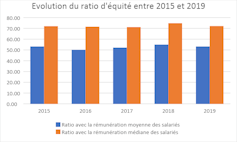
Évolution du ratio d’équité par rapport à la rémunération moyenne (bleu) et médiane (orange) des salariés de 2015 à 2019. auteurs
Ce chiffre représente 53 fois la rémunération moyenne de leurs employés (72 fois la rémunération médiane) : un ratio acceptable, selon l’agence de conseil en vote Proxinvest. En effet, selon cette agence, et afin de garantir la cohésion sociale au sein de l’entreprise, le ratio d’équité ne doit pas dépasser 100 (par rapport à la rémunération moyenne des salariés).
Deux dirigeants s’attribuent néanmoins des rémunérations qui dépassent le maximum socialement tolérable à savoir Bernard Charlès, vice-président du conseil d’administration et directeur général de Dassault Systèmes et Paul Hudson, directeur général de Sanofi avec un ratio d’équité qui s’établit respectivement de 268 et de 107.
Notons également que pour les deux sociétés publiques appartenant à l’indice boursier du CAC 40, le ratio d’équité dépasse le plafond de 20 (35 pour Engie et 38 pour Orange) fixé par le décret n° 2012-915 du 26 juillet 2012, relatif au contrôle de l’État sur les rémunérations des dirigeants d’entreprises publiques.