Gouvernance | Page 134
autres publications mission et composition du conseil d'administration Normes d'encadrement responsabilisation à l'échelle internationale
Droits de l’homme et CA : un guide en 5 étapes
Ivan Tchotourian 24 mai 2016
L’EHRC vient de publier un guide « Business and human rights – A five-step guide for company boards » bien intéressant pour les CA. Comme le précise ce document : « We recommend that boards should follow five steps to ensure that their company is fulfilling its responsibility to respect human rights in a robust and coherent manner that meets the expectations of the UN Guiding Principles and UK statutory reporting obligations. Boards should be aware of the company’s salient, or most severe, human rights risks, and ensure ».
The following are the five steps that it is recommended boards should follow to ensure that their company is fulfilling its responsibility to meet human rights in a robust and coherent manner that meets the expectations of the UN Guiding Principles and UK statutory reporting obligations:
- the company should embed the responsibility to respect human rights into its culture, knowledge and practices;
- the company should identify and understands its salient, or most severe, risks to human rights;
- the company should systematically address its salient, or most severe, risks to human rights and provide for remedies when needed;
- the company should engage with stakeholders to inform its approach to addressing human rights risks; and
- the company should report on its salient, or most severe, human rights risks and meet regulatory reporting requirements.
Attention : encore une fois, tout cela n’est que du droit international et donc du droit « mou ». Ce guide l’exprime très bien en ces termes : « The Guiding Principles do not create any new international legal obligations on companies, but they can help boards to operate with respect for human rights and meet their legal responsibilities set out in domestic laws ».
À la prochaine…
Ivan Tchotourain
mission et composition du conseil d'administration rémunération
Siéger sur un comité de rémunération : de plus en plus risqué !
Ivan Tchotourian 22 mai 2016
Siéger sur un comité de rémunération serait-il risqué ? Oui et de plus en plus selon un article du Financial Times : « Executive pay committee chair in the hot seat » (2 mai 2016). Les actionnaires semblent en effet tourner leur grogne touchant la rémunération vers les membres du comité,
In the most high-profile shareholder protests seen in the UK for four years, investors have been directing their anger squarely at company bosses for their multimillion pound pay packets. (…)
With pay protests set to continue in the coming weeks, some are now turning their sights on the people who determine the bumper awards, rather than the recipients. This puts the chairs of remuneration committees directly in the line of fire — an unusual position for the holders of these generally low-profile posts. Few, if any, remuneration committee chairs are household names. But, in conjunction with their committee members, they wield immense power. Not only do they decide the fixed salary of the boss, but they also determine the bonus structures that provides the lion’s share of a pay package.
À la prochaine…
Ivan Tchotourian
mission et composition du conseil d'administration objectifs de l'entreprise
Les P-DG vont-ils parler de plus en plus de RSE ?
Ivan Tchotourian 22 mai 2016
Les P-DG devraient investir davantage le terrain de la RSE dans leur déclaration. C’est en substance ce que l’on apprend d’un article du Wall Street Journal intitulé : “Salesforce’s Marc Benioff has kicked off new era of corporate social activism” (2 mai 2016).
Mr. Benioff is among CEOs of companies, including Apple Inc., Bank of America Corp., Walt Disney Co., Intel Corp. and International Business Machines Corp., that have begun pressuring lawmakers on social issues, often with a warning: Change laws or risk losing business.
That is a departure from the past, when U.S. CEOs often avoided weighing in on social issues lest they incur backlash from shareholders, customers and other constituents.
Now, the risk may be in not speaking up. “Our jobs as CEOs now include driving what we think is right,” says Bank of America CEO Brian Moynihan. “It’s not exactly political activism, but it is action on issues beyond business.
À la prochaine…
Ivan Tchotourian
autres publications normes de droit rémunération
Toujours le Dodd-Frank Act !
Ivan Tchotourian 22 mai 2016
Bonjour à toutes et à tous, 6 agences fédérales américaines (dont la SEC) ont publié pour commentaire (jusqu’au 22 juillet 2016) leur proposition de mise en place de l’article 956 du Dodd-Frank Act visant à interdire les rémunérations incitatives qui encourageraient une prise de risque inconsidéré des institutions financières. Ce document est intitulé : « Incentive-based Compensation Arrangements ».
The OCC, Board, FDIC, FHFA, NCUA, and SEC (the Agencies) are seeking comment on a joint proposed rule (the proposed rule) to revise the proposed rule the Agencies published in the Federal Register on April 14, 2011, and to implement section 956 of the Dodd-Frank Wall Street Reform and Consumer Protection Act (Dodd-Frank Act). Section 956 generally requires that the Agencies jointly issue regulations or guidelines: (1) prohibiting incentive-based payment arrangements that the Agencies determine encourage inappropriate risks by certain financial institutions by providing excessive compensation or that could lead to material financial loss; and (2) requiring those financial institutions to disclose information concerning incentive-based compensation arrangements to the appropriate Federal regulator.
À la prochaine…
Ivan Tchotourian
mission et composition du conseil d'administration
Succession des P-DG vedette : qui pour les remplacer ?
Ivan Tchotourian 22 mai 2016
Yannick Clerouin de Les affaires propose un billet pertinent intitulé « La retraite des pdg vedettes, un danger pour votre portefeuille? ». À cette occasion, il revient sur la délicate question de la succession d’un grand nom et des risque qu’engendre un mauvais choix.
Comme investisseur, la question de la succession des dirigeants m’interpelle, car un nombre croissant des meilleurs patrons des sociétés québécoises inscrites en Bourse ont passé le cap de la soixantaine, voire celui de l’âge habituel de la retraite. (…)
Le choix du successeur d’un pdg bien établi peut avoir d’importantes conséquences sur la performance d’une entreprise, ou encore être un boulet pour un titre pendant de nombreuses années.
À la prochaine…
Ivan Tchotourian
mission et composition du conseil d'administration
Norwegian oil fund attacks VW corporate governance
Ivan Tchotourian 21 mai 2016
Une action de groupe est en cours contre l’entreprise allemande Volkswagen comme l’annonce le Financial Times. Ce qui est intéressant dans cet article (« Norwegian oil fund attacks VW corporate governance ») est qu’un des gros investisseurs de cette entreprise (et des entreprises européennes en général) fait partie de ceux qui agissent.
Norway’s $8sobn oil fund does not like commenting about individual companies it owns shares in. It usually goes out of its way to avoid saying anything about any of its more than 9,000 investments. But Volkswagen is starting to become the exception that proves the rule. The world’s largest sovereign wealth fund has become increasingly open in its distaste for the German carmaker, culminating in it confirming to the Financial Times that it would take legal action against VWover its emissions scandal.
The decision to sue VW as part of a class-action lawsuit in the German courts is merely the latest sign of the oil fund’s growing willingness to criticise the carmaker.
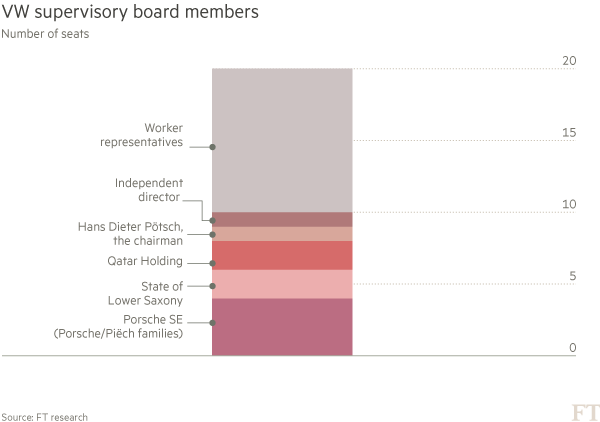
Comme le rappelle cet article, la composition du conseil de surveillance est au cœur des critiques ! « The concerns centre around VW’s supervisory board. Several investors and governance experts question whether, after three scandals at VW in 20 years, the board has the authority and independence to hold management to account. Out of the 10 shareholder representatives on the board, eight represent the three largest investors: the Porsche and Piëch families, the state government of Lower Saxony, and Qatar Holding, an arm of Qatar’s sovereign wealth fund. The ninth is VW’s former finance director, Hans Dieter Pötsch, who is now the board chairman. Only the tenth, Annika Falkengren, chief executive of Swedish bank SEB, is viewed as being independent ».
À la prochaine…
Ivan Tchotourian
normes de droit rémunération
Code gouvernance français : proposition d’un say on pay impératif
Ivan Tchotourian 21 mai 2016
L’Afep et le Medef ont annoncé aujourd’hui une révision de leur code de bonne conduite sur les rémunérations des dirigeants en donnant au say on pay un caractère impératif (« Révision du code Afep-Medef sur les rémunérations des dirigeants », 20 mai 2016).
Le vote des actionnaires en assemblée générale est purement consultatif en France. « Un vote négatif des actionnaires contraint le conseil d’administration à statuer sur les modifications à apporter à la rémunération due ou attribuée au titre de l’exercice clos ou à la politique de rémunération future », souligne un communiqué de l’Afep-Medef. Mais le caractère impératif s’applique seulement à la réaction du conseil. Le conseil d’administration de l’entreprise devra faire une contre-proposition «dans un délai raisonnable», soit quelques semaines, et rendre celle-ci publique, ont annoncé le président de l’Afep Pierre Pringuet et le président du Medef Pierre Gattaz au cours d’une conférence de presse.
En revanche, le nouveau code donne toujours le dernier mot au conseil d’administration de l’entreprise et ne préconise pas la tenue d’une nouvelle assemblée générale. Le conseil devra faire un rapport devant l’AG de l’année suivante.
La veille, le Haut Comité de gouvernement d’entreprise de l’Association française des entreprises privées (Afep) et du Medef, instance créée en 2013 pour veiller au respect du Code Afep-Medef qui concerne le gouvernement d’entreprise sous tous ses aspects (rémunérations, déontologie…), a recommandé au groupe Renault « des évolutions significatives du mode de rémunération » de son dirigeant (ici).
À la prochaine…
Ivan Tchotourian