autres publications
Commonsense Corporate Governance Principles : un appel qui doit être entendu
Ivan Tchotourian 22 juillet 2016
Les 13 bonzes du secteur économique américains ont exposé une série de principes auxquels ils voudraient voir adhérer les entreprises américaines inscrites en Bourse (voir les affaires.com) : Commonsense Corporate Governance Principles. Ces principes touchent le rôle, les responsabilités et la composition des conseils d’adminstration; les plans de succession; la rémunération des dirigeants; les droits des actionnaires; le rôle des grands gestionnaires de portefeuille; et la communication des données financières.
Voici un résumé des principes (ici) :
Truly independent corporate boards are vital to effective governance, so no board should be beholden to the CEO or management. Every board should meet regularly without the CEO present, and every board should have active and direct engagement with executives below the CEO level;
Diverse boards make better decisions, so every board should have members with complementary and diverse skills, backgrounds and experiences. It’s also important to balance wisdom and judgment that accompany experience and tenure with the need for fresh thinking and perspectives of new board members;
Every board needs a strong leader who is independent of management. The board’s independent directors usually are in the best position to evaluate whether the roles of chairman and CEO should be separate or combined; and if the board decides on a combined role, it is essential that the board have a strong lead independent director with clearly defined authorities and responsibilities;
Our financial markets have become too obsessed with quarterly earnings forecasts. Companies should not feel obligated to provide earnings guidance — and should do so only if they believe that providing such guidance is beneficial to shareholders;
A common accounting standard is critical for corporate transparency, so while companies may use non-Generally Accepted Accounting Principles (“GAAP”) to explain and clarify their results, they never should do so in such a way as to obscure GAAP-reported results; and in particular, since stock- or options-based compensation is plainly a cost of doing business, it always should be reflected in non-GAAP measurements of earnings; and
Effective governance requires constructive engagement between a company and its shareholders. So the company’s institutional investors making decisions on proxy issues important to long-term value creation should have access to the company, its management and, in some circumstances, the board; similarly, a company, its management and board should have access to institutional investors’ ultimate decision makers on those issues.
À la prochaine…
Ivan Tchotourian
autres publications normes de droit responsabilisation à l'échelle internationale
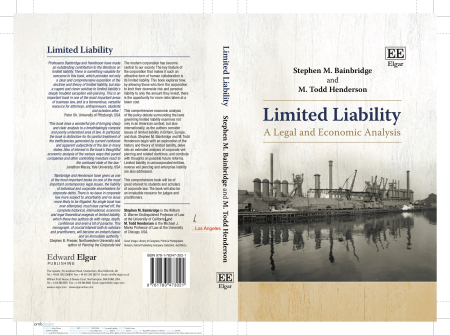
Nouvel ouvrage sur la responsabilité limitée : « Limited Liability: A Legal and Economic Analysis »
Ivan Tchotourian 17 juillet 2016
Stephen Bainbridge et Todd Henderson vont publier au mois de septembre 2016 leur dernier ouvrage portant sur la responsabilité limitée des actionnaires : « Limited Liability: A Legal and Economic Analysis » . Assurément un ouvrage à avoir dans une bibliothèque de droit des affaires !
The modern corporation has become central to our society. The key feature of the corporation that makes it such an attractive form of human collaboration is its limited liability. This book explores how allowing those who form the corporation to limit their downside risk and personal liability to only the amount they invest allows for more risks to be taken at a lower cost.This comprehensive economic analysis of the policy debate surrounding the laws governing limited liability examines limited it not only in an American context, but internationally, as the authors consider issues of limited liability in Britain, Europe and Asia. Stephen Bainbridge and M. Todd Henderson begin with an exploration of the history and theory of limited liability, delve into an extended analysis of corporate veil piercing and related doctrines, and conclude with thoughts on possible future reforms. Limited liability in unincorporated entities, reverse veil piercing and enterprise liability are also addressed. This comprehensive book will be of great interest to students and scholars of corporate law. The book will also be an invaluable resource for judges and practitioners.
À la prochaine…
Ivan Tchotourian
autres publications normes de droit Structures juridiques
Billet d’humeur sur Contact : L’organisation juridique de l’entreprise sociale (2 de 2)
Ivan Tchotourian 15 juillet 2016
Bonjour à toutes et à tous, je viens de publier mon nouveau billet sur le blogue Contact de l’Université Laval : « L’organisation juridique de l’entreprise sociale (2 de 2) ».
Plusieurs organisations juridiques sont susceptibles de soutenir une activité marquée par une finalité environnementale ou sociale. Dans le billet précédent, nous avons présenté l’organisme de bienfaisance, l’organisme à but non lucratif et la coopérative. Je me tourne maintenant vers 2 entreprises à vocation commerciale, mais qui ont quelque chose que les autres n’ont pas: elles ne sont pas exclusivement commerciales.
Se développe aujourd’hui un nouveau type d’entreprise qui, revêtant la forme traditionnelle d’une société par actions, s’en distingue par son objet social et son respect de certains des principes particuliers. La tendance mondiale est en effet à la création de ces entreprises dites «hybrides». De plus, n’oublions pas que les entreprises commerciales traditionnelles à visée lucrative s’ouvrent à la responsabilité sociale des entreprises (RSE). Comme l’affirment certains: «Social entrepreneurship: it’s for corporations too».
À la prochaine…
Ivan Tchotourian
autres publications Gouvernance objectifs de l'entreprise Valeur actionnariale vs. sociétale
Reclaiming the idea of shareholder value
Ivan Tchotourian 13 juillet 2016
Michael J. Mauboussin et Alfred Rappaport ont publié il y a quelques jours un article dans la Harvard Business Review qui revient sur la valeur actionnariale : « Reclaiming the Idea of Shareholder Value ». Les auteurs insistent sur l’importance de définir et de communiquer clairement l’objectif des entreprises.
Corporate governance issues are constantly in the headlines. Activist investors challenge management strategies. Investors and others ask why companies binge on buybacks while skimping on value-creating investment opportunities. But discussions of corporate governance invariably miss the real problem: most public companies have extensive governance procedures but no governing objective. As a result, there is no sound basis for stakeholders, including shareholders, to assess the performance of the company and its executives.
Corporate governance is a system of checks and balances that a company designs to ensure that it faithfully serves its governing objective. The governing objective is the cornerstone upon which the organization builds its culture, communications, and choices about how it allocates capital. Think of it as a clear statement of what a company is fundamentally trying to achieve.
Today there are two camps that aim to define the idea of governing objective, but neither is effective. The first believes the company’s goal is to maximize shareholder value. Countries that operate under common law, including the United States and the United Kingdom, lean in this direction.
The second advocates that the company balance the interests of all stakeholders. Countries that operate under civil law, including France, Germany, and Japan, tend to be in this camp.
À la prochaine…
Ivan Tchotourian
autres publications
Les nouveaux enjeux de la gouvernance d’entreprise
Ivan Tchotourian 13 juillet 2016
The conversation relaie l’introduction de la Conférence internationale de gouvernance CIG 2016 à l’Université de Montpellier : « Gouvernance et gouvernementalité à l’heure du big data : quels enjeux pour les entreprises ? ».
La 15e conférence internationale de gouvernance (CIG 2016) de l’AAIG (Association Académique Internationale de Gouvernance) qui s’est tenue les 17 et 18 mai 2016 à l’IAE de Montpellier a été l’occasion de débattre sur les nouveaux enjeux de la gouvernance d’entreprise. Les chercheurs en gouvernance sont au carrefour de plusieurs disciplines de management.
À l’origine, les recherches en gouvernance se sont principalement appuyées sur la théorie de l’agence (…) et centrées sur la grande entreprise de type managérial, où la relation plus ou moins conflictuelle entre actionnaires et dirigeants est prééminente. Ces problématiques classiques ne sont pas figées, elles sont régulièrement revisitées et restent d’actualité, comme en témoigne l’étendue des sujets abordés lors la CIG 2016, mais aussi l’actualité récente (…).
À la prochaine…
Ivan Tchotourian
autres publications Normes d'encadrement Nouvelles diverses
Européanisation de la gouvernance d’entreprise par la soft law
Ivan Tchotourian 11 juillet 2016
Sur le blogue de l’Université d’Oxford, Idoya Ferrero-Ferrero et Robert Ackrill publie une synthèse de leur dernier article : « Is Europeanization Though Soft-Law a Reality in Corporate Governance Policies? ». La question qu’il aborde est simple mais très pertinente pour les juristes : Est-ce que la soft law européenne en matière de gouvernance d’entreprise fait évoluer les cadres juridiques étatiques (et ce, sans avoir besoin d’édicter des règles contraignantes !) ? La réponse est oui…
Europeanization addresses the impacts of EU membership on national politics and policies, via both the processes by which EU decision-making manifests itself at the national level; and the outcomes of that EU decision-making. Over time, as EU membership and policy scope have expanded, new approaches to policy-making have been developed and, therefore, new channels created by which Europeanization can occur. One such has been the use of ‘soft law’ processes. These have allowed for greater discussion of ‘sensitive’ policy issues, where national policy sovereignty continues to dominate, given that these discussions do not result in legal texts binding on the member states. That said, the purpose of soft law is still to deliver national policy change. Which begs the question – can they work?
À la prochaine…
Ivan Tchotourian
autres publications
Corporate Governance Review d’Osler : un incontournable
Ivan Tchotourian 8 juillet 2016
Le cabinet Osler publie la 6e édition de sa revue de gouvernance d’entreprise : « The Corporate Governance Review ».
Corporate governance practices in Canada are shaped by legal rules, including provincial corporate statutes, securities regulations, stock exchange requirements and the common law, as well as best practices promoted by a range of stakeholders, such as institutional shareholder groups and professional director associations like the Institute of Corporate Directors (ICD). In addition, Canada may be unique in the role that institutional investors play in the development of corporate governance practices. For instance, the Canadian Coalition for Good Governance (CCGG) is a national institutional investor organisation comprised of 49 members that collectively manage nearly C$3 trillion in assets; the CCGG has pursued an organised programme of articulating its views and encouraging best practices generally without resorting to proxy battles.
In the recently released sixth edition of The Corporate Governance Review: Canada, authors Andrew MacDougall, Robert Yalden and John Valley examine the structure of corporate governance in Canada, with sections devoted to corporate leadership, disclosure requirements and corporate responsibility. The report also contains a section on matters related to shareholders, including rights and powers, activism, communication and takeover defences.
Perhaps most relevant is the analysis of the past year’s developments in the area of corporate governance, including the changes to the takeover bid regime, the introduction of the Ontario Securities Commission’s whistle-blowing programme, amendments to the continuous disclosure obligations of ‘venture issuers’ in Canada and the proclamation of Canada’s new Extractive Sector Transparency Measures Act.
À la prochaine…
Ivan Tchotourian