autres publications | Page 14
autres publications engagement et activisme actionnarial Normes d'encadrement
Actions et contrats financiers : un travail prometteur
Ivan Tchotourian 27 mai 2016
M. Romain Dambre propose un bel ouvrage aux éditions Bruylant intitulé : « Les contrats financiers sur actions : Droit français et européen des sociétés ». Un beau sujet que l’auteur aborde !
Les contrats financiers permettent aux parties de façonner le monde à l’image d’un profil de risque optimal : les parties y créent les conditions d’une réalité dérivée, un monde synthétique purgé de risques indésirables. Instruments de transfert de risque, les contrats financiers portent la marque d’une forte abstraction à l’égard du bien sous-jacent. Si les parties peuvent souhaiter fixer les conditions d’un transfert différé de la propriété, elles privilégient souvent la vertu protectrice ou le potentiel spéculatif de ces instruments en considérant les attributs économiques attachés à la propriété du bien sous-jacent plutôt que sa titularité sur le plan juridique.
Se dégage alors une règle d’autonomie du contrat financier à l’égard du bien comme du contrat sous-jacents, justifiée notamment par des considérations d’ordre systémique tenant à la protection des marchés financiers. Cette logique est toutefois mise à l’épreuve au contact du droit des sociétés.
Technique contractuelle de synthétisation de la propriété, le contrat financier opère un hiatus potentiel entre le statut juridique de l’actionnaire et son exposition à l’aléa social, menaçant de ce fait les équilibres traditionnels du droit des sociétés, notamment en termes d’attribution de la qualité d’actionnaire et d’exercice du droit de vote.
Si la règle d’autonomie, bien qu’ébranlée, reste le principe en droit des sociétés, les principes directeurs du droit boursier – Transparence, Égalité, Intégrité – conduisent à y faire exception face aux perturbations engendrées par ces techniques de dissociation de la forme juridique et de la substance économique, que l’on pense aux hypothèses de vote « vide » ou de prises de contrôle rampantes. Aussi la réglementation boursière soumet-elle les contrats financiers sur actions à un régime similaire à celui applicable aux titres financiers sous-jacents, notamment en matière de transparence des participations, d’offre publique et de répression des abus de marché.
À la prochaine…
Ivan Tchotourian
autres publications rémunération
S&P 500 CEO Pay Study
Ivan Tchotourian 26 mai 2016
L’“Associated Press/Equilar S&P 500 CEO Pay Study 2016” vient d’être publié. Since 2011, Equilar has worked together with the Associated Press on various executive compensation studies. This latest version of an ongoing annual study identifies total compensation for 341 CEOs who served in that role at an S&P 500 company for at least two years as of fiscal year-end.
Voici les éléments essentiels :
- Median total compensation* for S&P 500 CEOs in this year’s study totaled $10.8 million. For those executives, the median pay increase was 4.5% from the year prior.
- Of the 341 executives in the study, just 17 were female. However, those female executives earned a median $18.0 million, compared to $10.5 million at the median for the 324 male executives.
- Healthcare companies in the S&P 500 saw the highest pay packages at the median, reaching $14.5 million. Utilities CEOs earned a median $9.3 million, the lowest of the industry sectors in the study.
- CEOs based in New Jersey earned more at the median—$20.7 million—than executives in any other state. New York had the second-highest median CEO pay at $14.5 million. While the number of S&P 500 CEOs varies widely, New Jersey also boasted the sixth-highest number of S&P 500 executives with 14, trailing New York (39), California (36), Texas (36), Illinois (22) and Massachusetts (17).
Vous trouverez une synthèse publiée au Chicago Tribune sous le titre “CEO pay climbs again, even as their stock prices don’t”.
À la prochaine…
Ivan Tchotourian
autres publications normes de marché
En savoir plus sur l’ISR ?
Ivan Tchotourian 25 mai 2016
Bonjour à toutes et à tous, si la problématique si actuelle de l’investissement socialement responsable (ISR) vous intéresse, nul doute que ce bel ouvrage suscitera votre curiosité : « The Routledge Handbook of Responsible Investment » (T. Hebb, J. P. Hawley, A. G.F. HOEPNER, A. L. Neher et D. Wood) chez Routledge.
The UN-supported Principles for Responsible Investment initiative has led to around a third of the world’s financial assets being managed with a commitment to invest in a way that considers environmental, social or governance (ESG) criteria. The responsible investment trend has increased dramatically since the global financial crisis, yet understanding of this field remains at an early stage.
This handbook provides an atlas of current practice in the field of responsible investment. With a large global team of expert contributors, the book explores the impact of responsible investment on key financial actors ranging from mainstream asset managers to religious organizations.
Offering students and researchers a comprehensive introduction to current scholarship and international structures in the expanding discipline of responsible investment, this handbook is vital reading across the fields of finance, economics and accounting.
À la prochaine…
Ivan Tchotourian
autres publications mission et composition du conseil d'administration Normes d'encadrement
Comité de nomination : un intéressant rapport britannique
Ivan Tchotourian 24 mai 2016
En mai 2016, l’Institute of Chartered Secretaries and Administrators (ICSA) a publié avec Ernst & Young un rapport sur le rôle du comité de nomination : « The Nomination Committee – Coming out of the Shadows ».
While its role may be less clearly defined than that of the audit committee, and its profile lower than that of the remuneration committee, it is arguably the most important of the three. It plays a pivotal role in appointing directors to the board and, if the board lacks the right balance, knowledge, skills and attributes, the likelihood of it and its committees operating effectively is greatly reduced.
Concernant sa mission et ses membres, il est précisé les points suivants :
-
What the appropriate role of the committee should be, e.g., whether the committee should look at executive talent if it does not already do so, and whether the board would benefit from combining the committee into a nomination and governance committee.
-
Whether the following processes are clearly linked: the discussion of current board composition and future composition in light of the company’s strategy, the executive and senior talent succession planning and company strategy, the outcome of the board evaluation exercise and board succession plans, and the link between board evaluations and development and training plans.
-
The existence of a two-pronged approach to identify succession plans in both emergency and steady-state situations.
À propos de la planification de la relève et la détection de talent, le rapport mentionne relativement au comité :
-
The extent to which nomination committee looks across the market and internally to identify four or five potential successors to the CEO.
-
How deeply into the organisation the committee should be looking to identify future talent.
-
The best way to develop the skills of future executive leaders in the business.
À la prochaine…
Ivan Tchotourian
autres publications mission et composition du conseil d'administration Normes d'encadrement responsabilisation à l'échelle internationale
Droits de l’homme et CA : un guide en 5 étapes
Ivan Tchotourian 24 mai 2016
L’EHRC vient de publier un guide « Business and human rights – A five-step guide for company boards » bien intéressant pour les CA. Comme le précise ce document : « We recommend that boards should follow five steps to ensure that their company is fulfilling its responsibility to respect human rights in a robust and coherent manner that meets the expectations of the UN Guiding Principles and UK statutory reporting obligations. Boards should be aware of the company’s salient, or most severe, human rights risks, and ensure ».
The following are the five steps that it is recommended boards should follow to ensure that their company is fulfilling its responsibility to meet human rights in a robust and coherent manner that meets the expectations of the UN Guiding Principles and UK statutory reporting obligations:
- the company should embed the responsibility to respect human rights into its culture, knowledge and practices;
- the company should identify and understands its salient, or most severe, risks to human rights;
- the company should systematically address its salient, or most severe, risks to human rights and provide for remedies when needed;
- the company should engage with stakeholders to inform its approach to addressing human rights risks; and
- the company should report on its salient, or most severe, human rights risks and meet regulatory reporting requirements.
Attention : encore une fois, tout cela n’est que du droit international et donc du droit « mou ». Ce guide l’exprime très bien en ces termes : « The Guiding Principles do not create any new international legal obligations on companies, but they can help boards to operate with respect for human rights and meet their legal responsibilities set out in domestic laws ».
À la prochaine…
Ivan Tchotourain
autres publications normes de droit rémunération
Toujours le Dodd-Frank Act !
Ivan Tchotourian 22 mai 2016
Bonjour à toutes et à tous, 6 agences fédérales américaines (dont la SEC) ont publié pour commentaire (jusqu’au 22 juillet 2016) leur proposition de mise en place de l’article 956 du Dodd-Frank Act visant à interdire les rémunérations incitatives qui encourageraient une prise de risque inconsidéré des institutions financières. Ce document est intitulé : « Incentive-based Compensation Arrangements ».
The OCC, Board, FDIC, FHFA, NCUA, and SEC (the Agencies) are seeking comment on a joint proposed rule (the proposed rule) to revise the proposed rule the Agencies published in the Federal Register on April 14, 2011, and to implement section 956 of the Dodd-Frank Wall Street Reform and Consumer Protection Act (Dodd-Frank Act). Section 956 generally requires that the Agencies jointly issue regulations or guidelines: (1) prohibiting incentive-based payment arrangements that the Agencies determine encourage inappropriate risks by certain financial institutions by providing excessive compensation or that could lead to material financial loss; and (2) requiring those financial institutions to disclose information concerning incentive-based compensation arrangements to the appropriate Federal regulator.
À la prochaine…
Ivan Tchotourian
autres publications engagement et activisme actionnarial
Les fonds activistes montent en puissance en Europe
Ivan Tchotourian 21 mai 2016
Le quotidien L’Agefi (ici) nous apprend qu’une étude de Conatus Finance dévoile les grandes tendances de l’activisme des fonds d’investissement européens.
Les fonds d’investissement continuent d’affirmer leur pouvoir d’influence sur les directions des entreprises dont ils sont actionnaires, y compris en Europe, selon une étude réalisée par Conatus Finance. « Le marché de l’activisme est toujours dominé par les gros fonds américains mais deux nouvelles tendances apparaissent », selon l’étude intitulée « Actionnaires actifs: un modèle d’activisme long terme adapté au marché européen ». Ces deux tendances sont résumées ainsi: un renforcement de leur action en Europe et « un focus sur le long terme ».
(…)
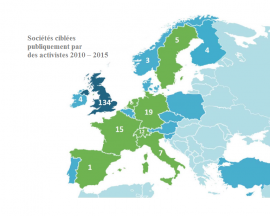
La majorité des fonds européens se concentrent d’avantage sur le long terme que les Etats-Unis mais la plupart des gros fonds activistes de long terme restent américains. En Europe, les sociétés les plus ciblées publiquement par les activistes sont très largement anglaises (134), suivies par les allemandes (19), les françaises (15) et les suisses (12).
À la prochaine…
Ivan Tchotourian