autres publications | Page 28
autres publications engagement et activisme actionnarial normes de marché
Le changement climatique : une nouvelle donne pour les investisseurs
Ivan Tchotourian 24 septembre 2015
Mercer a publié il y a quelques semaines une étude consacrée à l’investissement en période de changement climatique (nous y sommes je crois !) : Mercer, Investing in a Time of Climate Change – 2015 Study, June 2015. De cette étude, il apparaît que les investisseurs institutionnels doivent se montrer vigilants tant l’environnement est devenu pour eux une variable qu’ils doivent prendre en compte lorsqu’ils effectuent des placements.
Morceaux choisis :
Climate change presents risks expected to have their greatest impact in the long term. But to address it, change is needed now. This presents asset owners and investment managers with both risks and opportunities.
Investors have two key levers in their portfolio decisions — investment and engagement. From an investment perspective, resilience begins with an understanding that climate change risk can have an impact at the level of asset classes, of industry sectors and of sub-sectors. Climate-sensitive industry sectors should be the primary focus, as they will be significantly affected in certain scenarios. Investors also have numerous engagement options. They can engage with investment managers and the companies in their portfolio to ensure appropriate climate risk management and associated reporting. They can also engage with policymakers to help shape régulations.
À la prochaine…
Ivan Tchotourian
autres publications mission et composition du conseil d'administration
Quand le CA doit penser activiste
Ivan Tchotourian 22 septembre 2015
Selon une étude du cabinet Norton Rose Fulbright, les CA doivent davantage penser comme les activistes. Tel est le sens d’un article publié dans le Financial Post intitulé « Boards should think more like activist investors: Norton Rose Fulbright » (21 septembre 2015).
Directors are doing a better job when it comes to corporate governance, but that may not be enough to keep activist shareholders at bay, according to a white paper published Monday by law firm Norton Rose Fulbright. Boards have to think more like activists and can do so by focusing on value creation at all times, says the paper, which was produced in collaboration with RBC Capital Markets and The Boston Consulting Group. Directors, many of whom are former executive at other companies, should regularly engage with senior managers to “critically examine” strategy development and value creation alternatives.
À la prochaine…
Ivan Tchotourian
autres publications Nouvelles diverses
Publications des journées internationales de la SLC
Ivan Tchotourian 20 septembre 2015
Bonjour à toutes et à tous, les Journées internationales de la Société de législation comparée ont rassemblé des juristes de toutes professions et de tous horizons autour d’une réflexion sur le passé, le présent, et l’avenir du droit comparé. Le succès de ces Journées a été très grand et la SLC en publie les actes, en plusieurs volumes, composés d’un ouvrage général et des travaux des ateliers . L’ouvrage général constitue un témoignage irremplaçable, non seulement de ces journées, mais aussi de l’évolution du droit comparé et son rôle dans notre société.
Pour en savoir plus sur l’ouvrage, cliquez ici.
Pour en savoir plus sur les journées, cliquez ici.
À la prochaine…
Ivan Tchotourian
autres publications normes de marché
Prise en compte des critères ESG : les mythes s’effondrent
Ivan Tchotourian 18 septembre 2015
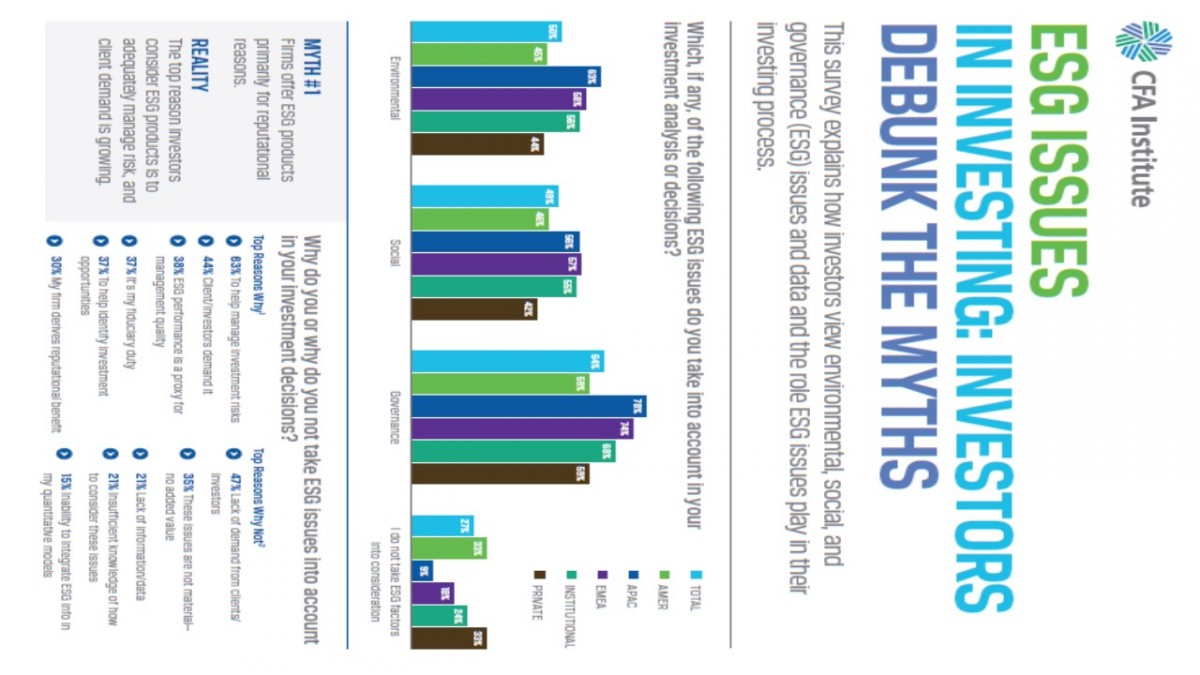
Bonjour à toutes et à tous, intéressante étude publiée à la mi-août par l’IRRC Institute (ESG Issues in Investing: Investors Debunk the Myths) selon laquelle : « Almost Three Quarters of Investment Professionals Use Environmental, Social & Governance Information When Making Investment Décisions. New CFA Institute survey highlights board accountability, human capital and executive compensation as important issues ».
Voici le bilan :
- Risk evaluation: Sixty-three percent of survey respondents said they consider ESG in the investment decision making process to help manage investment risks, 44 percent say that their clients/investors demand it and 38 percent said ESG performance is a proxy for management quality.
- Top three issues in decision-making: Survey respondents ranked board accountability, human capital, and executive compensation as the issues most important to investment analysis and decision-making.
- Regional breakdown: A high proportion of CFA Institute members in the Asia-Pacific region considered ESG issues (78 percent), followed closely by members in the Europe, Middle East, and Africa (EMEA) region (74 percent). Respondents in the Americas region were the least likely to use ESG information in their decision-making process, but, even there, a solid majority (59 percent) do use ESG factors.
- ESG integration in the investment process: Fifty-seven percent of respondents integrate ESG into the whole investment analysis and decision-making process, while 38 percent use best-in-class positive alignment; 36 percent use ESG analysis for exclusionary screening.
- ESG disclosures: Sixty-one percent of survey respondents agreed that public companies should be required to report at least annually on a cohesive set of sustainability indicators in accordance with the most up-to-date reporting framework. In addition, 69 percent of these respondents say ESG disclosures should be subject to independent verification. Furthermore, of these, 44 percent believe that verification at a high level of assurance, similar to an audit, is necessary. Another 46 percent believe limited verification, or a lower level of assurance, is necessary. When this group was asked how much should be spent on independent verification, responses varied from 10 percent to 100 percent of the cost of an audit of financial statements.
À la prochaine…
Ivan Tchotourian
autres publications normes de droit
Les devoirs fiduciaires ouverts à l’ISR
Ivan Tchotourian 15 septembre 2015
Le programme des Nations unies pour l’environnement a publié dans le cadre de ses travaux Inquiry into the Design of a Sustainable Financial System une série de rapports. L’un d’eux nous intéresse tout particulièrement. Il s’agit du rapport « The Fiduciary Duty in the 21st Century » qui explore le contenu des devoirs fiduciaires de manière comparative et qui a démontré qu’il n’y a aucun obstacle pour les fonds d’investissement à investir les champs environnementaux, sociaux et de gouvernance.
Dans ce rapport, les préconisations suivantes sont faites…
In particular, policymakers and regulators should:
Clarify that fduciary duty requires investors to take account of ESG issues in their investment processes, in their active ownership activities, and in their public policy engagement
Strengthen implementation of legislation and codes, clarifying that these refer to ESG issues, and require investor transparency on all aspects of ESG integration, supported by enhanced corporate reporting on ESG issues
Clarify the expectations of trustees’ competence and skill and support the development of guidance on investor implementation processes, including investment beliefs, long- term mandates, integrated reporting and performance
Support efforts to harmonise legislation and policy instruments on responsible investment globally, with an international statement or agreement on the duties that fduciaries owe to their benefciaries. This statement should reinforce the core duties of loyalty and prudence, and should stress that investors must pay attention to long-term investment value drivers, including ESG issues, in their investment processes, in their active ownership activities, and in their public policy engagement
À la prochaine…
Ivan Tchotourian
autres publications mission et composition du conseil d'administration normes de marché
Femmes et CA : les statistiques canadiennes qui tuent !
Ivan Tchotourian 13 septembre 2015
Depuis le 31 décembre 2014, les émetteurs des provinces participantes, à l’exception des émetteurs de la TSX croissance et des fonds d’investissement, sont assujettis à de nouvelles exigences en matière de divulgation de la représentation des femmes dans les conseils d’administration et les postes de cadres supérieurs. Or, que nous apprend la première année d’application du dispositif ?
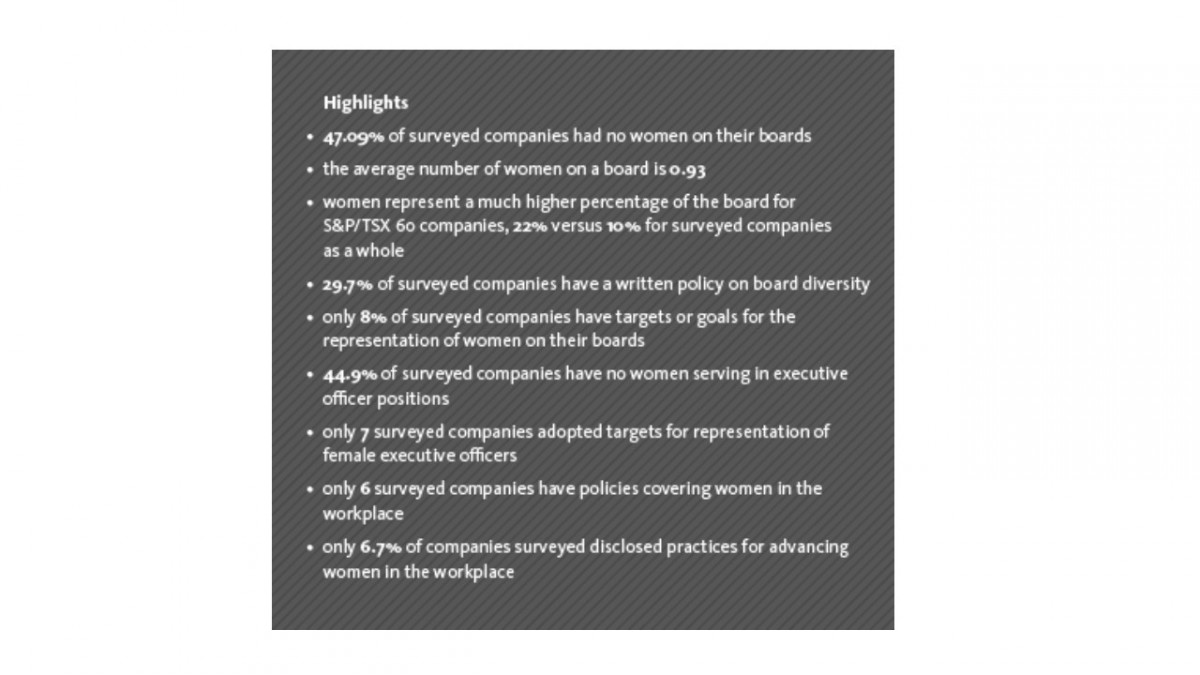
Le cabinet d’avocats Osler vient de publier les résultats d’une étude au bilan peu glorieux : « Le portrait global est décevant » pouvons-nous lire (ici). Vous trouverez en image ci-dessus un résumé de l’étude.
Cette première année d’application des nouvelles exigences en matière de divulgation reflète d’importants exemples de non-conformité, la faible représentation des femmes dans les conseils d’administration et les postes de cadres au sein d’entreprises cotées à la principale Bourse canadienne, et la quasi-inexistence d’objectifs ou de cibles à atteindre en ce qui a trait au nombre de femmes cadres supérieures.
Pour accéder au rapport « Diversity Disclosure Practices » : cliquez ici.
À la prochaine…
Ivan Tchotourian
autres publications Gouvernance
Détention des actions des entreprises britanniques : voulez-vous en savoir plus ?
Ivan Tchotourian 11 septembre 2015
L’Office for National Statistics a publié le 2 septembre 2015 une étude très intéressante intitulée « Ownership of quoted shares for UK domiciled companies, 2014 ».
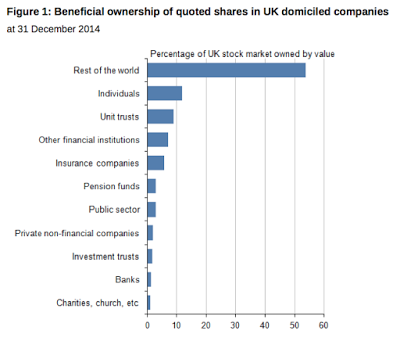
C’est effrayant de constater que la détention la plus importante (en termes de valeur des actions britanniques détenues) relève du reste du monde … « with 54% of the total at the end of 2014, similar to 2012 but higher than the 2010 level of 43%. Individuals owned the next largest proportion of shares at the end of 2014, with 12% of the total, higher than the estimated 10% they held in 2010 and 2012 ». Quant aux pays de provenance des détenteurs, notons que l’Amérique du Nord possède plus de 46 % des actions, suivie par l’Europe (26 %) et l’Asie (16 %).
La synthèse de cette étude est la suivante :
- The broad make-up of share ownership remained the same at the end of 2014 as it was in 2012, with rest of the world investors holding significantly more shares (in terms of value) than any other sector.
- Rest of the world ownership stood at an estimated 54% of the value of the UK stock market at the end of 2014. This was up from 31% in 1998 but unchanged from the 2012 estimate.
- UK individuals owned an estimated 12% of quoted UK shares by value at the end of 2014, an increase from the historic low of 10% in 2010 and 2012.
- Unit trusts held an estimated 9% by value at the end of 2014, slightly down from the 2012 level but still much higher than in 1998, when they only accounted for 2% of share ownership.
- Other financial institutions held an estimated 7% by value at the end of 2014, similar to 2012 but lower than the estimated 12% they held in 2010.
- Insurance companies held an estimated 6% and pension funds an estimated 3% by value at the end of 2014, continuing the downward trends in these sectors seen in recent years.
- The majority of shares by value are held in multiple-ownership pooled accounts, where the beneficial owner is not held centrally and must be established by means of a Companies Act 2006 Section 793 request. As in 2012, these accounted for over half (59%) of the total holdings by value at the end of 2014. Multiple ownership pooled accounts have been allocated to sectors using further analysis of share registers.
- This statistical bulletin provides estimates of holdings of ordinary shares in UK domiciled, quoted companies by sector of beneficial ownership, and also incorporates revisions to the 2012 data originally published in September 2013.
- The beneficial owner is the underlying owner; the person or body who receives the benefits of holding the shares, for example income through dividends (see Annex A for details). Companies included are those which are listed on the London Stock Exchange and are domiciled in the United Kingdom; that is, their country of incorporation is the UK. At the end of 2014, shares in quoted UK domiciled companies were valued at a total of £1.7 trillion.
Pour accéder au rapport en format pdf : cliquez ici.
À la prochaine…
Ivan Tchotourian