autres publications | Page 8
autres publications Nouvelles diverses Structures juridiques
Le non-financier est important pour les institutions financières
Ivan Tchotourian 16 août 2016
Excellent document produit par McKinsey & Company : « Nonfinancial risk: A growing challenge for the bank » (juillet 2016). Ce document rappelle que l’extra-financier est devenu un facteur à gérer par les institutions financières…
Yet the direct financial consequences of non Financial risk (NFR) are not the only concern. The reputational damage wrought can hit a bank hard at a time when customers, shareholders, and public stakeholders are questioning banks’ business models. And there are also the personal consequences for senior managers, whom regulators increasingly hold accountable for misconduct or failure to comply with laws and regulations. All of this, and the prospect of still tighter regulation, puts considerable pressure on banks to manage NFR better.
(…) Against this backdrop, many institutions seek a more integrated NFR-management approach in order to reduce the risk of further failures, meet stakeholders’ requirements and expectations, and limit costs. This article describes the three key components of such an integrated approach: an enhanced governance framework, a set of enablers, and changes in the front office’s approach and mind-set. It is based on our work with many financial institutions globally and an informal survey of 15 global and regional banks. Some of the structures and ideas we outline here are familiar to banks from their work on financial risk; many are newly conceived for the management of nonfinancial risk. Taken together, a full implementation of these concepts represents a paradigm shift in the NFR-management practices of many banks today.
À la prochaine…
Ivan Tchotourian
autres publications Nouvelles diverses
Cartographie des risques 2016 : une photo de l’AMF France
Ivan Tchotourian 16 août 2016
Dans son Risques et tendances n° 17 de juillet 2016, l’AMF France offre une belle cartographie des risques auxquels font face les entreprises et les marchés.
L’AMF a publié sa cartographie 2016 qui constitue un panorama de l’évolution sur un an des risques liés à l’actualité économique, financière et réglementaire. Elle analyse le financement de l’économie, les marchés ainsi que l’épargne des ménages et la gestion collective. Pour sa dixième édition, sa publication intervient quelques jours seulement après le référendum ayant conclu à la sortie du Royaume-Uni de l’Union Européenne qui constitue une décision sans précédent et ouvre une période de fortes incertitudes.
À la prochaine…
Ivan Tchotourian
autres publications
La gouvernance en chiffre (un billet à consommer sans modération !)
Ivan Tchotourian 10 août 2016
Mon collègue Jacques Grisé publie sur son blog un billet très intéressant tiré du Harvard Law School Forum (Corporate Governance by the Numbers de Ann Yerger, EY Center for Board Matters) : « La gouvernance en chiffre ».
Ce billet présente les principales données sur la gouvernance des sociétés américaines en les présentant sous forme chiffrée. L’auteur a compilé les données de plus de 3 000 sociétés publiques aux États-Unis, en les présentant selon les 5 indices les plus importants : S&P 500, S&P MidCap 400, S&P SmallCap 600, S&P 1500 et Russell 3000.
À la prochaine…
Ivan Tchotourian
autres publications Gouvernance mission et composition du conseil d'administration normes de droit
Fraude et corruption : synthèse de Deloitte
Ivan Tchotourian 10 août 2016
L’organisation moyenne perd chaque année 5 % de ses revenus en raison de la fraude et de la corruption, selon l’Association of Certified Fraud Examiners. Il n’est pas surprenant que les organismes de réglementation à l’échelle mondiale se concentrent de plus en plus sur la fraude et s’attendent à ce que les organisations mettent en œuvre des programmes efficaces de lutte contre la fraude. En outre, ces organismes accroissent leur coopération pour mettre en œuvre des lois anticorruption grâce auxquelles les coupables sont poursuivis pour leurs actes, y compris les dirigeants et les administrateurs qui sont responsables de l’environnement dans lequel ces crimes se produisent.
En cas de fraude ou de corruption, les administrateurs peuvent être tenus personnellement responsables s’il est démontré qu’ils n’ont pas fait preuve de la diligence voulue dans le cadre de leurs responsabilités visant la mise en œuvre des programmes et des contrôles appropriés de lutte contre la fraude et la corruption.
Votre conseil d’administration a-t-il une bonne compréhension des risques liés à la fraude et à la corruption? Quelles mesures votre organisation devrait-elle prendre pour les atténuer?
Dans son À l’ordre du jour du conseil de juillet 2016, Deloitte propose une revue des « Programmes efficaces de lutte contre la fraude et la corruption ».
À la prochaine…
Ivan Tchotourian
autres publications Gouvernance Normes d'encadrement
Comparer la gouvernance d’entreprise : étude de Martin Gelter
Ivan Tchotourian 4 août 2016
Martin Gelter (professeur à Fordham) nous offre un très bel article « Comparative Corporate Governance: Old and New » pour le compte de l’ECGI (Law Working Paper No. 321/2016). Si vous vous intéressez à la comparaison en matière de gouvernance d’entreprise, c’est un incontournable !
The most fundamental comparative corporate governance debates have often focused on two issues.
The first one concerns ownership structure: Why are large corporations in some corporate governance system owned by a multitude of disempowered shareholders, thus effectively giving management free rein? Why are corporations typically governed by a controlling shareholder or a coalition of controlling shareholders in other systems?
The second issue is the role of other ‘constituencies’ of the corporation besides shareholders, of which labor is most central to the debate. Some jurisdictions explicitly give labor an influential voice in corporate affairs, whereas in others its influence is developed through factual power or unintended consequences of legislation.
This chapter explores the interactions between firm ownership and labor, focusing on the United States on the one hand and Continental Europe, particularly Germany, on the other. It distinguishes between ‘old’ and ‘new’ comparative corporate governance, the former referring to the dichotomy studied by scholars of comparative corporate law up to the early 2000s. Recent changes, heralded by intermediated, but widespread share ownership are leading us to a new equilibrium whose contours have only begun to emerge.
Over the past decades, outside investors have gained power both in the United States and in Continental Europe. However, neither in the US nor in Continental Europe has the traditional corporate governance system been completely superseded by a new one. The US remains to a large extent manager-centric. Continental Europe retains powerful large shareholders, and labor as an independent force has remained more important than in the United States. Outside institutional investors – sometimes from the US – have become a player to be reckoned with, thus adding an additional layer of complexity to the system.
À la prochaine…
Ivan Tchotourian
autres publications Nouvelles diverses
Nouvel ouvrage : « Economics of corporate law »
Ivan Tchotourian 4 août 2016
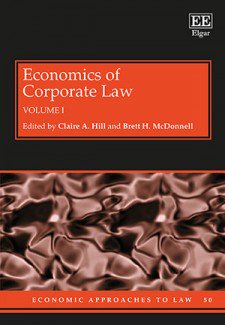
Bonjour à toutes et à tous, je vous signale la parution de ce nouvel ouvrage liant droit des sociétés par actions et analyse économique : « Economics of Corporate Law – Economic Approaches to Law series » (Edward Elgar Publishing, 2016).
Scholarly analysis of corporate law in the United States has come to be dominated by an economic approach. Professor Hill and Professor McDonnell here draw together seminal articles which represent major milestones along the road that economics has traveled in coming to play this central role in corporate law scholarship. The focus is on the analysis of corporate law, drawing mainly upon legal scholarship and particularly on US scholarship, which is the originator of the application of modern economic analysis to corporate law and has had much influence in other countries.
À la prochaine…
Ivan Tchotourian
autres publications Gouvernance normes de droit Nouvelles diverses
Rapport 2016 de PWC sur le crime économique
Ivan Tchotourian 3 août 2016
Belle étude annuelle de Pwc consacrée à la criminalité économique : « Global Economic Crime Survey 2016 – Adjusting the Lens on Economic Crime: Preparation brings opportunity back into focus ».
Today more than ever before, a passive approach to detecting and preventing economic crime is a recipe for disaster. To underscore this fact, our survey uncovered a widespread lack of confidence in local law enforcement – a phenomenon that is not limited to regions or level of economic development. The message is clear: the burden of preventing, protecting and responding to economic crime rests firmly with organisations themselves. Our survey this year focuses on three key areas – Cybercrime, Ethics and compliance programmes and Anti-Money Laundering – and explores certain common themes, including managing the risks associated with the pervasion of technology; what it means to conduct business responsibly across a widening business landscape; and integrating ethical conduct into decision-making.
In addition to highlighting specific areas of economic crime worth focusing on, we emphasise the things you can do better to tackle them – implementing more sophisticated and effective measures that can not only reduce these risks, but also bring the benefits of a more threat-aware business, confident of its defences in a changing world.
À la prochaine…
Ivan Tchotourian