autres publications | Page 9
autres publications Gouvernance Normes d'encadrement
Une politique ambitieuse de Vigeo
Ivan Tchotourian 3 août 2016
Alors que le changement climatique est sur le devant de la scène et que les entreprises et les investisseurs ne peuvent l’ignorer, l’agence de notation extra-financière Vigeo a publié le 12 janvier 2016 une politique ambitieuse intitulé « Post COP21: How well companies & investors are positioned to respond to climate change » (Policy Briefing, Climate Change & Transition to a Low Carbon Economy). Ce document rappelle haut et fort que le changement climatique est une affaire d’entreprise et d’investisseur !
Investors have already played a key role in bringing about COP21, and in the post COP21 landscape, investors are vital to ensure meaningful results.
No doubt initiatives such as the Montreal Pledge, the RE100 investor initiative, investor campaigns on stranded assets, and the plethora of events both before and during COP21, demonstrated to governments investor will and thought-leadership here. The growing corporate-investor-government nexus whereby some companies are calling for a credible carbon price/tax is significant.
The importance of incentives for emissions reduction activities are recognised in the Agreement preamble, including domestic policies and carbon pricing.16 These calls to action will drive forward collective performance on climate change, in addition to the ongoing pressure investors can put on companies through the investment process.
Responsible investment plays a leading role in highlighting companies’ exposure to the risks of climate change and evaluating their capacity to mitigate them. Analyses from research intermediaries such as Vigeo Eiris can help investors to understand and better manage these mounting climate change risks.
At present, only a small proportion of companies are found to have an advanced response to climate change and energy transition. To drive forward performance, companies could be encouraged to tie Board-level remuneration to climate change targets. Corporate reporting could be improved, particularly through use of quantitative assessments, and companies should be encouraged to report on the impact of the whole product lifecycle on emissions. There is also room for much greater corporate acknowledgement of the policy context.
À la prochaine…
Ivan Tchotourian
autres publications engagement et activisme actionnarial Nouvelles diverses
Exit, Voice and Loyalty from the Perspective of Hedge Funds Activism in Corporate Governance
Ivan Tchotourian 3 août 2016
Bonjour à toutes et à tous, en voilà un bel article ! « Exit, Voice and Loyalty from the Perspective of Hedge Funds Activism in Corporate Governance » d’Alessio Pacces (Law Working Paper No. 320/2016) revient sur les thématiques de l’activisme des hedge funds, du court-termisme et des multiples classes d’actions.
This article discusses the policy response to hedge funds activism in corporate governance based on Hirschman’s classic: Exit, Voice and Loyalty. From that perspective, the article argues that hedge funds do not create the loyalty concerns underlying the usual short-termism critique of hedge funds activism, because the arbiters of such activism are typically indexed funds, which cannot choose short-term exit. Nevertheless, the voice activated by hedge funds can be excessive for a particular company.
Furthermore, this article claims that the short-termism debate cannot shed light on the desirability of hedge funds activism. Neither theory nor empirical evidence can tell whether hedge funds activism systematically leads to short-termism or whether its absence lead management to the opposite bias, namely long-termism. The real issue with activism is a conflict of entrepreneurship, namely a conflict between the opposing views of the activists and the incumbent management regarding in how long an individual company should be profitable. Leaving the choice between these views to institutional investors is not efficient for every company at every point in time.
Consequently, this article argues that regulation should enable individual companies to choose whether to encourage or to curb hedge funds activism depending on the efficient time-horizon given the firm’s lifecycle. The recent European experience reveals that loyalty shares enable such choice, even in the midstream, operating as dual-class shares in disguise. However, loyalty shares can often be introduced without institutional investors’ consent. This outcome could be improved by allowing dual-class recapitalizations, instead of loyalty shares, but only with a majority of minority vote. This solution would screen for the companies for which temporarily curbing activism is efficient, and induce these companies to negotiate sunset clauses with institutional investors.
À la prochaine…
Ivan Tchotourian
autres publications Nouvelles diverses
ESG Spotlight : A new era for data privacy? (billet de Julie Bernard)
Julie Bernard30 juillet 2016
Bonjour à toutes et à tous, l’agence de notation extrafinancière Sustanalytics vient tout juste de sortir un nouveau rapport dans le cadre de la série ESG Spotlight : « ESG Spotlight | A new era for data privacy? ».
En voici un résumé :
Sustainalytics’ new ESG Spotlight Series report, A New Era for Data Privacy?, considers the impacts of the new Privacy Shield agreement, which was approved by the EU member states last Friday, on US IT companies. Our research shows that US IT companies generally are poorly prepared to meet rising regulatory requirements from Privacy Shield and the General Data Protection Regulation (GDPR).
Bonne lecture !
Julie Bernard, MAP, Adm.A
Étudiante au doctorat (PhD) en sciences de l’administration (Management)
Faculté des sciences de l’administration
Université Laval
autres publications Nouvelles diverses
An Effective Compliance and Ethics Program is key
Ivan Tchotourian 30 juillet 2016
Intéressant document de la Securities and Exchange Commission en matière de criminalité économique : « 2014 GUIDELINES MANUAL – CHAPTER EIGHT – SENTENCING OF ORGANIZATIONS ».
These guidelines of the U.S. Sentencing Commission (Chapter 8) offer incentives to organizations to reduce and ultimately eliminate criminal conduct by providing a structural foundation from which an organization may self-police its own conduct through an effective compliance and ethics program. The prevention and detection of criminal conduct, as facilitated by an effective compliance and ethics program, will assist an organization in encouraging ethical conduct and in complying fully with all applicable laws.
In regard to ‘economic criminality’, however defined, it is equally crucial that regulators across the globe push and pull robustly and cooperatively for effective compliance and ethics programs within industries. Without regulatory/supervisory efforts (a situation that is a systemic risk by itself), ‘economic criminality’ will be nothing more than an academic subject of theoretical interest without any consumer protection values whatsoever. That may well be where the next financial crisis lies. Only the future will tell.
À la prochaine…
Ivan Tchotourian
autres publications Gouvernance Nouvelles diverses
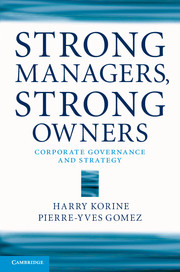
Strong managers, strong owners : un ouvrage pour cet été ?
Ivan Tchotourian 28 juillet 2016
Harry Korine et Pierre-Yves Gomez ont publié un ouvrage qui vient de rejoindre ma bibliothèque : « Strong Managers, Strong Owners: Corporate Governance and Strategy » (Cambridge University Press, décembre 2013).
The family firm preparing generational change, the partnership that welcomes new partners, and the shareholders of a firm that chooses to go public are making decisions that will have an impact on strategy and management. Conversely, a change in strategy such as a move to diversify or a decision to take on more risk in a business can make the firm more attractive to some shareholders and less attractive to others and is therefore not ownership neutral. Opening the black box of agency theory, Korine and Gomez show how management and ownership interact to shape the strategy of the firm. In their view, the critical question to ask is not what is the best strategy, but rather, who is the strategy for? With numerous detailed examples, Strong Managers, Strong Owners is an invaluable resource for company owners, board members and executives, as well as their advisors in strategy and governance.
Voici la table des matières :
Part I. Changes in the Identity of Ownership and Management:
1. Change in ownership
2. Change in management
Concluding remarks
Part II. Changes in the Form of Ownership and Organization:
3. Change of legal structure
4. Change of organizational structure
Concluding remarks
Part III. Changes in Strategy:
5. Corporate and business strategies
6. Despite failure, NO change in ownership, management, or strategy
7. Because of success, reinforcement of ownership, management, and strategy
Concluding remarks
Part IV. Implications for Corporate Governance:
8. The board of directors
Conclusion – strategy for whom?
À la prochaine…
Ivan Tchotourian
autres publications Nouvelles diverses
Bientôt un nouvel ouvrage : The Oxford Handbook of Corporate Law and Governance
Ivan Tchotourian 27 juillet 2016
Voilà un ouvrage que tous les spécialistes vont bientôt s’arracher : « The Oxford Handbook of Corporate Law and Governance » (Oxford University Press, à paraître dans quelque temps).
Corporate law and corporate governance have been at the forefront of regulatory activities across the world for several decades now, and are subject to increasing public attention following the Global Financial Crisis of 2008. The Oxford Handbook of Corporate Law and Governance provides the global framework necessary to understand the aims and methods of legal research in this field.
Written by leading scholars from around the world, the Handbook contains a rich variety of chapters that provide a comparative and functional overview of corporate governance. It opens with the central theoretical approaches and methodologies in corporate law scholarship in Part I, before examining core substantive topics in corporate law, including shareholder rights, takeovers and restructuring, and minority rights in Part II. Part III focuses on new challenges in the field, including conflicts between Western and Asian corporate governance environments, the rise of foreign ownership, and emerging markets. Enforcement issues are covered in Part IV, and Part V takes a broader approach, examining those areas of law and finance that are interwoven with corporate governance, including insolvency, taxation, and securities law as well as financial regulation.
The Handbook is a comprehensive, interdisciplinary resource placing corporate law and governance in its wider context, and is essential reading for scholars, practitioners, and policymakers in the field.
À la prochaine…
Ivan Tchotourian
autres publications mission et composition du conseil d'administration Normes d'encadrement Nouvelles diverses place des salariés
Système allemand de codétermination : un modèle exportable ?
Ivan Tchotourian 22 juillet 2016
Alors que Theresa May a fait part de son intérêt d’importer en Grande-Bretagne le système allemand, MM. Horst Eidenmüller, Mathias Habersack, Caspar Behme et Lars Klöhn reviennent sur la pertinence de cette proposition en jetant un regard prudent (de chercheurs !) sur ce système : « Corporate Co-Determination German-Style as a Model for the UK? » (18 juillet 2016).
On 13 July 2016, Theresa May took up office as Prime Minister of the United Kingdom. Only shortly before, she had made headlines when she proposed to adopt European-style worker representation on the boards of leading companies.
Corporate co-determination hence seems to gain a certain degree of popularity with the British government – which is highly astonishing, considering that it was the UK which most fiercely fought against co-determination on a European level. It was mainly the diverging views of the UK and Germany on co-determination which have thwarted projects like the Draft Fifth Company Law Directive or the establishment of a European Private Company (Societas Privata Europaea, SPE). It is downright ironic that while the UK now shows an interest in co-determination, the concept is being questioned in Germany after decades of lying dormant. The reason for the new German discussion of co-determination are doubts regarding the compatibility of its specific form of co-determination with higher-ranking Union law. This post provides a brief overview of the most recent developments in German co-determination law that were the focus of a joint Oxford/Munich conference at the Ludwig-Maximilians-Universität (LMU) in Munich in March 2016.
À la prochaine…
Ivan Tchotourian