engagement et activisme actionnarial normes de droit objectifs de l'entreprise
Actionnaires-investisseurs et dirigeants : des tensions (exemple du droit)
Ivan Tchotourian 30 juillet 2016
La Cour de cassation a donné raison à Eurazeo qui avait licencié pour faute lourde, donc sans droit à indemnités de rupture, Philippe Guillemot, ancien patron d’Europcar… Depuis la crise financière de 2008, les fonds se posent en investisseurs « actifs ».
Les conflits entre les fonds d’investissement actionnaires des entreprises et leurs dirigeants sont courants dans les LBO (rachats d’entreprise par la dette) et, depuis la crise financière de 2008, les premiers n’hésitent plus à évincer les seconds quand les résultats ne sont pas au rendez-vous.
À la prochaine…
Ivan Tchotourian
autres publications Gouvernance objectifs de l'entreprise Valeur actionnariale vs. sociétale
Reclaiming the idea of shareholder value
Ivan Tchotourian 13 juillet 2016
Michael J. Mauboussin et Alfred Rappaport ont publié il y a quelques jours un article dans la Harvard Business Review qui revient sur la valeur actionnariale : « Reclaiming the Idea of Shareholder Value ». Les auteurs insistent sur l’importance de définir et de communiquer clairement l’objectif des entreprises.
Corporate governance issues are constantly in the headlines. Activist investors challenge management strategies. Investors and others ask why companies binge on buybacks while skimping on value-creating investment opportunities. But discussions of corporate governance invariably miss the real problem: most public companies have extensive governance procedures but no governing objective. As a result, there is no sound basis for stakeholders, including shareholders, to assess the performance of the company and its executives.
Corporate governance is a system of checks and balances that a company designs to ensure that it faithfully serves its governing objective. The governing objective is the cornerstone upon which the organization builds its culture, communications, and choices about how it allocates capital. Think of it as a clear statement of what a company is fundamentally trying to achieve.
Today there are two camps that aim to define the idea of governing objective, but neither is effective. The first believes the company’s goal is to maximize shareholder value. Countries that operate under common law, including the United States and the United Kingdom, lean in this direction.
The second advocates that the company balance the interests of all stakeholders. Countries that operate under civil law, including France, Germany, and Japan, tend to be in this camp.
À la prochaine…
Ivan Tchotourian
objectifs de l'entreprise Structures juridiques Valeur actionnariale vs. sociétale
Des entreprises progressistes… vraiment ?
Ivan Tchotourian 27 juin 2016
« Faire de l’entreprise un bien commun » ? 18% des dirigeants d’entreprise annoncent aujourd’hui cet objectif comme prioritaire, selon le récent sondage réalisé par Opinion Way pour l’association Entreprise et Progrès et Generali * sur le thème « Les entreprises françaises sont-elles progressistes ? ».
L’enquête qui se penche sur l’évolution de l’implication des chefs d’entreprise en matière de RSE met aussi en relief un décalage entre deux perceptions : quand 89% des dirigeants estiment devoir placer l’impact sociétal de leur activité au même plan que la performance économique, les Français interrogés jugent _ quasiment dans les mêmes proportions (81%) _ que l’entreprise… reste uniquement tournée vers la rentabilité.
Pour celles et ceux que le mouvement progressistes intéressent, plusieurs juristes de renom s’y intéressent :
- Claude Champaud, dir, L’entreprise dans la société du 21e siècle, Bruxelles, Larcier, 2013; Claude Champaud, Manifeste pour la doctrine de l’entreprise : Sortir de la crise du financialisme, Bruxelles, Larcier, 2011.
- Isabelle Corbisier, « L’entreprise : Quelles sont ses valeurs fondatrices et ses finalités ? » dans Nicolas Thirion, dir, Crise et droit économique, Bruxelles, Larcier, 2014, 175 et aussi Isabelle Corbisier, La société : contrat ou institution ? Droits étatsuniens, français, belge, néerlandais, allemand et luxembourgeois, Bruxelles, Larcier, 2011.
- Simon Deakin, « The Juridical Nature of the Firm » dans Thomas Clarke et Douglas Branson, dir, The SAGE Handbook of Corporate Governance, Londres, SAGE, 2012, 113.
- Kent Greenfield, « Saving the World With Corporate Law » (2008) 57 Emory LJ 947; Kent Greenfield, « New Principles for Corporate Law » (2005) 1 Hastings Bus LJ 87.
- Andrew R Keay, The Corporate Objective: Corporations, Globalisation and the Law, Cheltenham, Edward Elgar, 2013.
- Catherine Malecki, Responsabilité sociale des entreprises : Perspectives de la gouvernance d’entreprise durable, Paris, LGDJ, 2014.
- David K Millon, « Why Is Corporate Management Obsessed with Quarterly Earnings and What Should be Done About It? » (2002) 70 Geo Wash L Rev. 890; David K Millon, « New Directions in Corporate Law: Communitarians, Contractarians, and Theorisis in Corporate Law » (1993) 50 Wash. & Lee L Rev 1373 ; David K Millon, « Redefining Corporate Law » (1991) 24 Ind L Rev 233; David K Millon, « Theories of the Corporation » (1990) 39 Duke LJ 201.
- Lawrence E Mitchell, Corporate Irresponsibility: America’s Newest Export, New Haven, Yale University Press, 2001 ; Lawrence E Mitchell, dir, Progressive Corporate Law, Boulder, Westview Press, 1995.
- Beate Sjåfjell et Benjamin Richardson, Company Law and Sustainability: Legal Barriers and Opportunities, New York, Cambridge University Press, 2015 et Beate Sjåfjell, Towards A Sustainable EU Company Law: A Normative Analysis of the Objectives of EU Law, with the Takeover Directive as a Test Case, European Company Law Series, Kluwer Law International, 2009.
- Lynn A Stout, The Shareholder Value Myth, San Francisco, Berrett-Koehler, 2012 ; Lynn A Stout, « Why We Should Stop Teaching Dodge v. Ford » (2008) 3:1 Va L & Bus Rev 163 ; Lynn A Stout, « Takeovers in the Ivory Tower: How Academics Are Learning Martin Lipton May be Right » (2005) 60 Bus Lawyer 1435 ; Lynn A Stout, « Share price as a Poor Criterion for Good Corporate Law » (2005) UCLA School of Law Document de travail No 05-7, en ligne: <http://papers.ssrn.com/abstract=660622> ; Lynn A Stout, « Bad and Not-So-Bad Arguments for Shareholder Primacy » (2002) 75:5 S Cal L Rev 1189.
- Alain Supiot, La gouvernance par les nombres, Paris, Éditions Fayard, 2015 ; Alain Supiot, dir, L’entreprise dans un monde sans frontières – Perspectives économiques et juridiques, Collection les sens du droit, Paris, Éditions Dalloz, 2015.
À la prochaine…
Ivan Tchotourian
Gouvernance objectifs de l'entreprise Valeur actionnariale vs. sociétale
The price of profits : à lire absolument !
Ivan Tchotourian 22 juin 2016
« The American corporation has been transformed by globalization and new technology. But equally powerful is the belief on Wall Street and in boardrooms that the sole responsibility of a corporation is to maximize profits for its shareholders ». Ce résumé du rapport de Marketplace « The price of profits » illustre parfaitement les 5 beaux chapitres (pas trop longs et accessibles à tout public) qu’il nous est donné de lire. Revoilà la primauté de la valeur actionnariale sur le devant de la scène pour être critiquée…
Listen to business news on cable TV, and you’ll hear bankers, fund managers and CEOs talk about a corporation’s legal responsibility to “maximize shareholder value.” The idea that the product of a corporation is profits is gospel. It’s taught in business school. But it’s not true.
(…) If jobs were the first target, how to spend a company’s profits was next. A corporation can invest in itself and grow or — what? Giant investment funds pressed for higher returns — higher share prices. An increasingly favorite strategy was to spend profits buying back the company’s own shares. It was financial engineering: fewer shares, higher share price.
The former corporate raider Carl Icahn, for example, started buying shares of Apple in 2013, and eventually owned more than 50 million, nearly 1 percent. He pressured Apple to buy back shares — and Apple is spending more than $100 billion doing so.
Icahn sold his shares this spring. Economist William Lazonick, the author of a shareholder-value analysis, “Profits Without Prosperity,” noted that Icahn was a share-renter, not a shareholder. He never invested a dollar in Apple itself.
Icahn said his investment in Apple shares netted him $2 billion. Apple? Its shares are below what the company paid for them. So far, Apple is a loser.
À la prochaine…
Ivan Tchotourian
autres publications Normes d'encadrement objectifs de l'entreprise Valeur actionnariale vs. sociétale
La valeur actionnariale au rancart !
Ivan Tchotourian 31 mai 2016
Belle tribune de la professeure Lynn A Stout : « The Myth of Maximizing Shareholder Value » (OpenEdNew, 23 mai 2016).
By the end of the 20th century, a broad consensus had emerged in the Anglo-American business world that corporations should be governed according to the philosophy often called shareholder primacy. Shareholder primacy theory taught that corporations were owned by their shareholders; that directors and executives should do what the company’s owners/shareholders wanted them to do; and that what shareholders generally wanted managers to do was to maximize « shareholder value, » measured by share price. Today this consensus is crumbling. As just one example, in the past year no fewer than three prominent New York Times columnists have published articles questioning shareholder value thinking. Shareholder primacy theory is suffering a crisis of confidence. This is happening in large part because it is becoming clear that shareholder value thinking doesn’t seem to work, even for most shareholders.
Je vous laisse lire la suite…
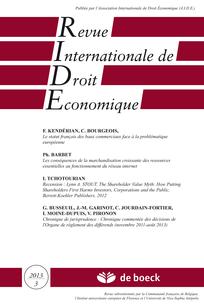
Pour rappel, j’avais eu l’occasion de faire une recension du très bel ouvrage de Lynn A Stout dans la Revue international de droit économique – 2013/3 ((t. XXVII)) – : ici.
Lynn A. STOUT, The Shareholder Value Myth: How Putting Shareholders First Harms Investors, Corporations and the Public, Berrett-Koehler Publishers, 2012
1 – Un sujet d’une grande actualité
2 – Remise en cause de la norme de primauté actionnariale
3 – Les actionnaires d’aujourd’hui
4 – Mise en perspective de l’ouvrage
À la prochaine…
Ivan Tchotourian
objectifs de l'entreprise Structures juridiques
Retour sur l’entreprise : un bien commun
Ivan Tchotourian 26 mai 2016
Bonjour à toutes et à tous, je vous signale cet édito dans Les Échos de M. Denis Terrien intitulé : « Faire de l’entreprise un bien commun ». Je ne peux que partager ce qui est exprimé d’autant que mes écrits y sont pour une grande part consacrés !
Petit extrait :
Depuis le boycott par des consommateurs anglais du sucre de canne des Caraïbes produit par des esclaves au XVIIIe siècle, l’affaire est entendue. Aux yeux d’un consommateur responsable, la mission de l’entreprise ne se réduit pas à engranger des bénéfices. Une entreprise est un créateur essentiel de richesse et de progrès, mais elle ne peut pas fonctionner comme si les conséquences de son activité pouvaient être cantonnées en son sein, comme si une paroi étanche existait entre le dedans et le dehors, comme si elle pouvait supprimer ses externalités négatives.
A l’intérieur et à l’extérieur de son périmètre, des parties prenantes, toujours plus nombreuses, se mobilisent pour défendre à la fois leurs intérêts particuliers et leur conception de l’intérêt général. La prise en compte et la convergence de ces aspirations multiples forment ce qu’on appelle depuis cinquante ans la responsabilité sociétale de l’entreprise (RSE). Avant de devenir la règle, grâce à la vision de certains dirigeants visionnaires, elle a longtemps été traitée avec dédain, désinvolture ou opportunisme.
A la prochaine…
Ivan Tchotourian
mission et composition du conseil d'administration objectifs de l'entreprise
Les P-DG vont-ils parler de plus en plus de RSE ?
Ivan Tchotourian 22 mai 2016
Les P-DG devraient investir davantage le terrain de la RSE dans leur déclaration. C’est en substance ce que l’on apprend d’un article du Wall Street Journal intitulé : “Salesforce’s Marc Benioff has kicked off new era of corporate social activism” (2 mai 2016).
Mr. Benioff is among CEOs of companies, including Apple Inc., Bank of America Corp., Walt Disney Co., Intel Corp. and International Business Machines Corp., that have begun pressuring lawmakers on social issues, often with a warning: Change laws or risk losing business.
That is a departure from the past, when U.S. CEOs often avoided weighing in on social issues lest they incur backlash from shareholders, customers and other constituents.
Now, the risk may be in not speaking up. “Our jobs as CEOs now include driving what we think is right,” says Bank of America CEO Brian Moynihan. “It’s not exactly political activism, but it is action on issues beyond business.
À la prochaine…
Ivan Tchotourian