engagement et activisme actionnarial | Page 18

engagement et activisme actionnarial Gouvernance

Shareholder Engagement: An Evolving Landscape

Les actionnaires sont de plus en plus activistes. Résultats ? Les entreprises doivent se préparer à être réceptives à l’engagement dont il va falloir faire preuve. Ce billet de Tom Johnson et Abernathy MacGregor « Shareholder Engagement: An Evolving Landscape » détaille les bonnes pratiques à développer.


When active shareholder engagement works, it leads to a productive dialogue with the voters—the governance departments established by the big institutional firms, which typically oversee proxy voting. It is important to remember the reality of public company ownership. The vast majority of public companies have shareholder bases dominated by a diverse set of large, institutional funds. Engagement with these voters not only helps head off potential problems and activists down the road, but it also gives management valuable insight into how patient and supportive their shareholder base is willing to be as they implement strategies designed to generate long-term growth. Indeed, the rising level of engagement is a positive trend that could, over time, help mitigate the threat of activism if properly managed.

This all sounds encouraging in theory and, in some cases, it works in practice as well. But the simple fact remains that this kind of dialogue is unobtainable for the vast majority of public companies, despite the best of intentions on both sides.


Dans ce qui ne va pas, notons :

1. If a meeting is unlikely, make your case in other ways

2. Know when to make contact

3. Know who to talk to

4. Don’t assume passive investors are passive

5. Choose the best messenger

6. Be prepared and walk in with a clear set of goals


À la prochaine…

Ivan Tchotourian

autres publications engagement et activisme actionnarial Gouvernance normes de droit

Billet d’humeur sur Contact : les actionnaires sont-ils à blâmer ?

Bonjour à toutes et à tous, je viens de publier sur un de mes derniers billets publiés sur le blogue Contact de l’Université Laval : « Les actionnaires sont-ils diaboliques ». La saga de Bombardier venant de se terminer, une lecture de ce billet vous démontrera toute sa pertinence…


Si cette question peut surprendre et heurter, elle n’en demeure pas moins très actuelle. Beaucoup d’experts en gouvernance d’entreprise se déchirent en cherchant à confirmer ou à infirmer la thèse voulant que le court-termisme – que les entreprises sont accusées de propager – trouve sa source dans le comportement des actionnaires et la trop grande concentration des juristes sur leur situation. Vrai ou faux, le raccourci est souvent fait de considérer les actionnaires comme animés par un seul et unique objectif : s’assurer que l’entreprise dans laquelle ils ont investi génère toujours plus de bénéfices ! Le professeur de droit américain Stephen M. Bainbridge écrit dans un ouvrage consacré à la gouvernance d’entreprise que : « […] to the extent corporate governance contributed to the financial crisis, it did so because shareholders are already too strong, not because they were too weak » (S. M. Bainbridge, Corporate Governance after the Financial Crisis, New York, Oxford University Press, 2012, à la p. 253)


Alors, les actionnaires sont-ils si diaboliques ? Méritent-ils l’opprobre ? C’est sur interrogation que le présent billet se penche à travers 3 constatations :

  1. Les actionnaires sont (en réalité) multiples.
  2. Les actionnaires sont (qu’on le veuille ou non) indispensables.
  3. Les actionnaires sont (parfois) court-termistes.


Petit extrait pour les juristes :


Les juristes reconnaissent l’importance des actionnaires en sécurisant leur position et leur investissement. Les multiples scandales corporatifs survenus depuis le début des années 2000 ont rappelé la nécessité d’assurer une protection adéquate des actionnaires. Au bout du compte, c’est la confiance des investisseurs et des marchés qui est en jeu. À ce titre:

  • Le droit limite la responsabilité des actionnaires à ce qu’ils ont investi dans l’entreprise, et il importe de garder en mémoire que cette responsabilité ne joue que dans le cas où une entreprise serait dissoute et liquidée. Attention toutefois, ce n’est pas pour autant que les actionnaires sont irresponsables dès lors qu’ils commettent une fraude ou qu’ils se montrent négligents.
  • Le droit reconnaît aux actionnaires divers droits, tantôt fondamentaux (droit de voter, droit de participer au partage des dividendes et du reliquat de l’actif), tantôt moins fondamentaux mais non négligeables (droit à l’information, droit de participer à l’administration, droit dans des changements importants…). Même si le droit fixe des balises, ces droits peuvent être aménagés au gré de la volonté des fondateurs.
  • Le droit permet aux actionnaires de se comporter de manière égoïste. Dans la décision North-West Transportation Beatty, il a été reconnu que les devoirs d’une personne diffèrent selon qu’elle agit comme administrateur (elle doit alors agir de bonne foi et dans l’intérêt de la société) ou comme actionnaire (elle peut voter selon ses propres intérêts).
  • Le droit permet aux actionnaires de prendre le pouvoir dans l’entreprise. Ils s’attribuent alors le pouvoir de prendre certaines (ou toutes) décisions d’affaires. Les juristes reconnaîtront ici la convention unanime d’actionnaires que l’article 213 de la Loi sur les sociétés par actions (LSAQ) consacre et encadre.
  • Le droit octroie aux actionnaires des recours judiciaires (recours en oppression, recours en redressement en cas d’abus de pouvoir ou d’iniquité) les protégeant contre les comportements opportunistes des dirigeants, des administrateurs, voire des autres actionnaires (abus, détournement, fraude…) ou les autorisant à représenter une entreprise pour obtenir la réparation d’un préjudice subi par cette dernière. Ils assurent donc un contrôle de la gestion de l’entreprise et de ses fonds.


À la prochaine…

Ivan Tchotourian

engagement et activisme actionnarial Gouvernance mission et composition du conseil d'administration Nouvelles diverses

Can Staggered Boards Improve Value? Evidence from the Massachusetts Natural Experiment

Les chercheurs Robert Daines, Shelley Xin Li, Charles C.Y. Wang publient un article intéressant : « Can Staggered Boards Improve Value? Evidence from the Massachusetts Natural Experiment » (ECGI Finance series, 499/2017). Alors que la démocratie actionnariale est débattue et que le staggered board est critiqué, voilà une étude qui démontre toute sa pertinence.


We study the effect of staggered boards on long-run firm value, using a natural experiment: a 1990 law that imposed a staggered board on all firms incorporated in Massachusetts.

We find a significant and positive average increase in Tobin’s Q among the Massachusetts treated firms, suggesting that staggered boards can be beneficial for early-life-cycle firms, which exhibit greater information asymmetries between insiders and investors. These results are validated using a larger sample of firms from the Investor Responsibility Research Center.

In exploring possible channels for these effects, we find that the effects are stronger among innovating Massachusetts firms, particularly those facing greater Wall Street scrutiny. The evidence is consistent with staggered boards improving managers’ incentives to make long-term investments.


À la prochaine…

Ivan Tchotourian

engagement et activisme actionnarial Gouvernance mission et composition du conseil d'administration

Retour sur « le » cas canadien d’activisme : CP Rail

Yvan Allaire et François Dauphin reviennent sur l’intervention agressive d’activistes chez CP Rail dans un papier publié par l’IGOPP : « Pershing Square, Ackman and CP Rail: A Case of Successful ‘Activism’? » (28 novembre 2016). Si terribles ces activistes ?


Pershing Square Capital Management, an activist hedge fund owned and managed by William Ackman, began hostile maneuvers against the board of CP Rail in September 2011 and ended its association with CP in August 2016, having netted a profit of $2.6 billion for his fund. This Canadian saga, in many ways, an archetype of what hedge fund activism is all about, illustrates the dynamics of these campaigns and the reasons why this particular intervention turned out to be a spectacular success… thus far.

(…) In this day and age, the CP case teaches us that no matter its size or the nature of its business, a company is always at risk of being challenged by dissident shareholders, and most particularly by those funds which make a business of these sorts of operations, the activist hedge funds. Of course, a number of critical features of this saga can be singled out to explain the particular success of this intervention, but this is not the focal point of this post. After all, a widely held company with weak financial results and a stagnating stock price will inevitably attract the attention of these funds

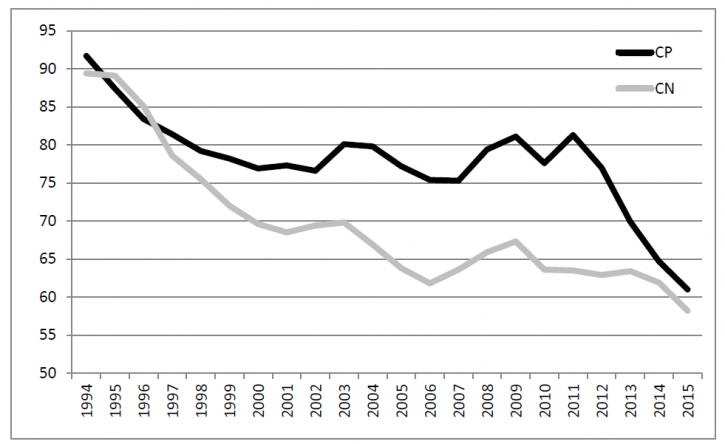
But the puzzling question and it is an unresolved dilemma of corporate governance remains: how come the board did not know earlier what became apparent very quickly after the Ackman/Harrison takeover? Why would the board not call on independent experts to assess management’s claim that structural differences made it impossible for CP to achieve a performance similar to that of other railroads? The gap in operating ratio between CP and CN had not always been as wide. In fact, as shown in Figure 1, CP had a lower operating ratio than CN during a period of time in the 1990s (Of course, CN was a Crown corporation at that time). The gap eventually widened, reaching unprecedented levels during Fred Green’s tenure (…)

How could the board have known that performances far superior to those targeted by the CEO could be swiftly achieved?

Lurking behind these questions is the fundamental flaw of corporate governance: the asymmetry of information, of knowledge and time invested between the governors and the governed, between the board of directors and management. In CP’s case, the directors, as per the norms of “good” fiduciary governance, relied on the information provided by management, believed the plans submitted by management to be adequate and challenging, and based the executives’ lavish compensation on the achievement of these plans. The Chairman, on behalf of the Board, did “extend our appreciation to Fred Green and his management team for aggressively and successfully implementing our Multi-Year plan and creating superior value for our shareholders and customers.” That form of governance is being challenged by activist investors of all stripes.

Their claim, a demonstrable one in the case of CP, is that with the massive amount of information now accessible about a publicly listed company and its competitors, it is possible for dedicated shareholders to spot poor strategies and call for drastic changes. If push comes to shove, these funds will make their case directly to other shareholders via a proxy contest for board membership.

Corporate boards of the future will have to act as “activists” in their quest for information and their ability to question strategies and performances.

 

À la prochaine…

Ivan Tchotourian

engagement et activisme actionnarial Gouvernance mission et composition du conseil d'administration Nouvelles diverses rémunération

Shareholders ready to show their hand over executive pay

Alors rébellion ou pas des actionnaires ? Alors que les documents des entreprises commencent à être rendus publics (pour des raisons de sollicitation de procuration), les chiffres de la rémunération des hauts-dirigeants le sont tout autant ! Faut-il croire aux propos optimistes des journalistes du Financial Times (« Shareholders ready to show their hand over executive pay« ) ?


It will not be a quiet season. Investors have already won several small victories, forcing some UK companies to backtrack on pay decisions. Now they have the scent of blood.

This month global companies including BP and some of the biggest UK banks will divulge how much they awarded top executives last year, setting the scene for potentially fractious showdowns with investors.

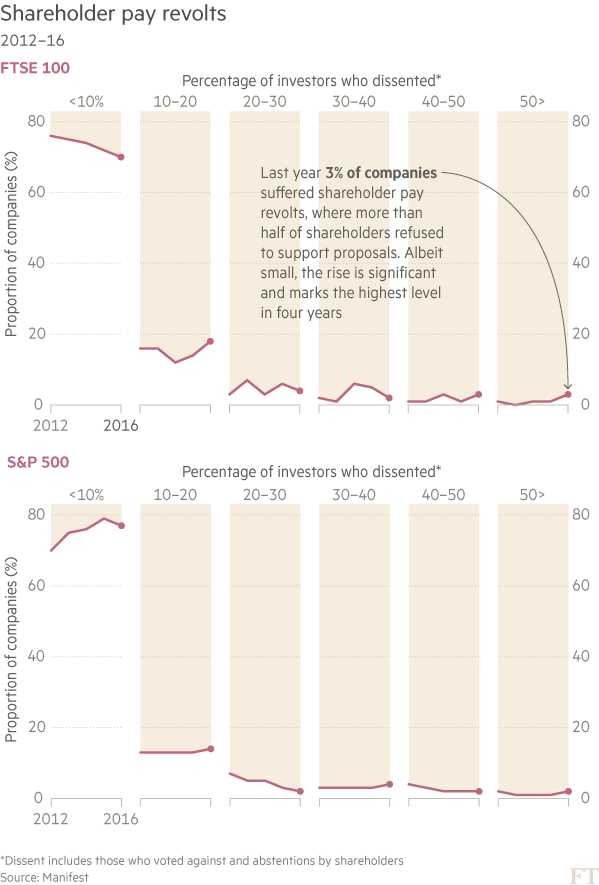
Last year, a majority of investors rejected plans at seven of the biggest US companies and three of the UK’s largest groups. This year is expected to be an even bigger rebellion.

(…) A new mood on executive awards has already swept through Europe. Last year investor support for pay proposed by German companies dropped from 90 per cent to 76 per cent for large companies.

Opposition has also increased in the Netherlands, Switzerland and France “because executive pay is seen to have become excessive,” says Georgina Marshall, head of research at voting adviser, ISS. The outlier is the US where more than three-quarters of proposals won 90-plus per cent support last year. However, even there criticism of excessive rewards is mounting.The mood in the UK has become particularly tense, however. There were as many shareholder revolts against UK pay plans last year as there were during 2012’s so-called “shareholder spring”, according to Manifest data.


À la prochaine…

Ivan Tchotourian

engagement et activisme actionnarial Gouvernance Nouvelles diverses

Les actionnaires comprennent-ils les audits ?

Inquiétant pourrais-je vous dire ? Récemment, a été publiée une étude « Auditor Ratification: Can’t Get No (Dis)Satisfaction » par Lauren Cunningham qui démontre que les actionnaires votent très rarement contre la ratification du travail de l’auditeur, et ce, malgré l’intervention précieuse des agences de conseil en vote qui viennent éclairer les actionnaires sur ce sujet si délicats des états financiers.


The auditor ratification vote provides shareholders with an opportunity to voice their opinions about the company’s choice of auditor, but, historically, less than 2 percent of shareholders express dissent in their vote. Motivated by regulatory attention on the importance of shareholder involvement and the institutional power of proxy advisors on voting outcomes, I examine the proxy advisor’s role in the auditor ratification vote. I find that proxy advisors have a statistically significant influence over shareholder voting outcomes when they recommend against auditor ratification, but the Against recommendation is rare, and the qualitative significance is less clear. Proxy advisor Against recommendations are based on concerns about auditor independence and poor audit quality, but there appears to be variation in the extent to which proxy advisors issue Against recommendations for each of these criteria. I discuss the implications of the findings, which should be of interest to regulators, investors, public companies, and audit firms.


Bilan établit par l’auteur ?


My findings may be useful to these discussions because they suggest that even a reasonably sophisticated user, such as a proxy advisor, often lacks clear enough evidence about poor audit quality to warrant issuing an against recommendation


À la prochaine…

Ivan Tchotourian

engagement et activisme actionnarial Gouvernance normes de droit normes de marché Nouvelles diverses

Vote majoritaire : où en est-on au Canada ?

Dans un article publié récemment (« Majority Voting: Latest Developments in Canada »), Stephen Erlichman revient sur la situation du vote majoritaire au Canada à travers les positions :

  1. du gouvernement fédéral avec le projet de loi C-25
  2. de la TSX dans un document publié en mars 2017 : « TSX Releases Guidance with respect to Majority Voting Policies and Advance Notice Policies » (du cabinet McCarthy tetrault)
  3. du gouvernement de l’Ontario : « Business Law Advisory Council Fall 2016 Report »

Une belle mise à jour !


A previous post on this site was written about (i) the Toronto Stock Exchange (“TSX”) adopting a majority voting listing requirement, effective June 30, 2014, which requires each director of a TSX listed issuer (other than those which are majority controlled) to be elected by a majority of the votes cast, other than at contested meetings (the “TSX Majority Voting Requirement”) and (ii) Bill C-25 which was introduced by the federal Canadian government on September 28, 2016 and proposes amendments to the Canada Business Corporations Act (“CBCA”) that include true majority voting (i.e., by requiring shareholders to cast their votes “for” or “against” each individual director’s election and prohibiting a director who has not been elected by a majority of the votes cast from serving as a director except in prescribed circumstances) (the “Bill C-25 Amendments”). This post explains the latest developments in Canada with respect to both of these initiatives, as well as a further development with respect to majority voting in the Province of Ontario.


À la prochaine…

Ivan Tchotourian