engagement et activisme actionnarial | Page 32
engagement et activisme actionnarial Nouvelles diverses
Exxonmobil pourra-t-elle longtemps ignorer le climat ?
Ivan Tchotourian 28 avril 2016
Selon le site de Novethic (ici), 17 nouveaux investisseurs institutionnels ont décidé de soutenir, lors de son assemblée générale qui aura lieu le 25 mai, la résolution exigeant d’ExxonMobil qu’elle se soumette à un stress test climatique. L’objectif : que le groupe pétrolier analyse l’impact financier d’un scénario 2°C sur ses activités et qu’il en informe ses actionnaires.
Parmi ces investisseurs, Aviva Investors, Mercy Health, ACTIAM… Ils rejoignent notamment BNP Paribas, Axa, Natixis, Calpers, AP4.
Cette initiative, qui prend de l’ampleur et qui est à replacer dans le contexte d’un nombre grandissant de résolutions climat dans les AG, intervient alors qu’Exxon est de plus en plus malmené.
À la prochaine…
Ivan Tchotourian
engagement et activisme actionnarial Nouvelles diverses rémunération
La rémunération à Bombardier inquiète
Ivan Tchotourian 28 avril 2016
Selon un article de La presse du 27 avril 2016 (ici), l’Office d’investissement du régime de pensions du Canada (OIRPC) et le Régime de retraite des enseignants de l’Ontario (Teachers) ont exprimé à Bombardier leurs préoccupations à l’égard des « octrois accordés aux dirigeants en sus du programme habituel de rémunération ».
De plus, l’OIRPC et Teachers s’opposent à la volonté de Bombardier d’augmenter significativement le nombre d’actions pouvant être émises dans le cadre du régime d’options d’achat d’actions.
Enfin, les deux organisations appuient une proposition du MEDAC prônant plus de transparence dans le dévoilement des résultats des votes des actionnaires.
À la prochaine…
Ivan Tchotourian
engagement et activisme actionnarial normes de droit rémunération
Say on pay : éléments statistiques
Ivan Tchotourian 20 avril 2016
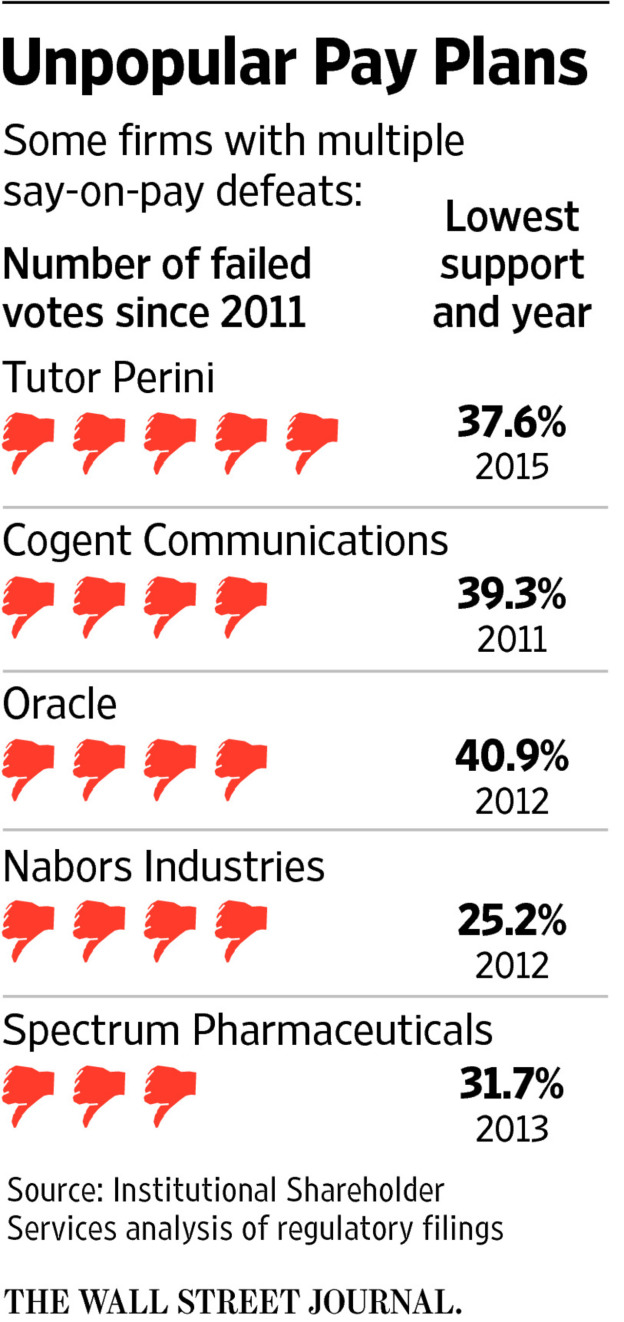
« Companies Wind Up in the ‘Penalty Box’ on Executive Pay »… c’est sous ce titre que The Wall Street Journal revient le 20 avril 2016 sur le say on pay et les révoltes récentes de plusieurs actionnaires de grandes sociétés américaines.
Last week, for ~nstance, BP PLC saw a majority of votes cast against the oil company’s compensation decisions for 2015.
The only thing worse than losing a say-on-pay vote is losing two votes. Or three. Several businesses with multiple defeats, such as TCF Financial Corp., Oracle Corp. and gectrum Pharmaceuticals ,Inc., likely will face shareholder outcries over related payor corporate governance issues this year.
In all, 39 companies in the Russell 3000 index have lost say-on-pay votes at least twice between 2011 and April 15, according to Willis Towers Watson, a consulting firm. Nine lost the vote tliree or more times, its analysis found.
After losing a pay vote, many boards work hard to overcome investor dissatisfaction by conferring with major stock.
À la prochaine…
Ivan Tchotourian
autres publications engagement et activisme actionnarial Normes d'encadrement Nouvelles diverses
Sociétés contrôlées, multiple catégories d’actions et performance
Ivan Tchotourian 17 avril 2016
L’Investor Responsibility Research Center Institute vient de publier un rapport en mars 2016 intitulé « Controlled Companies in the Standard & Poor’s 1500 – A Follow-up Review of Performance & Risk » d’Edward Kamonjoh. Dans ce rapport, l’IRRC Institute y dénonce les actions à classe multiple dans les entreprises : celles-ci sous-performeraient du fait de la présence de telles actions.
Pour un commentaire, voir sur MarketWatch : « Companies with unequal voting rights underperform shareholder friendly ones, study finds ».
The Council of Institutional Investors, whose members collectively hold more than $3 trillion in assets, calling for an end to multi-class shareholder structures for new public companies. In a statement, the organization said that companies “going public should have a “one share, one vote” structure, simple majority vote requirements, independent board leadership and annual elections for board directors.” CII said that it “adopted these expectations in an effort to protect shareholder interests.”
À la prochaine…
Ivan Tchotourian
engagement et activisme actionnarial Gouvernance mission et composition du conseil d'administration Normes d'encadrement Nouvelles diverses rémunération
Rémunération des dirigeants : le CA doit prendre ses responsabilités
Ivan Tchotourian 17 avril 2016
Belle réflexion offerte par le Financial Times sur le rôle que le conseil d’administration devrait assumer en matière de rémunération des dirigeants : « Boards are responsible for limiting excess pay » (Financial Times, 17 avril 2016).
Boards of directors are not appointed to rubber-stamp formulas devised by consultants, no matter what the result. If there appears to be something awry, they should be able to exercise their judgment and not be limited by employment contracts that deny them authority. BP’s remuneration committee failed this simple test and so found itself exposed to scorn.
Nothing absolves a board of its responsibility to limit the quantum of pay. Chief executives perform tough, demanding, responsible jobs and their decisions heavily affect the value of companies. But it is not obvious why some need to be paid double-digit millions to do their best when single-digit millions or less were accepted as sufficient financial rewards not so long ago.
Boards sometimes need to compete for talent, signing contracts that raise expectations and constrain their freedom to cap pay. As the tenure of CEOs has reduced, bosses want to get rich faster. Some argue that they could earn more in private equity, away from the unforgiving public spotlight.
À la prochaine…
Ivan Tchotourian
engagement et activisme actionnarial Normes d'encadrement normes de droit
Actionnaires : faut-il renforcer leur pouvoir ?
Ivan Tchotourian 15 avril 2016
Le choix de renforcer le pouvoir des actionnaires est-il « le » bon choix ? Au travers de l’exemple de la banque d’investissement Morgan, Jill Fisch aborde cette thématique dans une de ces dernières études intitulé : « The Mess at Morgan: Risk, Incentives and Shareholder Empowerment » (ECGI Law Working Paper No. 311/2016, mars 2016).
The financial crisis of 2008 focused increasing attention on corporate America and, in particular, the risk-taking behavior of large financial institutions. A growing appreciation of the “public” nature of the corporation resulted in a substantial number of high profile enforcement actions. In addition, demands for greater accountability led policymakers to attempt to harness the corporation’s internal decision-making structure, in the name of improved corporate governance, to further the interest of non-shareholder stakeholders. Dodd-Frank’s advisory vote on executive compensation is an example.
This essay argues that the effort to employ shareholders as agents of public values and, thereby, to inculcate corporate decisions with an increased public responsibility is misguided. The incorporation of publicness into corporate governance mistakenly assumes that shareholders’ interests are aligned with those of non-shareholder stakeholders. Because this alignment is imperfect, corporate governance is a poor tool for addressing the role of the corporation as a public actor.
À la prochaine…
Ivan Tchotourian
engagement et activisme actionnarial Normes d'encadrement rémunération
La révolte de BP !
Ivan Tchotourian 15 avril 2016
Bonjour à toutes et à tous, en voilà une nouvelle : « BP investors revolt over chief Bob Dudley’s 20% pay rise » (Financial times, 14 avril 2016). La révolte des actionnaires est en marche dans le domaine de la rémunération des dirigeants des grandes entreprises américaines. BP vient d’en fournir une illustration…
Angry shareholders mounted an unprecedented protest against BP on Thursday, rebelling against a 20 per cent pay rise for chief executive Bob Dudley despite the oil group making its worst ever loss.
Investors voted against the company’s pay decisions for the first time in living memory, with 59 per cent of proxy votes cast going against BP’s decision to pay Mr Dudley nearly $20m for 2015, a year in which the company ran up a $5.2bn loss.
À la prochaine…
Ivan Tchotourian