En voilà une nouvelle ! La province de Colombie-Britannique vient de faire place à une Benefit Corporation. Certaines modifications apportées à la Business Corporations Act de la Colombie-Britannique (la « BCBCA ») qui vont entrer en vigueur le 30 juin 2020 permettent la création d’un nouveau sous-type de société, la « société d’intérêt social » (la benefit company). La Colombie-Britannique est le premier territoire canadien à adopter ce concept qui n’est pourtant pas nouveau aux États-Unis. Pas sûr que ce choix soit heureux dans la mesure où la 3C existait déjà et qu’elle se révèle sans doute plus porteuse pour la RSE…
The major distinctions between a B.C. benefit company and other B.C. companies are as follows:
Notice of articles: The benefit company’s notice of articles will contain the following statement (the “benefit statement”):
This company is a benefit company and, as such, is committed to conducting its business in a responsible and sustainable manner and promoting one or more public benefits.
Articles: The benefit company’s articles must include a provision that specifies the public benefits to be promoted (“benefit provision”). “Public benefit” refers to something that has a positive effect that benefits (i) a class of persons other than shareholders of the company in their capacity as shareholders, or a class of communities or organizations, or (ii) the environment. The positive effect can be:
Artistic
Charitable
Cultural
Economic
Educational
Environmental
Literary
Medical
Religious
Scientific
Technological
Alterations: Any decision to adopt or eliminate the benefit statement (i.e. to alter the company’s status as a benefit company) must be approved by a special resolution of the voting shareholders. Both voting and non-voting shareholders of the benefit company are entitled to dissent rights with respect to such a change or to a change in the benefit provision.
Benefit report: Each year, the benefit company must prepare, provide to its shareholders and post on its website (if it has one) a report (“benefit report”) that assesses the company’s performance in carrying out the commitments set out in the company’s benefit provision compared to a third-party standard. The report needs to include information about the process and rationale for selecting or changing the relevant third-party standard. Regulations may be enacted that provide more details about the third-party standard and the contents of the benefit report.
Penalties relating to the benefit report: It will be an offence if the directors of the benefit company do not prepare and post the benefit report as required by the BCBCA and the regulations. There is a potential fine of up to $2,000 for individuals or $5,000 for persons other than individuals.
Augmented fiduciary duty: The directors and officers of a benefit company will be required to act honestly and in good faith with a view to conducting the business in a responsible and sustainable manner and promoting the public benefits that the company has identified in its benefit provision. They must balance that public benefits duty against their duties to the company. (There is currently no guidance with respect to achieving this balance.) However, the amendments state that the public benefits duty does not create a duty on the part of directors or officers to persons who are affected by the company’s conduct or who would be personally benefitted by it.
Enforcement and remedies where duty breached: Several significant provisions in the amendments relate to enforcement and remedies:
Shareholders are the only persons who are able to bring an action against a BCBCA benefit company’s directors and officers over an alleged violation of their duty relating to public benefits;
Only shareholders that, in the aggregate, hold at least 2% of the company’s issued shares may bring such an action (in the case of a public company, a $2 million shareholding, in the aggregate, will also suffice); and
The court may not order monetary damages in relation to a breach of that duty. Other remedies, such as removal or a direction to comply, would still be available.
It is not the first time a leader with a fiduciary responsibility waded into the public discourse. In January, Michael McCain, chief executive of Maple Leaf Foods Inc., used Twitter to criticize the White House for creating geopolitical conditions that led to Iran’s military destroying a Ukrainian airliner carrying more than 170 people, including 55 Canadian citizens and 30 permanent residents.
(…) Corporate stances on environmental, social and political issues are becoming more common. And in Canada, a change to corporate law last year freed executives of some companies to expand their mandates beyond simply maximizing shareholder returns without fear of legal reprisal.
(…) “Companies and investors are beginning to recognize that what happens out there in the real world is arguably even more important than what happens on their spreadsheets and terminals,” said Kevin Thomas, chief executive of the Shareholder Association for Research and Education, a not-for-profit group focused on responsible investing.
The responses by the heads of some of Canada’s biggest companies to the protests in the United States, as well as their various attempts to assist customers during the coronavirus pandemic, come as companies are also embracing more “stakeholder” capitalism, wherein the raison d’être for firms is more than just returning cash to shareholders.
(…) Stakeholder capitalism was the theme of this year’s World Economic Forum’s gathering in Davos, Switzerland, where one of Masrani’s peers, Royal Bank of Canada chief executive Dave McKay, was in attendance.
“As trust in governments wanes, and the complexity of society’s problems grows, companies are charting their own course on environment, social and governance issues, to maintain public confidence in business and ensure the prosperity of communities that business serves,” McKay wrote in January.
On Tuesday, McKay published a post on LinkedIn stating he was “personally outraged at the senseless and tragic deaths in the U.S., which are clearly symptomatic of ongoing racial discrimination and injustice, and I know we are not immune to it in Canada.”
A year ago, Parliament passed legislation that amended the Canada Business Corporations Act (CBCA), which lays out the legal and regulatory framework for thousands of federally incorporated firms, to spell out in greater detail how directors and company officers could meet their legal responsibility to “act honestly and in good faith with a view to the best interests of the corporation.”
The updated law states that directors and officers may consider shareholders, as well as employees, retirees, creditors, consumers and governments when setting corporate strategy. The law also now states that both the environment and “the long-term interests of the corporation” can be taken into consideration.
In a recent paper, I discuss the directors’ duty of care in times of financial distress from a global perspective and focus on directors’ roles in different types of SMEs. I argue that while the economic crunch of the years 2007–2009 was a direct result of large governance deficiencies (Bruner, 2011), which generated various reforms that reinforced the monitoring role of directors, the current crisis will highlight the significance of the directors’ managerial roles. Accordingly, we can expect jurists and policymakers to design numerous regulatory reforms that will reinforce their advisory role in a fashion that will assist them in tackling the severe consequences of our current times. Moreover, supervisory authorities may decrease the regulatory burden imposed on directors to allow them to invest considerable managerial resources for supporting the survival of companies (as Enriques demonstrates concerning corporate law, and Chiu et al point out regarding financial regulation).
Furthermore, I argue that the civil law on directors’ duty of care provides boards with a broader scope of discretion to confront the challenges associated with COVID-19 than the Anglo-American law. Delaware corporate law, for instance, posits that since directors, rather than shareholders, manage the affairs of the corporation, they should be protected by the business judgment rule. However, a recent empirical study demonstrated that challenges to business judgment in English and Welsh cases have been increasingly successful from the mid-nineteenth century until the present, with a marked increase in legal liability since 2007. This indicates that the proposition that English courts will generally not review directors’ business decisions is incorrect (Keay et al, 2020). In contrast, under the law applicable in countries such as Germany, France, Italy, and the Netherlands, the standard of care cannot be determined absolutely: it must address the specific situation for which the question of the due diligence of organ dealing arises. Accordingly, this standard is at the same time objective and relative, ie, a company comparable in size, business, and the economic situation shall serve as a model (as illustrated by, the Cancun ruling of the Dutch Supreme Court).
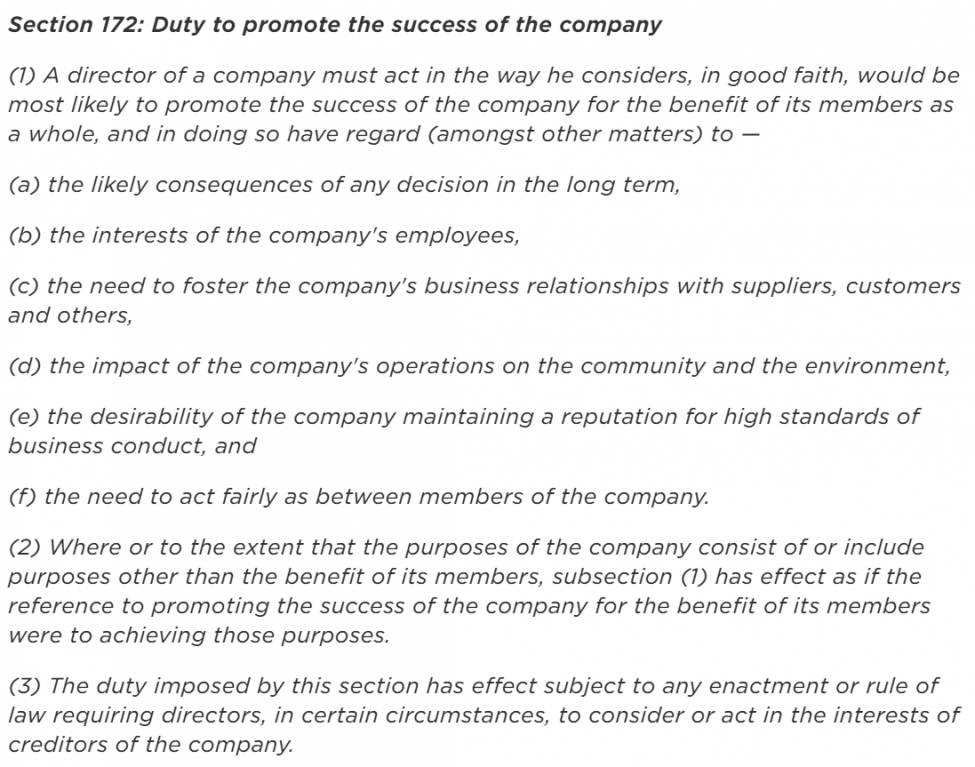
A nuance to director’s duties in the United Kingdom is the expansive statutory delineation of s 172, which endows numerous considerations for directors when acting to promote the success of the company for the benefit of members. Given the unique circumstances of the present-day commercial sphere and the more humanitarian demands being put to businesses, having a statutory foundation upon which to base non-traditional business strategies may assist effective decision-making and financial reporting.
The initial three considerations enshrined within s 172 are (a) the likely long term consequences of any decision, (b) the interests of employees and (c) the need to foster business relationships with suppliers, customers and others. These factors are of particular relevance for firms who sought justification for voluntary shutdown of businesses prior to the wider governmental shutdown.
(…)
Where production changes become quasi-humanitarian in tone and companies internalise cost in the interim, directors may seek justification through s 172(1)(d) and (e), these being the impact on the community and the desirability of maintaining high business standards respectively. Accordingly, directors can seek to frame these quasi-humanitarian efforts in long-term reputational terms, thereby engendering prospective communitarian goodwill.
Furthermore, as political pressure mounts, boards may evaluate reputational factors not simply in terms of market reputation, but also in terms of Governmental co-operation. This is particularly so where companies face increased intervention by public authorities through the Civil Contingencies Act. Comparatively, in a recent memorandum the Trump administration has attempted to exert control over the distribution of ventilators by the multinational conglomerate 3M. Cautious of such intervention occurring within their own enterprises, companies may shift business operations to such an extent to signal their compliance and co-operation with public authorities, thereby disincentivising the wholesale overrule of board discretion.
Within jurisdictions with vaguer duties to act bona fide in the best interests of the company (Delaware, Australia, Ireland), directors may still engage in such quasi-humanitarian efforts. Nevertheless, utilising s 172 to steer directorial judgment may assist effective decision-making, and furthermore guide financial reporting, which mandates s 172 director’s statements. Given that the tenor of 2020 reports will be likely dominated by COVID-19, UK directors will benefit from the homogenising structure of s 172 when making such disclosures in the coming months.
Dans le cadre du cours DRT-7022 Gouvernance de l’entreprise du Professeur Ivan Tchotourian, nos étudiants ont eu l’opportunité de réfléchir sur un sujet pendant toute une session. Voici le fruit de leur réflexion !
Article 172 du droit des sociétés britanniques, utile ou pas ?
Le Royaume-Uni a vu entre 2006 et 2009 entrer en vigueur le Companies Act 2006 remplaçant le précédent Companies Act de 1985. Cette loi apporte des modifications à presque tous les aspects du droit des sociétés britanniques. Parmi les principales nouveautés, nous pouvons tout d’abord mentionner la consécration du devoir des administrateurs et des dirigeants de promouvoir le succès de l’entreprise, par le renforcement de la voix des parties prenantes. Ce renforcement passe à travers différentes propositions consacrées par l’article 172.
Le 29 août 2017, le gouvernement britannique a publié « Corporate Governance Reform : The Government Response to the Green Paper Consultation », proposant des mesures sur deux enjeux : la prise en compte des parties prenantes dans leur ensemble par le conseil d’administration de l’entreprise, ainsi que sur la rémunération des dirigeants. En somme, le gouvernement suggère d’utiliser le mécanisme de « comply or explain » et l’instrument législatif afin de soumettre de nouvelles propositions à ajouter à cet article.
Le gouvernement s’attaque également à la rémunération des dirigeants, par un encadrement souple se concrétisant à travers différents outils, tels que : le « name and shame », le ratio, ainsi que le comité de rémunération.
The House of commons, chambre basse du parlement du Royaume-Uni, a par son comité « Business, Energy and Industrial Strategy », a publié quelques recommandations suite à une enquête effectuée en 2016. Dans l’objectif d’améliorer l’accessibilité ainsi que l’application de l’article 172 par les sociétés britanniques, il ressort des recommandations du comité notamment la mise en place de rapports au sujet de la politique des entreprises, qui devront être publiés. Mais aussi la création de groupes consultatifs composés des différentes parties prenantes, la rédaction et l’application d’un nouveau code de gouvernance de l’entreprise aux sociétés britanniques cotées et non cotées, et l’attribution de nouvelles missions au Financial Reporting Council.
Mais aussi la création de groupes consultatifs composés des différentes parties prenantes, la rédaction et l’application d’un nouveau code de gouvernance de l’entreprise aux sociétés britanniques cotées et non cotées, et l’attribution de nouvelles missions au Financial Reporting Council.
L’article 172 suite à sa promulgation introduit dans le cadre légal britannique le devoir des administrateurs de « promouvoir le succès de leur société dans l’intérêt de ses membres en prenant en considération l’ensemble des parties prenantes », par la codification de règles issues de la common law. Cet article suppose de la part des administrateurs de non seulement prendre en considération l’ensemble des parties prenantes, mais également d’agir de bonne foi au profit du succès de l’entreprise.
Cependant cet article connaît bon nombre de critiques, en effet, il lui est d’abord reproché l’inexistence de moyens de recours pour les parties prenantes autres que les actionnaires, le rôle normalement protecteur de l’article 172 à l’égard des parties prenantes est limité en dehors de la promotion des intérêts des actionnaires.
Toutefois, malgré les critiques supportées par cet article, grand nombre de pays s’en sont inspirés afin d’améliorer leurs codes de gouvernance d’entreprise.
1. Over the last several years, investors and proxy advisory firms have increasingly focused their attention on environmental, sustainability and governance (ESG) and human capital management (HCM) issues. While there is no one definition of HCM, the term is widely used to cover a very broad range of workforce matters that are of concern to investors and the public as they focus on building long-term value and reducing business and reputational risks. These concerns have resulted in calls for enhanced company disclosures about their HCM practices and processes.
2. Under Delaware and federal law, directors have no duties that are specifically focused on HCM. However, under Delaware law and that of many other states, directors have duties of care, loyalty and oversight that can under certain circumstances apply to HCM matters and can result in director liability.
3. While federal securities laws and rules contain several corporate disclosure requirements that apply to employees and touch on HCM issues, current laws and rules are not as robust or focused as many investors would like and have proposed. In response to rulemaking and other investor requests, the U.S. Securities and Exchange Commission has proposed amendments to its disclosure rules that would expressly require companies to describe their human capital resources to the extent that they are material to an understanding of a company’s business as a whole.
4. Some public companies have already articulated board responsibilities for oversight of HCM matters; some have renamed and expanded the responsibilities of their compensation committees to reflect their expanded focus; and some have disclosed their HCM polices and efforts in their securities law filings and other publications.
5. Separate and apart from the legal requirements that apply to corporate board duties and corporate disclosure requirements, there are important business, governance and reputational reasons for boards and companies to care about and address HCM matters. 6. While there is no one-size-fits-all approach to board oversight of HCM matters, areas for possible board attention are (i) diversity and inclusion, (ii) employee satisfaction and engagement, (iii) succession and talent management, (iv) attrition and retention, and (v) ethics, workforce culture and risk.
Cette discussion aborde les principaux défis auxquels sont confrontés les chefs d’entreprise canadiens à l’approche de la phase de réouverture :
se concentrer sur les véritables enjeux;
veiller à la gestion immédiate des crises et à la préparation du conseil d’administration;
repenser la stratégie et la gestion des risques;
repenser les cadres incitatifs; et
repenser l’objectif de l’entreprise.
Comme en conclut l’article, cette crise redéfinira une grande partie de ce que nous considérons comme étant de la « bonne gouvernance ». Les conseils d’administration, en particulier, doivent élargir leurs missions pour s’assurer que leurs entreprises sont préparées à la nouvelle réalité qui les attend.