parties prenantes | Page 2
devoir de vigilance Gouvernance normes de droit parties prenantes Responsabilité sociale des entreprises
UE et devoir de vigilance
Ivan Tchotourian 26 octobre 2020 Ivan Tchotourian
Où s’en va l’UE avec le devoir de vigilance ? M. Farid Baddache propose une synthèse avec des pistes de réflexions : « L’UE veut un devoir de vigilance sur les droits humains obligatoire en 2021 » (Ksapas, 4 juin 2020).
Résumé :
Depuis plus de 10 ans, les entreprises appliquent les Principes Directeurs des Nations Unies sur les Entreprises et les Droits de l’Homme. Faisant écho à de multiples réglementations nationales – notamment en Californie, en France, au Royaume-Uni, aux Pays-Bas ou en Allemagne – la Commission Européenne a annoncé la mise en œuvre d’une directive sur la diligence raisonnable obligatoire en matière de Droits Humains en 2021. Quels sont les retours des entreprises à date ? Une directive européenne peut-elle imposer le respect des Droits Humains sur l’ensemble des chaînes d’approvisionnement, au-delà de ce qui existe déjà ? Quel impact la pandémie Covid-19 pourrait-elle avoir sur son éventuelle application ?
À la prochaine…
Gouvernance Nouvelles diverses parties prenantes Responsabilité sociale des entreprises
The Stakeholder Model and ESG
Ivan Tchotourian 17 septembre 2020 Ivan Tchotourian
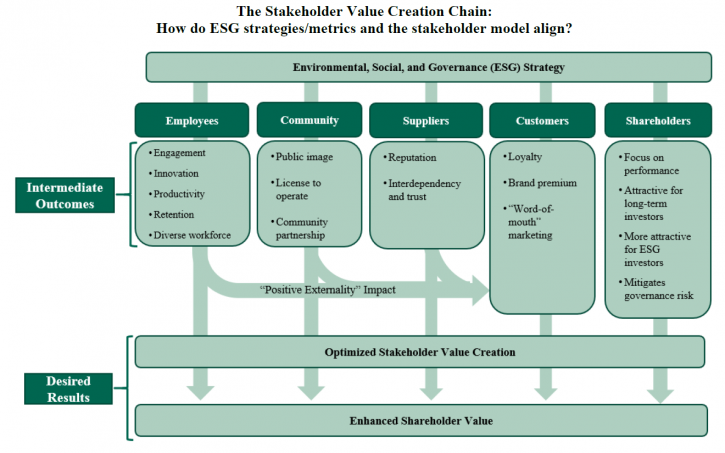
Intéressant article sur l’Harvard Law School Forum on Corporate Governance consacré au modèle partie prenante et à ses liens avec les critères ESG : « The Stakeholder Model and ESG » (Ira Kay, Chris Brindisi et Blaine Martin, 14 septembre 2020).
Extrait :
Is your company ready to set or disclose ESG incentive goals?
ESG incentive metrics are like any other incentive metric: they should support and reinforce strategy rather than lead it. Companies considering ESG incentive metrics should align planning with the company’s social responsibility and environmental strategies, reporting, and goals. Another essential factor in determining readiness is the measurability/quantification of the specific ESG issue.
Companies will generally fall along a spectrum of readiness to consider adopting and disclosing ESG incentive metrics and goals:
- Companies Ready to Set Quantitative ESG Goals: Companies with robust environmental, sustainability, and/or social responsibility strategies including quantifiable metrics and goals (e.g., carbon reduction goals, net zero carbon emissions commitments, Diversity and Inclusion metrics, employee and environmental safety metrics, customer satisfaction, etc.).
- Companies Ready to Set Qualitative Goals: Companies with evolving formalized tracking and reporting but for which ESG matters have been identified as important factors to customers, employees, or other These companies likely already have plans or goals around ESG factors (e.g., LEED [Leadership in Energy and Environmental Design]-certified office space, Diversity and Inclusion initiatives, renewable power and emissions goals, etc.).
- Companies Developing an ESG Strategy: Some companies are at an early stage of developing overall ESG/stakeholder strategies. These companies may be best served to focus on developing a strategy for environmental and social impact before considering linking incentive pay to these priorities.
We note it is critically important that these ESG/stakeholder metrics and goals be chosen and set with rigor in the same manner as financial metrics to ensure that the attainment of the ESG goals will enhance stakeholder value and not serve simply as “window dressing” or “greenwashing.” [9] Implementing ESG metrics is a company-specific design process. For example, some companies may choose to implement qualitative ESG incentive goals even if they have rigorous ESG factor data and reporting.
Will ESG metrics and goals contribute to the company’s value-creation?
The business case for using ESG incentive metrics is to provide line-of-sight for the management team to drive the implementation of initiatives that create significant differentiated value for the company or align with current or emerging stakeholder expectations. Companies must first assess which metrics or initiatives will most benefit the company’s business and for which stakeholders. They must also develop challenging goals for these metrics to increase the likelihood of overall value creation. For example:
- Employees: Are employees and the competitive talent market driving the need for differentiated environmental or social initiatives? Will initiatives related to overall company sustainability (building sustainability, renewable energy use, net zero carbon emissions) contribute to the company being a “best in class” employer? Diversity and inclusion and pay equity initiatives have company and social benefits, such as ensuring fair and equitable opportunities to participate and thrive in the corporate system.
- Customers: Are customer preferences driving the need to differentiate on sustainable supply chains, social justice initiatives, and/or the product/company’s environmental footprint?
- Long-Term Sustainability: Are long-term macro environmental factors (carbon emissions, carbon intensity of product, etc.) critical to the Company’s ability to operate in the long term?
- Brand Image: Does a company want to be viewed by all constituencies, including those with no direct economic linkage, as a positive social and economic contributor to society?
There is no one-size-fits-all approach to ESG metrics, and companies fall across a spectrum of needs and drivers that affect the type of ESG factors that are relevant to short- and long-term business value depending on scale, industry, and stakeholder drivers. Most companies have addressed, or will need to address, how to implement ESG/stakeholder considerations in their operating strategy.
Conceptual Design Parameters for Structuring Incentive Goals
For those companies moving to implement stakeholder/ESG incentive goals for the first time, the design parameters range widely, which is not different than the design process for implementing any incentive metric. For these companies, considering the following questions can help move the prospect of an ESG incentive metric from an idea to a tangible goal with the potential to create value for the company:
- Quantitative goals versus qualitative milestones. The availability and quality of data from sustainability or social responsibility reports will generally determine whether a company can set a defined quantitative goal. For other companies, lack of available ESG data/goals or the company’s specific pay philosophy may mean ESG initiatives are best measured by setting annual milestones tailored to selected goals.
- Selecting metrics aligned with value creation. Unlike financial metrics, for which robust statistical analyses can help guide the metric selection process (e.g., financial correlation analysis), the link between ESG metrics and company value creation is more nuanced and significantly impacted by industry, operating model, customer and employee perceptions and preferences, etc. Given this, companies should generally apply a principles-based approach to assess the most appropriate metrics for the company as a whole (e.g., assessing significance to the organization, measurability, achievability, etc.) Appendix 1 provides a list of common ESG metrics with illustrative mapping to typical stakeholder impact.
- Determining employee participation. Generally, stakeholder/ESG-focused metrics would be implemented for officer/executive level roles, as this is the employee group that sets company-wide policy impacting the achievement of quantitative ESG goals or qualitative milestones. Alternatively, some companies may choose to implement firm-wide ESG incentive metrics to reinforce the positive employee engagement benefits of the company’s ESG strategy or to drive a whole-team approach to achieving goals.
- Determining the range of metric weightings for stakeholder/ESG goals. Historically, US companies with existing environmental, employee safety, and customer service goals as well as other stakeholder metrics have been concentrated in the extractive, industrial, and utility industries; metric weightings on these goals have ranged from 5% to 20% of annual incentive scorecards. We expect that this weighting range would continue to apply, with the remaining 80%+ of annual incentive weighting focused on financial metrics. Further, we expect that proxy advisors and shareholders may react adversely to non-financial metrics weighted more than 10% to 20% of annual incentive scorecards.
- Considering whether to implement stakeholder/ESG goals in annual versus long-term incentive plans. As noted above, most ESG incentive goals to date have been implemented as weighted metrics in balanced scorecard annual incentive plans for several reasons. However, we have observed increased discussion of whether some goals (particularly greenhouse gas emission goals) may be better suited to long-term incentives. [10] There is no right answer to this question—some milestone and quantitative goals are best set on an annual basis given emerging industry, technology, and company developments; other companies may have a robust long-term plan for which longer-term incentives are a better fit.
- Considering how to operationalize ESG metrics into long-term plans. For companies determining that sustainability or social responsibility goals fit best into the framework of a long-term incentive, those companies will need to consider which vehicles are best to incentivize achievement of strategically important ESG goals. While companies may choose to dedicate a portion of a 3-year performance share unit plan to an ESG metric (e.g., weighting a plan 40% relative total shareholder return [TSR], 40% revenue growth, and 20% greenhouse gas reduction), there may be concerns for shareholders and/or participants in diluting the financial and shareholder-value focus of these incentives. As an alternative, companies could grant performance restricted stock units, vesting at the end of a period of time (e.g., 3 or 4 years) contingent upon achievement of a long-term, rigorous ESG performance milestone. This approach would not “dilute” the percentage of relative TSR and financial-based long-term incentives, which will remain important to shareholders and proxy advisors.
Conclusion
As priorities of stakeholders continue to evolve, and addressing these becomes a strategic imperative, companies may look to include some stakeholder metrics in their compensation programs to emphasize these priorities. As companies and Compensation Committees discuss stakeholder and ESG-focused incentive metrics, each organization must consider its unique industry environment, business model, and cultural context. We interpret the BRT’s updated statement of business purpose as a more nuanced perspective on how to create value for all stakeholders, inclusive of shareholders. While optimizing profits will remain the business purpose of corporations, the BRT’s statement provides support for prioritizing the needs of all stakeholders in driving long-term, sustainable success for the business. For some companies, implementing incentive metrics aligned with this broader context can be an important tool to drive these efforts in both the short and long term. That said, appropriate timing, design, and communication will be critical to ensure effective implementation.
À la prochaine…
actualités internationales Gouvernance Normes d'encadrement parties prenantes Responsabilité sociale des entreprises
Pour un comité social et éthique en matière de gouvernance
Ivan Tchotourian 17 septembre 2020 Ivan Tchotourian
Dans BoardAgenda, Gavin Hinks propose une solution pour que les parties prenantes soient mieux pris en compte : la création d’un comité social et éthique (déjà en fonction en Afrique du Sud) : « Companies ‘need new mechanism’ to integrate stakeholder interests » (4 septembre 2020).
Extrait :
While section 172 of the Companies Act—the key law governing directors’ duties—has been sufficiently flexible to enable companies to re-align themselves with stakeholders so far, it provides no guarantee they will maintain that disposition.
In their recent paper, MacNeil and Esser argue more regulation is needed and in particular a mandatory committee drawing key stakeholder issues to the board and then reporting on them to shareholders.
Known as the “social and ethics committee” in South Africa, a similar mandatory committee in the UK considering ESG (environmental, social and governance) issues “will provide a level playing field for stakeholder engagement,” write MacNeil and Esser.
Recent evidence, they concede, suggests the committees in South Africa are still evolving, but there are advantages, with the committee “uniquely placed with direct access to the main board and a mandate to reach into the depths of the business”.
“As a result, it is capable of having a strong influence on the way a company heads down the path of sustained value creation.”
Will stakeholderism stick?
The issue of making “stakeholder” capitalism stick has vexed others too. The issue was a dominant agenda item at the World Economic Forum’s Davos conference this year, as well as becoming a key element in the presidential campaign of Democrat candidate Joe Biden.
Others worry that stakeholderism is a talking point only, prompting no real change in some companies. Indeed, when academics examined the practical policy outcomes from the now famous 2019 pledge by the Business Roundtable—a group of US multinationals—to shift their focus from shareholders to stakeholders, they found the companies wanting.
In the UK, at least, some are taking the issue very seriously. The Institute of Directors recently launched a new governance centre with its first agenda item being how stakeholderism can be integrated into current governance structures.
Further back the Royal Academy, an august British research institution, issued its own principles for becoming a “purposeful business”, another idea closely associated with stakeholderism.
The stakeholder debate has a long way to run. If the idea is to gain traction it will undoubtedly need a stronger commitment in regulation than it currently has, or companies could easily wander from the path. That may depend on public demand and political will. But Esser and MacNeil may have at least indicated one way forward.
À la prochaine…
Gouvernance parties prenantes
Stakeholderism: study finds evidence in short supply
Ivan Tchotourian 29 août 2020 Ivan Tchotourian
Retour sur la tribune de Lucian Bebchuk et Roberto Tallarita dans le Wall Street Journal critiquant le soi-disant stakeholderism qui émergerait de l’après COVID-19 par Cavin Hinks dans Board Agenda du 7 août 2020 : « Stakeholderism: study finds evidence in short supply ».
Extrait :
(…)
Acceleration
Where does that leave stakeholderism? It’s no secret that many have argued fundamental change would be needed for the movement to really gain traction. In the UK, at least, the Institute of Directors has set up an entirely new governance centre to specifically explore this issue.
It may also be the case that boardroom approval and governance guidelines are not sufficient to prove that stakeholderism is absent in the US or elsewhere. Policy decision making at different levels—including chief executives acting alone—may reflect a shift to new forms of corporate behaviour, regardless of board-sanctioned decisions.
When the Sustainability Board Report , a campaign group, looked as corporate statements made by the world’s largest 100 companies as a result of Covid-19, it concluded there was evidence to suggest stakeholderism had “accelerated” during the pandemic. But it was inspecting disclosures about policies relating to employees, customers, suppliers and communities rather than formal boardroom approval processes or redrafted governance guidelines.
That might suggest CEOs make decisions that reflect stakeholderism without constructing a formal board-approved shift in approach. For that matter, it might also indicate such a movement could be short-lived and swing back once the threat of Covid-19 has receded.
Campaigners hope not. Close observers might also ask how stakeholderism might be properly observed or even measured.
The discussion has a long way to go. Bebchuk and Tallarita raise important questions with some compelling evidence. But it’s not entirely clear we’ve reached a final verdict on stakeholderism.
À la prochaine…
Gouvernance parties prenantes Responsabilité sociale des entreprises
Vers le stakeholderism
Ivan Tchotourian 29 août 2020 Ivan Tchotourian
Article à lire sur l’Harvard Law School Forum on Corporate Governance : « An Inflection Point for Stakeholder Capitalism » (de Seymour Burchman et Seamus O’Toole).
Extrait :
From the Business Roundtable to BlackRock, there’s growing pressure on companies to respect all major stakeholders—employees, customers, suppliers and local communities, as well as investors. Meanwhile, a variety of innovations are effectively making these stakeholders central to long-term company success. Digital technologies, new ways of organizing work and transactions, and the shift to the service economy have forced businesses to prioritize the interests of all stakeholders—adding significant opportunities and risks.
As a result, unless the company’s survival is in question, stakeholder-centricity is becoming essential to its overall management. Even under short-term pressures such as pandemics, executives and directors will need to view the company as operating within an integrated ecosystem. Only by supporting all major stakeholders, through calibrated and balanced incentives, will companies achieve sustained success.
(…)
Reinforcing stakeholder-centricity through compensation
Through trial and error, Acme has been fine-tuning its approach. In our work with the boards of Acme, and of other companies, we’ve found four principles for making it all work.
Emphasize the long-term. It’s impossible to attend to all stakeholders equally in the short term. Companies are constantly making near-term trade-offs while still optimizing outcomes for all over the long-run. Investments in customer experience today might squeeze suppliers or reduce profitability in the near-term, for example, but boost the value proposition and expand revenues and margins in the future.
Any pay program tied to short-term outcomes will subconsciously influence how leaders balance these trade-offs. Accordingly, Acme has emphasized an ownership culture with greater equity compensation, broad participation, and policies that promote longer employee holding periods. It also steered clear of the usual practice of overlapping three-year performance cycles, as the overlaps effectively create a series of one-year cliffs that emphasize short-term thinking. While Acme has continued to use a short-term, cash-based bonus, it reduced that element’s weight relative to the rest of executive compensation. (Although a clear minority, some companies looking to prioritize long-term, balanced stakeholder outcomes have eliminated bonuses entirely.)
Explicitly tie pay to outcomes for all stakeholders. Acme wanted to keep the cash-based bonus tied to short-term profit and revenue goals, but was concerned that these would keep employees from weighing the stakeholder tradeoffs discussed above. So the company balanced the investor-focused metrics for the bonus with stakeholder-oriented goals such as employee engagement, customer retention, and supplier satisfaction. The simple act of ‘naming’ the priorities and directly tying them to compensation boosted buy-in across the organization.
Balance metrics with discretion. Acme believed that stakeholder dynamics were too fluid to be captured in a typical bonus construct, where ‘hard’ goals were established at the beginning of the year and performance measured formulaically twelve months later. The board set specific priorities and definitions of success, but allowed for discretion in the actual assessments and payouts. They also allowed for the updating of priorities frequently to ensure continued alignment with the strategy.
Stick to your guns. Finally, and perhaps most difficult, boards need to build up the resolve to align compensation outcomes with the stakeholder model. That means letting cash-based incentive awards follow stakeholder outcomes even when short-term financials are weak. And conversely, it means pulling back on pay when stakeholder priorities weren’t achieved, even if financial performance was strong. Note that executives will still be motivated to respect investor interests, as much of their pay will be in stock.
Boards must build the credibility to diverge from the “one-size-fits-all” status quo on pay for today’s U.S. public companies. They have to stand firm in the face of external pressure from impatient investors and shareholder advisory groups to align with their guidelines, most of which are anchored in and promote a shareholder-centric perspective. Some investors won’t agree with this philosophy and decide to select out, but others will take their place if they find the company’s mission, strategy, and execution compelling and in shareholders’ interests long-term. This will require boards to be consistent, symmetrical, proportional, and transparent in their compensation decisions. If the tie always goes to the executive, or if the company applies its philosophy selectively, the board will lose credibility and struggle to operate outside the typical investor-centric norms.
Finally, to sustain and optimize incentives that align with the stakeholder-centric model, boards must be relentless about communication, internal and external. They need to dialogue continually with investors and employees. They can emphasize the mission and strategy, how they’re balancing stakeholder needs over the long-term (even as they make trade-offs in the short term), and how the incentives align.
À la prochaine…
engagement et activisme actionnarial finance sociale et investissement responsable Gouvernance mission et composition du conseil d'administration Normes d'encadrement parties prenantes Responsabilité sociale des entreprises
COVID-19, purpose et critères ESG : une alliance nécessaire
Ivan Tchotourian 13 août 2020 Ivan Tchotourian
Billet à découvrir sur le site de Harvard Law School Forum on Corporate Governance pour y lire cet article consacré à la sortie de crise sanitaire et aux apports de la raison d’être et des critères ESG : « ESG and Corporate Purpose in a Disrupted World » (Kristen Sullivan, Amy Silverstein et Leeann Galezio Arthur, 10 août 2020).
Extrait :
Corporate purpose and ESG as tools to reframe pandemic-related disruption
The links between ESG, company strategy, and risk have never been clearer than during the COVID-19 pandemic, when companies have had to quickly pivot and respond to critical risks that previously were not considered likely to occur. The World Economic Forum’s Global Risks Survey 2020, published in January 2020, listed “infectious diseases” as number 10 in terms of potential economic impact, and did not make the top 10 list of risks considered to be “likely.” The impact of the pandemic was further magnified by the disruption it created for the operations of companies and their workforces, which were forced to rethink how and where they did business virtually overnight.
The radical recalibration of risk in the context of a global pandemic further highlights the interrelationships between long-term corporate strategy, the environment, and society. The unlikely scenario of a pandemic causing economic disruption of the magnitude seen today has caused many companies—including companies that have performed well in the pandemic—to reevaluate how they can maintain the long-term sustainability of the enterprise. While the nature and outcomes of that reevaluation will differ based on the unique set of circumstances facing each company, this likely means reframing the company’s role in society and the ways in which it addresses ESG-related challenges, including diversity and inclusion, employee safety, health and well-being, the existence of the physical workplace, supply chain disruptions, and more.
ESG factors are becoming a key determinant of financial strength. Recent research shows that the top 20 percent of ESG-ranked stocks outperformed the US market by over 5 percentage points during a recent period of volatility. Twenty-four out of 26 sustainable index funds outperformed comparable conventional index funds in Q1 2020. In addition, the MSCI ACWI ESG Leaders Index returned 5.24 percent, compared to 4.48 percent for the overall market, since it was established in September 2007 through February 2020. Notably, BlackRock, one of the world’s largest asset managers, recently analyzed the performance of 32 sustainable indices and compared that to their non-sustainable benchmarks as far back as 2015. According to BlackRock the findings indicated that “during market downturns in 2015–16 and 2018, sustainable indices tended to outperform their non-sustainable counterparts.” This trend may be further exacerbated by the effects of the pandemic and the social justice movement.
Financial resilience is certainly not the only benefit. Opportunities for brand differentiation, attraction and retention of top talent, greater innovation, operational efficiency, and an ability to attract capital and increase market valuation are abundant. Companies that have already built ESG strategies, measurements, and high-quality disclosures into their business models are likely to be well-positioned to capitalize on those opportunities and drive long-term value postcrisis.
As businesses begin to reopen and attempt to get back to some sense of normalcy, companies will need to rely on their employees, vendors, and customers to go beyond the respond phase and begin to recover and thrive. In a postpandemic world, this means seeking input from and continuing to build and retain the confidence and trust of those stakeholder groups. Business leaders are recognizing that ESG initiatives, particularly those that prioritize the health and safety of people, will be paramount to recovery.
What are investors and other stakeholders saying?
While current events have forced and will likely continue to force companies to make difficult decisions that may, in the short term, appear to be in conflict with corporate purpose, evidence suggests that as companies emerge from the crisis, they will refresh and recommit to corporate purpose, using it as a compass to focus ESG performance. Specific to the pandemic, the public may expect that companies will continue to play a greater role in helping not only employees, but the nation in general, through such activities as manufacturing personal protective equipment (PPE), equipment needed to treat COVID-19 patients, and retooling factories to produce ventilators, hand sanitizer, masks, and other items needed to address the pandemic. In some cases, decisions may be based upon or consistent with ESG priorities, such as decisions regarding employee health and well-being. From firms extending paid sick leave to all employees, including temporary workers, vendors, and contract workers, to reorienting relief funds to assist vulnerable populations, examples abound of companies demonstrating commitments to people and communities. As companies emerge from crisis mode, many are signaling that they will continue to keep these principles top of mind. This greater role is arguably becoming part of the “corporate social contract” that legitimizes and supports the existence and prosperity of corporations.
In the United States, much of the current focus on corporate purpose and ESG is likely to continue to be driven by investors rather than regulators or legislators in the near term. Thus, it’s important to consider investors’ views, which are still developing in the wake of COVID-19 and other developments.
Investors have indicated that they will assess a company’s response to the pandemic as a measure of stability, resilience ,and adaptability. Many have stated that employee health, well-being, and proactive human capital management are central to business continuity. Investor expectations remain high for companies to lead with purpose, particularly during times of severe economic disruption, and to continue to demonstrate progress against ESG goals.
State Street Global Advisors president and CEO Cyrus Taraporevala, in a March 2020 letter to board members, emphasized that companies should not sacrifice the long-term health and sustainability of the company when responding to the pandemic. According to Taraporevala, State Street continues “to believe that material ESG issues must be part of the bigger picture and clearly articulated as part of your company’s overall business strategy.” According to a recent BlackRock report, “companies with strong profiles on material sustainability issues have potential to outperform those with poor profiles. We believe companies managed with a focus on sustainability may be better positioned versus their less sustainable peers to weather adverse conditions while still benefiting from positive market environments.”
In addition to COVID-19, the recent social justice movement compels companies to think holistically about their purpose and role in society. Recent widespread protests of systemic, societal inequality leading to civil unrest and instability elevate the conversation on the “S” and “G” in ESG. Commitments to the health and well-being of employees, customers, communities, and other stakeholder groups will also require corporate leaders to address how the company articulates its purpose and ESG objectives through actions that proactively address racism and discrimination in the workplace and the communities where they operate. Companies are responding with, among other things, statements of support for diversity and inclusion efforts, reflective conversations with employees and customers, and monetary donations for diversity-focused initiatives. However, investors and others who are pledging to use their influence to hold companies accountable for meaningful progress on systemic inequality will likely look for data on hiring practices, pay equity, and diversity in executive management and on the board as metrics for further engagement on this issue.
What can boards do?
Deloitte US executive chair of the board, Janet Foutty, recently described the board as “the vehicle to hold an organization to its societal purpose.” Directors play a pivotal role in guiding
companies to balance short-term decisions with long-term strategy and thus must weigh the needs of all stakeholders while remaining cognizant of the risks associated with each decision. COVID-19 has underscored the role of ESG principles as central to business risk and strategy, as well as building credibility and trust with investors and the public at large. Boards can advise management on making clear, stakeholder-informed decisions that position the organization to emerge faster and stronger from a crisis.
It has been said before that those companies that do not control their own ESG strategies and narratives risk someone else controlling their ESG story. This is particularly true with regards to how an organization articulates its purpose and stays grounded in that purpose and ESG principles during a crisis. Transparent, high-quality ESG disclosure can be a tool to provide investors with information to efficiently allocate capital for long-term return. Boards have a role in the oversight of both the articulation of the company’s purpose and how those principles are integrated with strategy and risk.
As ESG moves to the top of the board agenda, it is important for boards to have the conversation on how they define the governance structure they will put in place to oversee ESG. Based on a recent review, completed by Deloitte’s Center for Board Effectiveness, of 310 company proxies in the S&P 500, filed from September 1, 2019, through May 6, 2020, 57 percent of the 310 companies noted that the nominating or governance committee has primary oversight responsibility, and only 9 percent noted the full board, with the remaining 34 percent spread across other committees. Regardless of the primary owner, the audit committee should be engaged with regard to any ESG disclosures, as well as prepared to oversee assurance associated with ESG metrics.
Conclusion
The board’s role necessitates oversight of corporate purpose and how corporate purpose is executed through ESG. Although companies will face tough decisions, proactive oversight of and transparency around ESG can help companies emerge from recent events with greater resilience and increased credibility. Those that have already embarked on this journey and stay the course will likely be those well-positioned to thrive in the future.
Questions for the board to consider asking:
How are the company’s corporate purpose and ESG objectives integrated with strategy and risk?
- Has management provided key information and assumptions about how ESG is addressed during the strategic planning process?
- How is the company communicating its purpose and ESG objectives to its stakeholders?
- What data does the company collect to assess the impact of ESG performance on economic performance, how does this data inform internal management decision- making, and how is the board made aware of and involved from a governance perspective?
- Does the company’s governance structure facilitate effective oversight of the company’s ESG matters?
- How is the company remaining true to its purpose and ESG, especially now given COVID-19 pandemic and social justice issues?
- What is the board’s diversity profile? Does the board incorporate diversity when searching for new candidates?
- Have the board and management discussed executive management succession and how the company can build a diverse pipeline of candidates?
- How will the company continue to refresh and recommit to its corporate purpose and ESG objectives as it emerges from the pandemic response and recovery and commit to accelerating diversity and inclusion efforts?
- How does the company align its performance incentives for executive leadership with attaining critical ESG goals and outcomes?
À la prochaine…
Gouvernance parties prenantes Valeur actionnariale vs. sociétale
Concilier actionnaires et parties prenantes : le temps !
Ivan Tchotourian 7 août 2020 Ivan Tchotourian
Merci à M. Jean-Florent Rérolle qui offre une tribune bien intéressante sur la nécessité de faire concilier les intérêts des actionnaires et des parties parties prenantes et de ne pas les opposer. Seule cette conciliation permet de dégager une valeur globale : économique et sociale.
Jean-Florent Rérolle, « Actionnaires/parties prenantes : une union sacrée », Option finance, 17 juillet 2020.
Extrait :
Cette vision, qui repose sur l’idée que ce qui est donné à l’un est pris à l’autre, est archaïque et contre-productive. Elle ne correspond pas à la réalité des marchés, qui valorisent en fait le long terme (depuis 2005, 40 % en moyenne de la valeur des entreprises françaises s’explique par des flux de trésorerie qui seront générés au-delà d’une période de dix ans) et tiennent compte des performances ou des risques extra-financiers. L’intégration ESG et l’engagement actionnarial sont deux tendances lourdes dans la gestion d’actifs. Elles ont des répercussions très positives sur les entreprises, car elles les poussent à perfectionner sans cesse leur stratégie RSE.
Vouloir privilégier les partenaires de l’entreprise au détriment des actionnaires est aussi un mauvais calcul. Nous sommes tous à la fois des consommateurs, des employés, des contribuables, des épargnants et des futurs retraités ! Nous avons besoin de croissance, et donc d’investissement pour nos emplois et notre niveau de vie. De nombreuses recherches montrent que, à long terme, il existe une corrélation entre la valeur actionnariale et la valeur sociale.
L’heure est donc à la réconciliation des intérêts des partenaires de l’entreprise avec celui de leurs actionnaires.
Plusieurs approches sont susceptibles de pacifier leurs relations :
– Théorisée par Jensen, l’«enlightened shareholder value» considère que la valeur actionnariale ne peut être maximisée sur le long terme qu’à condition que l’entreprise serve correctement ses partenaires. La maximisation de la valeur actionnariale demeure l’objectif final, et la valeur sociale est un sous-produit de cette logique.
– La «shared value» de Michael Porter consiste à rechercher une création de valeur qui bénéficie également à la société. L’objectif n’est plus le profit, mais la valeur partagée. La responsabilité des entreprises est de trouver les moyens de créer de la valeur économique tout en s’efforçant de générer de la valeur sociale.
– La troisième approche est celle d’Alex Edmans, présentée dans un livre récent : «Grow the Pie1». Pour ce professeur de finance de la London Business School, la raison d’être de l’entreprise n’est pas le profit mais la maximisation de la valeur sociale. En créant de la valeur pour ses partenaires, les entreprises créent aussi de la valeur à long terme pour leurs actionnaires. La valeur actionnariale est le sous-produit de la valeur sociale.
Quelle que soit l’approche, la croissance de la valeur dépend de la matérialité stratégique de la politique ESG. Une politique ESG même ambitieuse, mais non matérielle, n’apporte aucun avantage et peut même conduire à une moindre performance. Du point de vue de l’investisseur, cette matérialité doit être définie en fonction d’un objectif clair et univoque : maximiser la valeur financière à long terme de l’entreprise (ce qui se traduira à terme dans le cours de Bourse), objectif cohérent avec la valeur sociale. Elle doit s’appuyer sur une compréhension fine des éléments clés de la valeur, financiers et non financiers, ce qui suppose une bonne dose d’empathie actionnariale. Elle doit viser l’amélioration des avantages concurrentiels, la résilience du business model et l’efficacité de l’allocation du capital.
Au bout du compte, les initiatives ESG retenues doivent résulter d’un arbitrage en faveur de celles qui sont les plus proches de la proposition de valeur de l’entreprise et qui ont un impact évident et démontré sur sa rentabilité et son risque. L’extra-financier doit être soumis à la même discipline que le financier. La valeur économique et sociale tout comme la confiance des actionnaires en dépendent.
À la prochaine…