Archives
autres publications normes de marché
En savoir plus sur l’ISR ?
Ivan Tchotourian 25 mai 2016
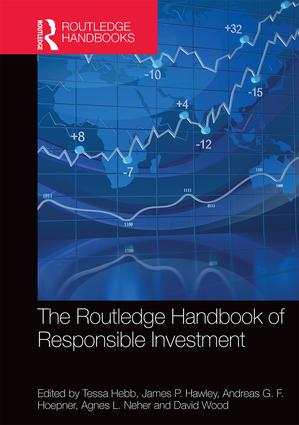
Bonjour à toutes et à tous, si la problématique si actuelle de l’investissement socialement responsable (ISR) vous intéresse, nul doute que ce bel ouvrage suscitera votre curiosité : « The Routledge Handbook of Responsible Investment » (T. Hebb, J. P. Hawley, A. G.F. HOEPNER, A. L. Neher et D. Wood) chez Routledge.
The UN-supported Principles for Responsible Investment initiative has led to around a third of the world’s financial assets being managed with a commitment to invest in a way that considers environmental, social or governance (ESG) criteria. The responsible investment trend has increased dramatically since the global financial crisis, yet understanding of this field remains at an early stage.
This handbook provides an atlas of current practice in the field of responsible investment. With a large global team of expert contributors, the book explores the impact of responsible investment on key financial actors ranging from mainstream asset managers to religious organizations.
Offering students and researchers a comprehensive introduction to current scholarship and international structures in the expanding discipline of responsible investment, this handbook is vital reading across the fields of finance, economics and accounting.
À la prochaine…
Ivan Tchotourian
autres publications mission et composition du conseil d'administration Normes d'encadrement
Comité de nomination : un intéressant rapport britannique
Ivan Tchotourian 24 mai 2016
En mai 2016, l’Institute of Chartered Secretaries and Administrators (ICSA) a publié avec Ernst & Young un rapport sur le rôle du comité de nomination : « The Nomination Committee – Coming out of the Shadows ».
While its role may be less clearly defined than that of the audit committee, and its profile lower than that of the remuneration committee, it is arguably the most important of the three. It plays a pivotal role in appointing directors to the board and, if the board lacks the right balance, knowledge, skills and attributes, the likelihood of it and its committees operating effectively is greatly reduced.
Concernant sa mission et ses membres, il est précisé les points suivants :
-
What the appropriate role of the committee should be, e.g., whether the committee should look at executive talent if it does not already do so, and whether the board would benefit from combining the committee into a nomination and governance committee.
-
Whether the following processes are clearly linked: the discussion of current board composition and future composition in light of the company’s strategy, the executive and senior talent succession planning and company strategy, the outcome of the board evaluation exercise and board succession plans, and the link between board evaluations and development and training plans.
-
The existence of a two-pronged approach to identify succession plans in both emergency and steady-state situations.
À propos de la planification de la relève et la détection de talent, le rapport mentionne relativement au comité :
-
The extent to which nomination committee looks across the market and internally to identify four or five potential successors to the CEO.
-
How deeply into the organisation the committee should be looking to identify future talent.
-
The best way to develop the skills of future executive leaders in the business.
À la prochaine…
Ivan Tchotourian
mission et composition du conseil d'administration normes de droit
Proposition de loi américaine pour accroître la diversité dans les CA
Ivan Tchotourian 24 mai 2016
Le 7 mars 2016, a été introduit le projet H.R. 4718 Gender Diversity in Corporate Leadership Act of 2016 par Carolyn B. Maloney à la Chambre des représentants.
To require the Securities and Exchange Commission to establish a Gender Diversity Advisory Group to study and make recommendations on stratégies to increase gender diversity among the members of the board of directors of issuers, to amend the Securities Exchange Act of 1934 to require issuers to make disclosures to shareholders with respect to gender diversity, and for other purposes.
Pour suivre l’évolution législative de ce projet, cliquez ici.
À la prochaine…
Ivan Tchotourian
autres publications mission et composition du conseil d'administration Normes d'encadrement responsabilisation à l'échelle internationale
Droits de l’homme et CA : un guide en 5 étapes
Ivan Tchotourian 24 mai 2016
L’EHRC vient de publier un guide « Business and human rights – A five-step guide for company boards » bien intéressant pour les CA. Comme le précise ce document : « We recommend that boards should follow five steps to ensure that their company is fulfilling its responsibility to respect human rights in a robust and coherent manner that meets the expectations of the UN Guiding Principles and UK statutory reporting obligations. Boards should be aware of the company’s salient, or most severe, human rights risks, and ensure ».
The following are the five steps that it is recommended boards should follow to ensure that their company is fulfilling its responsibility to meet human rights in a robust and coherent manner that meets the expectations of the UN Guiding Principles and UK statutory reporting obligations:
- the company should embed the responsibility to respect human rights into its culture, knowledge and practices;
- the company should identify and understands its salient, or most severe, risks to human rights;
- the company should systematically address its salient, or most severe, risks to human rights and provide for remedies when needed;
- the company should engage with stakeholders to inform its approach to addressing human rights risks; and
- the company should report on its salient, or most severe, human rights risks and meet regulatory reporting requirements.
Attention : encore une fois, tout cela n’est que du droit international et donc du droit « mou ». Ce guide l’exprime très bien en ces termes : « The Guiding Principles do not create any new international legal obligations on companies, but they can help boards to operate with respect for human rights and meet their legal responsibilities set out in domestic laws ».
À la prochaine…
Ivan Tchotourain
mission et composition du conseil d'administration rémunération
Siéger sur un comité de rémunération : de plus en plus risqué !
Ivan Tchotourian 22 mai 2016
Siéger sur un comité de rémunération serait-il risqué ? Oui et de plus en plus selon un article du Financial Times : « Executive pay committee chair in the hot seat » (2 mai 2016). Les actionnaires semblent en effet tourner leur grogne touchant la rémunération vers les membres du comité,
In the most high-profile shareholder protests seen in the UK for four years, investors have been directing their anger squarely at company bosses for their multimillion pound pay packets. (…)
With pay protests set to continue in the coming weeks, some are now turning their sights on the people who determine the bumper awards, rather than the recipients. This puts the chairs of remuneration committees directly in the line of fire — an unusual position for the holders of these generally low-profile posts. Few, if any, remuneration committee chairs are household names. But, in conjunction with their committee members, they wield immense power. Not only do they decide the fixed salary of the boss, but they also determine the bonus structures that provides the lion’s share of a pay package.
À la prochaine…
Ivan Tchotourian
mission et composition du conseil d'administration objectifs de l'entreprise
Les P-DG vont-ils parler de plus en plus de RSE ?
Ivan Tchotourian 22 mai 2016
Les P-DG devraient investir davantage le terrain de la RSE dans leur déclaration. C’est en substance ce que l’on apprend d’un article du Wall Street Journal intitulé : “Salesforce’s Marc Benioff has kicked off new era of corporate social activism” (2 mai 2016).
Mr. Benioff is among CEOs of companies, including Apple Inc., Bank of America Corp., Walt Disney Co., Intel Corp. and International Business Machines Corp., that have begun pressuring lawmakers on social issues, often with a warning: Change laws or risk losing business.
That is a departure from the past, when U.S. CEOs often avoided weighing in on social issues lest they incur backlash from shareholders, customers and other constituents.
Now, the risk may be in not speaking up. “Our jobs as CEOs now include driving what we think is right,” says Bank of America CEO Brian Moynihan. “It’s not exactly political activism, but it is action on issues beyond business.
À la prochaine…
Ivan Tchotourian
Normes d'encadrement
Nouveau code de gouvernance britannique à l’horizon
Ivan Tchotourian 22 mai 2016
Avis à toutes et à tous, c’est le 17 juin 2016 que le nouveau code de gouvernance britannique rentrera en vigueur. Cette modification du code s’accompagne de modifications substantielles dans le domaine de l’audit (ici).
Following the 2014 Code amendments, which focussed on the provision by companies of information about the risks which affect longer term viability, the FRC will continue to monitor compliance with these changes. Companies should be presenting information to give a clearer and broader view of solvency, liquidity, risk management and viability. For their part, investors should assess these statements thoroughly and engage accordingly.
Pour accéder au (futur) nouveau code : cliquez ici.
À la prochaine…
Ivan Tchotourian