Archives
Gouvernance mission et composition du conseil d'administration Normes d'encadrement
CA et enjeux assurantiels
Ivan Tchotourian 24 avril 2022 Ivan Tchotourian
Rarement évoquée, la question des enjeux assurantiels mérite d’être discutée dans les CA. Du moins, je vous invite à lire cet article de La Tribune : « Pourquoi et comment associer les conseils d’administration aux enjeux assurantiels ? » de Marc Verspyck.
Extrait
Les conseils d’administration sont désormais résolument actifs en matière de cartographie des risques, mais sont-ils au fait des couvertures assurantielles existantes sur le marché et souscrites par l’entreprise ? Un sujet souvent traité par des spécialistes internes – mais in fine, qui valide les orientations ? En l’absence de revue par les commissaires aux comptes ou d’autres intervenants indépendants, l’implication des administrateurs peut donc se poser, dans un cadre que nous proposons de définir.
(…) Mais soyons clairs : un conseil d’administration n’a pas pour objet de rentrer dans le détail, de passer en revue des tableaux d’occurrence et de subsister au management. C’est donc d’une autre manière que cette supervision doit être conduite ; à chaque contexte et sensibilité au risque, une approche plus ou moins détaillée peut être proposée, ou avec le soutien d’un œil extérieur. Un comité de direction pourrait par exemple assurer au conseil qu’il a pris soin de passer ces sujets en revue et lui transmettre une synthèse.
(…) Il n’en demeure pas moins que l’entreprise se doit de vérifier le degré de couverture et les risques résiduels. Il n’est pas question ici de « sur-assurer » ou d’adopter un comportement pusillanime en « ouvrant des parapluies » pour se protéger juridiquement. On peut arguer du contraire : comment améliorer les actions préventives, diminuer les coûts et alerter les équipes managériales sur ces sujets (et donc aligner les revues et les reportings en ce sens). Au fond, et en simplifiant, comment un board peut-il évaluer la performance d’un groupe s’il ne s’attache qu’à la revue des risques et non aux actions de « mitigation » et aux couvertures assurantielles correspondantes ? Il en sera réduit à constater après coup les conséquences d’un incendie de data center, la défaillance d’un gros client ou les effets d’un rançongiciel.
À la prochaine…
Gouvernance
Facteurs ESG et entreprises
Ivan Tchotourian 23 avril 2022 Ivan Tchotourian
Dans son billet de Les affaitres.com, Mme Champoux-Paillé revient sur les facteurs ESG et leur importance pour les entreprises : « Garder les facteurs ESG au cœur des préoccupations des entreprises » (4 avril 2022).
Extrait
Les chefs d’entreprise considèrent de plus en plus le développement durable comme un clé de leur mission et l’intègrent dans leurs principes et leurs stratégies afin d’assurer la pérennité des entreprises.
Toutefois, lorsque les tensions économiques sont fortes ou en temps de crise, les dirigeants peuvent avoir tendance à se concentrer sur la rentabilité à court terme, reléguant parfois au second plan les facteurs ESG.
Un défi futur consistera à s’assurer que le développement durable demeure au cœur des préoccupations des entreprises, quel que soit l’environnement économique ambiant.
À la prochaine…
Publications Structures juridiques
Lecture conseillée : Corporate Purpose and Personhood
Ivan Tchotourian 12 avril 2022 Ivan Tchotourian
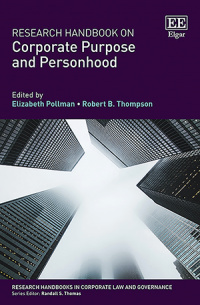
Bel ouvrage touchant la raison d’être et la personnalité morale que propose Edward Elgar Publishing : « Research Handbook on Corporate Purpose and Personhood ».
Table des matières
PART I JUMPING OFF POINTS FOR A NEW LOOK
AT TRADITIONAL TOPICS
1 What Jensen and Meckling really said about the public company 2
Brian R. Cheffins
2 Business purpose and the objective of the corporation 27
Edward B. Rock
3 A more equitable corporate purpose 47
Veronica Root Martinez
PART II SHAREHOLDERS VS. STAKEHOLDERS, BENEFIT
CORPORATIONS, AND ESG
4 The “value” of a public benefit corporation 68
Jill E. Fisch & Steven Davidoff Solomon
5 Enlightened shareholder value, stakeholderism, and the quest for
managerial accountability 91
Dorothy S. Lund
6 The shareholder-stakeholder alliance: exposing the link between
shareholder power and the rise of a corporate social purpose 109
Lisa M. Fairfax
7 ESG investing, or, if you can’t beat ’em, join ’em 130
Ann M. Lipton
8 Purpose in business association statutes: much ado about something
(but not much) 148
Brett McDonnell
9 For whom is the corporation managed and what is its purpose?
A stakeholder perspective based on the law of Delaware 165
Cynthia A. Williams
PART III BROADER THEORETICAL FOUNDATIONS FOR
GROUNDING VIEWS OF CORPORATE PURPOSE AND
PERSONHOOD
10 Shareholder primacy is illogical 186
Frank Partnoy
11 The “franchise” view of the corporation: purpose, personality, public policy 201
Saule T. Omarova
12 Corporate personality, purpose, and liability 222
Paul B. Miller
13 Facts and values in corporate legal theory 240
James D. Nelson
PART IV CORPORATE PERSONALITY, POLITICS, AND RIGHTS
14 Regulatory partitioning as a key function of corporate personality 263
Mariana Pargendler
15 Corporate personhood and the putative First Amendment right to discriminate 283
Kent Greenfield & Daniel A. Rubens
16 The corporation’s political purpose 299
Sarah C. Haan
17 Personhood, procedure and the endurance of corporate compliance 320
Miriam H. Baer
PART V LESSONS FROM COMPARATIVE AND INTERNATIONAL
STUDY AND POSSIBLEWAYS FORWARD
18 Beyond shareholder value: exploring justifications for a broader
corporate purpose 344
Martin Petrin
19 Lessons from India’s struggles with corporate purpose 362
Afra Afsharipour
20 Varieties of shareholderism: three views of the corporate purpose cathedral 386
Amir N. Licht
Publications
Conseil de lecture : The capitalist and the activist
Ivan Tchotourian 12 avril 2022 Ivan Tchotourian
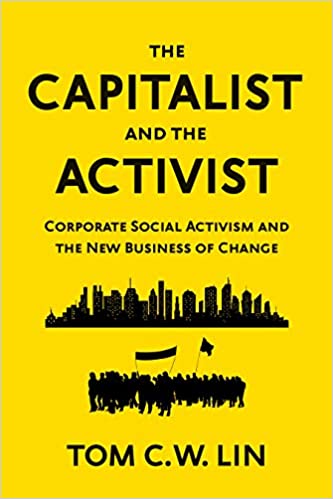
Ouvrage intéressant que vient de publier Tom C.W. Lin : « The Capitalist and the Activist: Corporate Social Activism and the New Business of Change » (Berrett-Koehler Publishers, 2022). À découvrir…
Résumé
Today, corporations and their executives are at the front lines of some of the most important and contentious social and political issues of our time, such as voting rights, gun violence, racial justice, immigration reform, climate change, and gender equality. Why is this sea change in business and activism happening? How should executives and activists engage one another to create meaningful progress? What are potential pitfalls and risks for each side? What can they learn from each other? What first principles should guide leaders moving forward?
The Capitalist and the Activist offers an engaging and thoughtful look at the new reality of corporate social activism—its driving forces, promises and perils, and implications for our businesses and personal lives. Weaving deep research and fascinating stories that span business, entertainment, history, science, and politics, Tom Lin provides an insightful road map for how society arrived here and a practical compass for moving forward. Drawing together examples from the civil rights movement, campaign finance litigation, gun regulation, Black Lives Matter, the Confederate flag controversy, the Trump presidency, and other historical events, Lin brilliantly reveals and charts the course for a changing society of capitalists and activists seeking both profit and progress.
The Capitalist and the Activist is a must-read for anyone trying to understand the emerging future of activism, business, and politics.
À la prochaine…
Gouvernance mission et composition du conseil d'administration
Mondialisation de la gouvernance d’entreprise
Ivan Tchotourian 12 avril 2022 Ivan Tchotourian
M. Peregrine fait une lecture des conséquences de la guerre en Ukraine sous le prisme de la gouvernance d’entreprise en proposant de revisiter les notions de risques globaux et de gouvernance globale : « The Globalization Of Corporate Governance » (Forbes, 13 mars 2022).
Extrait
The global economic sanctions against Russia, and the potential impact of their application, will have significant governance implications for U.S. corporations. This will be the case regardless of whether they have been direct participants in the sanctions process or are just observers, indirectly affected by what is expected to be a significant spillover effect.
(…) The most immediate governance impact will likely be with respect to decisions on conducting business in Russia or with Russian-based companies, as well as participation in the delivery of humanitarian aid to Ukraine and its citizens. The more long-term impact may be on the need for more focused board oversight of the economic, social and political implications of a possible return to a global West/East Cold War environment.
(…)
Global considerations have long been a staple of sophisticated corporate enterprise risk programs, but have been monitored with varying degrees of commitment by the board’s audit and risk committees. They have typically addressed risks which are grounded principally in “whole world” environmental, social, health and cultural issues. Particular “ERM” global risk focus has been on such recognizable topics as climate change, climate inaction, infectious diseases, erosion of social cohesion and natural resource deterioration.
Additional risks, as identified by the World Economic Forum’s 2022 Global Risk Report, include labor market gaps, protectionism, educational disparities, greater barriers to international mobility, and crowding and competition in space, as well as supply chain and operating challenges impacted by foreign economic trends. All of these are, of course, legitimate enterprise risks. They are worthy of consideration by the boards of directors of U.S. companies, especially when viewed through the experience of a multi-year global pandemic. But they have not always been addressed with any degree of priority or urgency by the board.
(…) Specific elements of these new global risks to be considered by the board, or its ERM committee, might include the following:
Je vous laisse découvrir la suite !
À la prochaine…
actualités canadiennes Divulgation divulgation extra-financière Normes d'encadrement Responsabilité sociale des entreprises
Faire confiance aux entreprises, vraiment ?
Ivan Tchotourian 12 avril 2022 Ivan Tchotourian
Drôle de tribune qu’offre Francis Vaille dans La Presse : « Comment faire confiance aux entreprises ». Cette tribune interpelle le lecteur sur le contenu de l’information non financière et ses conséquences sur la réalité de la divulgation des entreprises en matière de GES.
Extrait
Pour l’instant, certaines entreprises en Bourse publient des renseignements sur leurs émissions de GES par million de dollars de valeur ou de revenus de façon volontaire. Elles se basent notamment sur les travaux menés par le groupe de travail sur les informations financières liées au climat (TCFD).
Les normes demeurent toutefois imprécises et incomplètes. Elles incorporent souvent les émissions de premier et de deuxième niveau – celles faites par l’entreprise elle-même –, mais pas celles de leurs fournisseurs. La norme ISSB proposera une norme commune par industrie pour les trois niveaux.
Et d’ici peu, les autorités des valeurs mobilières rendront la publication obligatoire.
À la prochaine…
devoir de vigilance Gouvernance Responsabilité sociale des entreprises
Ending Human Rights Abuses in which Companies and States are Complicit
Ivan Tchotourian 12 avril 2022 Ivan Tchotourian
Le professeur Paul Davies commente la récente directive européenne sur le devoir de vigilance et rappelle une chose essentielle : les États ont un rôle à jouer ! À lire : « Ending Human Rights Abuses in which Companies and States are Complicit » (Oxford Business Law Blog, 5 avril 2022).
Extrait
The company’s actions under Arts 6-8 are subject to supervision by authorities (to be established in each Member State, not a Union level), which are to have a wide range of enforcement powers, including the imposition of financial penalties linked to turnover. In addition, those harmed by adverse impacts are to be given a right to sue companies in the courts of the Member States (for damages among other remedies), though it is unclear from Art 22 how far the Member State needs to modify its domestic liability system when transposing that Article.
One way to think about what the above might mean for companies is to ‘stress test’ the provisions in the context of the most distressing, widespread and difficult-to-fix human rights cases which recent litigation around the world has revealed. These are cases where the host state of a multinational’s operations is complicit in the abuses.
In my view, litigation and straight-down-the-line supervisory action are unlikely to bring about a satisfactory forward-looking resolution to these deep-seated problems. If exit is to be a true last resort for companies covered by the proposal, what is needed is an inducement for companies to exercise voice rather than exit. And that voice is likely to have to be, not that of the company alone, but part of a cooperation among the company, the host state, local communities and overseas development agencies. A company playing its part in the cooperation should be granted protection against both litigation and supervisory action. Look as hard as one likes, however, no such safe harbour provisions are to be found in the Commission’s proposal. In fact, Art 18(4) specifically rules out protection against supervisory sanctions and private litigation when the company engages in remedial action after being found in breach. In short, the proposal is a standard, backward-looking set of provisions for imposing liability on companies, not a blue-print for cooperative efforts to end abuses in the future. In the most difficult cases where it is most desirable to alter behaviour, exit is what the Commission’s proposal is likely to induce, with uncertain or no benefits for the victims of the abuses.