Archives
Nouvelles diverses Responsabilité sociale des entreprises
RSE : pratiques des entreprises canadiennes
Ivan Tchotourian 23 novembre 2020 Ivan Tchotourian
Numéro intéressant de Les affaires avec une série d’articles : « Des valeurs qui ont de la valeur » (11 novembre 2020).
Ceux qui accordent une grande attention à la responsabilité sociétale des entreprises (RSE) vous le diront : l’altruisme peut se transformer en actifs. L’envie de contribuer au bien commun qui anime ces entrepreneurs ne les empêche pas d’obtenir un rendement intéressant ; au contraire. Par ailleurs, si la pandémie a servi d’accélérateur au virage « solidaire » de certaines entreprises, d’autres ont seulement poursuivi sur leur lancée. Dans les deux cas, elles sortiront de la crise avec un avantage comparatif aux yeux de plusieurs.
Pour en savoir plus :
À la semaine prochaine
Gouvernance Normes d'encadrement rémunération
Rémunération et COVID-19
Ivan Tchotourian 12 novembre 2020 Ivan Tchotourian
L’Harvard Law School Forum on Corporate Governance publie une intéressante synthèse portant sur la rémunération des hauts dirigeants en période post-pandémie : « Evolving Compensation Responses to the Global Pandemic » (par Mike Kesner, Sandra Pace et John Sinkular, 7 novembre 2020).
Résumé :
- For many of the companies severely harmed by the global pandemic, immediate cost-cutting measures were necessary to protect the business including furloughs, layoffs, suspended 401(k) matching contributions, and base salary reductions for most/all of the workforce.
- Many of these companies approved their fiscal 2020 annual and long-term incentive (LTI) plans and prior LTI performance awards (i.e., 2018-2020 and 2019-2021 cycles) without any consideration for a global pandemic. These incentives often represent ≥50% of an executive’s annual compensation (≥70% in the case of the CEO), and it is highly likely the performance-contingent incentives are tracking to a zero payout and time-vested restricted stock units (RSUs) have greatly diminished in value.
- The reduced value of realizable compensation directionally aligns with companies’ pay-for-performance (P4P) philosophies; however, the reductions are largely based on an unprecedented shutdown of the global economy due to health concerns and a reshaping of how many companies will “do business” now and into the future.
- Severely harmed companies are assessing the near- and long-term implications of the downturn on all stakeholders and determining if changes to annual and long-term incentive programs are appropriate to balance the company’s talent goals with its P4P philosophy.
À la prochaine…
Gouvernance Normes d'encadrement Nouvelles diverses Valeur actionnariale vs. sociétale
Varieties of Shareholderism: Three Views of the Corporate Purpose Cathedral
Ivan Tchotourian 12 novembre 2020 Ivan Tchotourian
À lire cet intéressant article du professeur Licht : Amir Licht, « Varieties of Shareholderism: Three Views of the Corporate Purpose Cathedral », 19 octobre 2020, European Corporate Governance Institute – Law Working Paper No. 547/2020.
Résumé :
This Chapter seeks to make three modest contributions by offering views of the corporate purpose cathedral that bear on the role of law in it. These views underscore the difference and the tension between an individual perspective and a societal/national legal perspective on the purpose of the corporation. First, it reviews a novel dataset on national legal shareholderism – namely, the degree to which national corporate laws endorse shareholder primacy – as an exercise in operationalizing legal constructs. Second, it anchors the two archetypal approaches of shareholderism and takeholderism in personal human values. It is this connection with the fundamental conceptions of the desirable which animates attitudes and choices in this context. The upshot is potentially subversive: Legal injunctions to directors on corporate purpose might be an exercise in futility. Third, this Chapter highlights the importance of acknowledging the tensions between the two levels of analysis by looking at the works of prominent writers. Adolf Berle, Victor Brudney, and Leo Strine have been careful to keep this distinction in mind, which has enabled them to hold multiple views of the cathedral without losing sight of it.
À la prochaine…
Nouvelles diverses Responsabilité sociale des entreprises
Réputation et droit : un ouvrage
Ivan Tchotourian 12 novembre 2020 Ivan Tchotourian
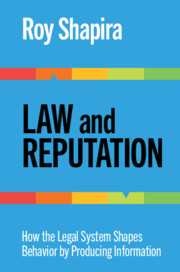
Bel ouvrage qui intéressera nos lectrices et lecteurs du blogue : « Law and reputation » (de Roy Shapira). Ce livre vient enrichir la réflexion sur le mécanisme de réputation qui est particulièrement important en matière de RSE.
Pour un résumé de cet ouvrage : ici
Résumé :
The book starts with the basic questions of what reputation is and why it is noisy. Not all bad news is created equal. Some companies and businessmen emerge from failures unscathed while others go bankrupt. To better understand why similar behaviors lead to different reputational outcomes, I break the process of reputational sanctioning into its different components: revelation, diffusion, certification, and attribution of information. Damning information has to be widely diffused so that it reaches a critical mass of stakeholders in order for the reputational sanction to be meaningful. Information that was widely diffused has to be certified as credible for the company’s stakeholders to consider it seriously. And information that was diffused and certified has to first be attributed to deep-seated flaws that are likely to reoccur in the future, in order for the company’s stakeholders to update their beliefs and act on it.
Law enforcement—both private and public—can affect the process of reputational sanctioning along each of the abovementioned stages. Think for example about internal emails exposed during the discovery stage, revealing a systematic cover-up or total lack of checks and balances throughout the corporate hierarchy. Litigation thus affects reputation by uncovering information to which market players were not privy. Litigation also affects reputations without producing new information, simply by changing the framing, credibility, and saliency of existing pieces of information. In particular, litigation shapes the scope and tenor of media coverage. To illustrate, I analyze the content analysis of the investigative projects that won the Pulitzer Prize over the last twenty years, finding that “legal sources” (court documents, regulatory investigation reports, and so on) are more often than note the key source for such media investigations (a separate article elaborates).
The bulk of the book is dedicated to specific applications of the law-and-reputation framework. Consider the following three issues, all frequently debated in this blog.
The first example comes from corporate fiduciary duty litigation. Directors may not fear the highly unlikely prospect of paying out of pocket in litigation, but they fear the nonlegal costs that come with litigation, such as having their shenanigans or faulty processes exposed in discovery and called out by an expert Delaware judge. By analyzing corporate law doctrines through their impact on information production, we get a fresh perspective on much-debated features, such as Delaware’s recent expansion of shareholders’ right to inspect the company’s books and records (I wrote elsewhere about the rise of section 220 and how it is reshaping deal negotiations and oversight duties).
A second application concerns the SEC’s enforcement practices, which became the center of national debate in the wake of the 2007-2009 financial crisis. While the existing debate revolves around the amount of money being paid or admissions being collected in SEC settlements, the reputational framework offers an alternative way to measure the effectiveness of SEC enforcement. The real problem with SEC settlements is not that the SEC leaves money on the table, but rather that the SEC leaves information on the table. Both the SEC and big-firm defendants have incentives to settle quickly and for high amounts, in exchange for limiting the public release of damning information. Such information-underproduction dynamics are good for both parties but bad for society at large. The reputational framework helps us identify solutions, like evaluating the proper scope of judicial review of SEC actions.
A third, timely issue that the reputational framework sheds light on is the proliferation of mandatory arbitration clauses that effectively waive class actions. With the blessing of the Supreme Court, mandatory arbitration provisions with class action waivers have become common in contract, consumer, and labor law. Policymakers now consider importing this trend to corporate and securities laws as well. The existing debate centers around consent and compensation: Can shareholders be held to consent to arbitration provisions in the company’s corporate governance documents? Are shareholders better off with arbitration, given that litigation currently offers them very little compensation (with high fees)? Yet the extant debate misses the forest for the trees. Even if shifting from litigation to arbitration may be good for a specific company and its investors, it may prove detrimental to the market overall. We will lose the positive externality (in the form of quality information on corporate behavior) that comes with litigation. A shift to mandatory arbitration may therefore reduce the administrative costs of litigation, but hurt the ability of the market to discipline itself. In other words, mandatory arbitration provisions may reduce the effectiveness of reputational deterrence, and therefore be bad for investors as a group.
My book thus centers around one overarching point: the law shapes behavior not just through imposing sanctions, but also through producing information. In the course of fleshing out this point and examining the interactions between law and reputation, the book contributes to various other debates beyond the ones highlighted here, such as the desirability of heightened pleading standards, or whether to assess director liability individually or collectively.
At a more general level, delving into the interconnections between law and reputation allows us to revisit the age-old policy debate over legal intervention. Two binary camps have been dominating this debate: one advocates “leaving things to the market” while the other calls for “ramping up legal sanctioning.” Yet those who oppose legal intervention fail to recognize the importance of the legal system for the functioning of market discipline. And those who advocate for more legal sanctions fail to recognize the ability of the legal system to shape behavior indirectly, without interfering with business decisions. Sometimes the most effective and realistic way to promote deterrence is not to increase legal sanctions, but to increase the quantity and quality of information production.
À la prochaine…
Gouvernance
Reimagining Capitalism in the Shadow of the Pandemic
Ivan Tchotourian 6 novembre 2020 Ivan Tchotourian
Belle tribune de Rebecca Henderson dans le Harvard Business Review – Economics & Society : « Reimagining Capitalism in the Shadow of the Pandemic » (28 juillet 2020). a mise en perspective est intéressante et l’exemple de l’entreprise Kodak très parlant…
Extrait :
Instead, I want to reimagine capitalism, or at least our current version — the one that is obsessed with the short term and that doesn’t believe that business needs to care about the health of our society or our institutions. Doing so is the best way to ensure both businesses and our society prosper in the decades ahead.
The Pandemic’s Challenges — and Opportunities
Capitalism is one of the great inventions of the human race — an unparalleled source of prosperity, opportunity and innovation. We won’t solve the problems that we face without it. To solve inequality, we need good jobs — and lots of them. To solve climate change, we need (among other things) to transform the world’s energy, transportation, and agricultural systems. Only the relentless pressure of the free market can drive this kind of transformative innovation at scale.
In this context, the pandemic is both a massive challenge and an opportunity. A challenge because more than a half a million people have died, the global economy has been massively disrupted, and tens of millions of people have lost their jobs. A challenge because the combination of deep economic disadvantage — at the beginning of May nearly 61% percent of Hispanic and 44% of Black households had experienced a job or wage loss due to the corona virus, for example, compared with 38% percent of whites — and the killings of George Floyd, Ahmaud Arbery, Breona Taylor and countless others have brought anger and calls for justice to our streets. The world will almost certainly be poorer, more divided, and more fearful in 2021 than it was in 2019.
It’s an opportunity because it has also shown us so vividly what is wrong. Inequality is no longer simply an abstract idea. It’s a reality that many “essential” workers must show up even when they’re sick because they have no savings and no paid leave. That racism is not something that was solved by the civil rights movement. As the skies clear and early research suggests that the reduction in fossil fuel pollution is saving lives, the costs of continuing to rely on dirty energy have become much more tangible. Watching states bid against each other for vital medical equipment while the federal government fumbles its response to the virus has made the reality of our broken politics very clear.
The pandemic has reminded us that we stand and fall as a society and that the welfare of the poorest among us is integral to everyone’s welfare. It has shown us that planning for the future is essential and that, when the chips are down, a capable, responsive government is a necessity, not a dirty word. We’ve learned that when we must do something, we can: Fundamental change no longer seems impossibly out of the reach.
We can do better. We already have the resources and the knowledge we need to build a more equitable, sustainable capitalism. But to get there, business will have to change how it understands its role in the world (and in the U.S. in particular) — and how it thinks about government.
A New Path Forward
While free markets are an unparalleled source of prosperity and freedom, the free market can only take us where we need to go if externalities such as carbon pollution are properly priced, if there is genuine freedom of opportunity, and if the rules of the game are such that competition is free and fair. Markets do not police themselves; they must be balanced by transparent, capable, democratically accountable governments.
Today — in large part due to the rise of shareholder primacy, the increasing role of money in politics, and the systematic attack on government as a necessary or effective institution — that balance is largely absent. As a result, one of the fastest routes to profitability is often to persuade politicians to write the rules in your favor. Firms feel free to dump greenhouse gases into the atmosphere, for example, while spending hundreds of millions of dollars to lobby against carbon regulation. We’re even seeing this dynamic in the U.S. government’s response to the pandemic: It’s increasingly clear that an uncomfortably large share of the benefits from the recent stimulus has gone to very large firms and to very wealthy individuals.
I’m not suggesting that firms neglect their duty to their shareholders. Focusing on profitability is essential if a company is to thrive in today’s brutally competitive market. But profit maximization has always been a means to an end, justified by the idea that when markets are genuinely free and fair, there’s good reason to believe they lead to both prosperity and freedom.
But when markets are no longer held in check by governments that can police the rules of the game, appropriately control externalities, or provide the public goods necessary to support real opportunity, they become too powerful for their own good. The chaotic and uneven pandemic response we are experiencing today flows directly from 30 years of treating government as something that should be “drowned in the bathtub.”
Now more than ever, I believe firms have not just a moral duty to contribute to the health of the institutions that keep our society strong and our capitalism genuinely free and genuinely fair, but also an economic interest in doing so. We need to rebuild our democracy, strengthen our public conversation so that it’s firmly based on facts and mutual respect, commit with everything we have to building an inclusive society for everyone, and yes, find ways to rediscover the importance of democratically accountable, capable, responsive government.
Why? We cannot decarbonize the world’s energy supply without government regulating fossil fuel emissions and providing positive incentives to embrace low carbon solutions. Yes, individual firms can provide better jobs — paying employees a decent wage and providing ongoing training, among other necessary steps — but we’ll only successfully address inequality and racism at scale through structural reform, if we can do things like: provide quality education and health care to everyone, no matter their parents’ income; raise the minimum wage; and find ways to give employees more power as they negotiate with increasingly powerful firms. Most fundamentally, we’ll only rebuild trust in the political system, and with it a government that is genuinely responsive to ordinary people, if we can get money out of politics and stop tolerating business’s attacks on government. These attacks are often framed in terms of defending the free market, but too often are simply attempts to block the action we need to build a more equitable society.
Collective action — a sustained effort by coalitions of firms — could make a huge difference in helping to drive this kind of institutional change. Firms are already working together to solve some of the world’s toughest problems. A third of the world’s invested capital is already committed to insisting that the firms in their portfolios plan for the challenge of climate change. Businesses across the world are increasingly coming to realize that democratically accountable, freely elected, capable governments are critical to long term economic health — and are willing to say so in public. But they need to do more.
A “Kodak Moment” for the World
I can feel your skepticism as I write. Can business really change — and help government change along with it? Can it embrace a version of capitalism that focuses on the longer term and the common good? Can it help to rebuild the power of the very institutions that are needed to keep it in check?
I believe it can. We already know that it is possible to make money by addressing the world’s social and environmental problems. Walmart saved a billion dollars in fuel costs by increasing the efficiency of their trucking fleet. Elon Musk has revolutionized the automotive business and built a company worth more than GM and Ford combined in the process. The most successful $200M+ IPO of the last 20 years was a company that promised to replace beef with a burger made largely from soy. At Unilever, so called “purpose-driven” brands are growing 69% faster than the rest of the portfolio as consumers increasingly vote with their wallets.
Change on a broader scale will be much harder. But not impossible. Think of this as a “Kodak moment” for the world. I spent the first 20 years of my career at MIT as a professor of innovation and strategy. For much of it I was quite literally the Eastman Kodak professor of management. My title was a coincidence — but a deeply ironic one, since I spent most of my time trying to understand why large, successful firms like Kodak had so much trouble responding effectively when the world around them changed.
By now the company’s story is well-known: Kodak was once one of the world’s most successful firms. The firm invented classic film-based commercial photography and used it to build one of the world’s most iconic brands. As one senior vice president and director of Kodak research noted in a 1985 Wall Street Journal article, “We’re moving into an information-based company…[but] it’s very hard to find anything [with profit margins] like color photography that is legal.” But Kodak went bankrupt in 2012, having failed to master the transition to digital photography.
The business community now faces a similar transition. As the Business Roundtable’s historic decision last year to “lead their companies for the benefits of all stakeholders” suggested, the vast majority of the world’s leading firms know that we must tackle the challenge of climate change, that we must find a way to ensure that everyone has a chance to share in the world’s wealth, and that it’s vital that we not let democracy lose out to either oligarchy or tyranny. We know that we need to change. But too often it’s tempting to emulate Kodak, claiming that change will come — but not now. Insisting that it’s more profitable to stick with the old ways, that if it’s really important we’ll get around to doing something new — later. Change is hard. It’s not surprising that we’re struggling to adopt new ways of thinking about the world and business’s role in it.
But I am hopeful. Not optimistic, in the sense that I’m sure everything will work out just fine — I’m not sure of that at all. But hopeful. As a species, we have a gift for problem solving. Kodak failed to manage the digital transition, but Nikon, Canon and Fujifilm continue to be billion-dollar companies. Thousands of firms and millions of people are even now exploring ways to solve our common problems — for example, firms are partnering with each other and with governments to search for vaccines and to bring people back to work safely. This kind of cooperation must continue beyond the pandemic. As recent data shows, trust in business has fallen during the pandemic, but trust in government has risen dramatically. There is no better time for business to see government as a partner, not an adversary, in helping to make society work everyone — not just the lucky few.
We can learn from the horrors of the pandemic. We must. We don’t need to go back to “normal” — we need to reimagine capitalism instead. We need to find a way to balance the energy of the free market with the power of competent, responsive government. Together, they can help us build a more just and sustainable world.
À la prochaine…
actualités canadiennes Gouvernance normes de droit
Droit de parole en assemblée : le MÉDAC mécontent
Ivan Tchotourian 6 novembre 2020 Ivan Tchotourian
Sous le titre suivant « Droit de parole verbal des actionnaires aux assemblées annuelles des sociétés par actions », le MÉDAC a partagé son expérience des dernières assemblées annuelles et son désarroi…
Je reproduis la lettre ci-dessous :
Montréal, vendredi le 30 octobre 2020
Éric Girard, ministre des Finances
390, boulevard Charest Est, 8e étage
Québec (Québec) G1K 3H4
Chrystia Freeland, ministre des Finances
90, rue Elgin
Ottawa (Ontario) K1A 0G5
Madame Freeland, Monsieur Girard, ministres des Finances,
La pandémie frappe le monde entier et il n’est pas possible de savoir quand le régime d’exception actuel prendra fin. Aussi, dans les circonstances, les assemblées annuelles des sociétés par actions, dont toutes les plus grandes, ont lieu virtuellement.
La tenue de pareilles assemblées virtuelles constitue une solution logique aux problèmes engendrés par la rigueur des consignes sanitaires de l’État. Cependant, les principes qui devraient encadrer ces assemblées ne sont pas respectés. Nous en témoignons. Calquer la pratique étasunienne ne suffit certes pas.
L’assemblée annuelle d’une société constitue le socle de sa légitimité quant à la délégation du contrôle de ses affaires aux administrateurs, par les actionnaires. Il en est ainsi depuis plusieurs centaines d’années. L’assemblée annuelle réunit les actionnaires. C’est leur assemblée à eux. Ceux-ci devraient pouvoir y prendre la parole verbalement, sur chaque point à l’ordre du jour. C’était du moins la pratique auparavant.
Les assemblées virtuelles devraient avoir pour objectif de reproduire, le plus fidèlement possible, l’ensemble des caractéristiques essentielles des véritables assemblées en personne, notamment le droit de parole verbal des actionnaires, en priorité.
Or, lors des assemblées virtuelles de cette année, de manière très générale, le droit de parole verbal a été refusé aux actionnaires. Nous le déplorons vivement.
Les Lois et les règlements devraient rendre ce droit de parole verbal explicite, comme il l’est dans la coutume, tel que confirmé dans la jurisprudence et repris par la doctrine. Le déni actuel de ce droit dans la pratique constitue un précédent inacceptable. Il faut agir.
Il s’agit là d’un seul problème parmi tous les autres qui doivent être réglés au sujet des assemblées virtuelles. C’est cependant le problème le plus important, à la source de plusieurs autres. Nous ne sommes pas seuls à penser cela. Par conséquent, nous vous invitons tous les deux à intervenir formellement pour régler la situation.
Nous demeurons bien évidemment disponibles pour discuter du détail de nos positions sur cette question (comme sur plusieurs autres), déjà communiquées à l’Autorité des marchés financiers (AMF), par ailleurs.
Prière d’agréer, Madame la ministre, Monsieur le ministre, notre considération cordiale.
Gouvernance Normes d'encadrement
COVID-19 : quel impact à long terme sur le gouvernance ?
Ivan Tchotourian 6 novembre 2020 Ivan Tchotourian
Sur le blogue d’Harvard, Michael W. Peregrine, Ralph DeJong et Sandy DiVarco reviennent en 10 points sur l’impact de la COVID-19 pour la gouvernance d’entreprise : « The Long-Term Impact of the Pandemic on Corporate Governance » (Harvard Law School Forum on Corporate Governance, 16 juillet 2020).
Extrait :
1. The Board/Management Dynamic
The board and management should be alert to the need for clarity on lines of decision-making authority between them.
The ability of both senior leadership components to execute their duties in times of crisis requires a shared understanding of the basic distinctions between the roles of governance and of management. This is particularly the case as both seek to satisfy enhanced expectations of their conduct created by the crisis.
The Business Roundtable’s statement of governance principles [1] ascribe to the board the basic responsibility for oversight of corporate management and business strategies, consistent with the goal of long-term sustainability. It ascribes to management responsibility for establishing, managing, and implementing corporate strategies, including but not limited to the day-to-day operations of the company under board oversight and updating the board on operational status.
But the line separating what is the responsibility of the board, and what is the responsibility of management, tends to blur in times of crisis. The absence of a “bright line” separating their respective duties can be the source of much leadership-level friction. It is vitally important that the parties work diligently to establish understandable lines of authority that assure the sustainability of organizational decisions and avoid confusion.
2. Greater Board Engagement
Boards of health care entities are likely to retain for the foreseeable future a heightened level of engagement with governance responsibilities, and with management.
Disasters, such as the pandemic, call for board involvement beyond that contemplated by basic governance principles. The pandemic presents such fundamental challenges to corporate stability that the organizational response cannot be delegated to executive management as it would be in the normal course, or even with more traditional crises.
It’s a level of engagement that will be difficult to withdraw from, at least for the near term. For one reason, commerce can be expected to remain in some uproar until public health concerns have been satisfactorily addressed. The leadership, scrutiny, and perspective offered by the board will remain at a premium. For another reason, the lasting impact of the crisis on industries and individual company business models will take time to realize and address. The board will need to remain at a heightened level of attentiveness to evaluate this change. In addition, it is now clear that boards can stay well involved through a variety of “virtual” means; it is logistically easier to perform their duties.
3. Oversight of Business Resiliency
The obligation to exercise oversight of business resiliency will become a primary board focus going forward.
The evolution of the pandemic to the resumption of sustained economic activity prompts the board to pivot to its unique oversight obligation for business resiliency. This refers to concepts of oversight that focus on long-term business and cultural ‘bounce-back’ from truly abrupt disruptions of cross-industry, national, or global proportions. It is a critical board obligation under the circumstances, but one that nevertheless should be exercised with discretion to avoid unnecessary conflict with management.
Business resiliency is an essential part of the board’s risk oversight function. It is grounded in the obligation to periodically review management’s plans to recover from catastrophe and disaster, including such tasks as business continuity, physical security, cybersecurity, and crisis management.
Ultimately, this responsibility encompasses several basic categories: whether there is a plan for getting the organization back on its feet; which corporate officers are designated to lead the effort; whether outside advisors are to be consulted; what are the features of the plan; when is it to be initiated; and whether it addresses workforce health, safety, and support.
4. Enterprise Risk Management
One of the most significant governance implications of the pandemic may be its impact on the role and function of the board’s enterprise risk management (ERM) committee.
From one perspective, the pandemic may serve to elevate that committee to a role of greater significance, potentially on a par with that of the audit committee. From a related perspective, it may prompt significant board contemplation of the level of oversight expected from that committee.
The catalyst for such change is grounded in five interconnected factors: (i) the broad-based application of ERM-focused board committees; (ii) the nature and scope of the pandemic; (iii) the environment of “second guessing” on risk preparedness likely to emerge from the pandemic; (iv) the extent to which the Caremark [2]oversight standard has evolved over the past year; and (v) the lessons on risk identification disaster response that individual corporations are certain to take from the pandemic.
COVID-19 has validated the need for a vital ERM function. Perhaps more significant is the extent to which it has confirmed that cataclysmic disasters can indeed occur and may henceforth be given greater consideration in the ERM risk identification process. These factors will, in turn, place a premium on close board evaluation on the effectiveness of the current ERM program.
5. Quality and Patient Safety
A much greater level of system-wide board collaboration with management on quality of care and patient safety concerns can be expected.
The pandemic has shone a spotlight on the vital role of the board in supporting management to ensure that both that emergency preparedness and response efforts are fully coordinated, and that the impacts of a large-scale effort are analyzed from the perspective of those who are ultimately responsible for the operation of the health care enterprise.
In the past, governing boards may have considered “operational” subjects like quality of care, infection prevention, and shifts in regulatory compliance as solely the province of management and staff. Going forward, the effects of the national health emergency and the lasting influence it will have on health care operations indicate these areas are appropriate for board-level review and decision making. Oversight and inquiry to ensure that management and health care leaders have pressure-tested their plans, and considered the effect on the organization as a whole, is well within the scope of the governing board.
By way of example, the exigencies of the pandemic and the attendant stresses due to lack of health care equipment, staff, and resources have brought to the fore complex issues like rationing care and development of “crisis standards of care.” Board involvement in vetting and adopting care protocols or care priorities developed by the organization is important, as the potential risks—legal, ethical, and reputational—rest squarely with the organization.
6. Executive Compensation
Compensation Committees (and CEOs) will focus on greater discretion in executive pay programs, and on finding a new balance between salary and performance
Indeed, the lessons of the pandemic suggest that the Compensation Committee will need to address a variety of important and sometimes unique compensation concepts that may prompt a long-term expansion of its agenda.
For example, the Committee and the CEO will want to reach a new understanding on CEO emergency powers to change executive compensation during a crisis. From a talent development perspective (and to avoid losing key executives before or during a crisis), the Committee will want to review the overall retention effect of executive programs and determine when retention will be weakest.
A key pandemic lesson is the benefit of having an appropriate level of Compensation Committee discretion built into all executive compensation and benefit arrangements. This includes the flexibility in a crisis not to pay something, or to pay it later, as well as the flexibility to pay something different or additional when extraordinary circumstances intervene.
Long-standing executive pay or benefit programs should be taken off auto pilot and given a fresh look. This includes reviewing supplemental retirement plans to understand all costs under a wider range of financial scenarios, to assess long-term affordability, and to add discretion to suspend new benefits during a crisis.
Executives will be expected to conduct their work outside the traditional office setting. A mobile leadership model will have implications for paid time-off programs, productivity, availability, and performance evaluation.
With many organizations coming out of a period of executive pay reductions, and likely an absence of incentive pay awards, the Committee will wrestle with how to restore executive compensation. The Committee will have to decide whether lost amounts are restored, whether pay increases will be through salary or greater incentive opportunity, and whether restored base salaries will at least make the organization competitive for key leadership talent.
7. Scenario-based Technology Planning
More rigorous board oversight will be exercised over long-term access to key technology, equipment, and
The health care economy has long relied on the availability and effectiveness of both technology and the technicians who operate and maintain it. The pandemic and its collateral impact on technology’s adaptability has shaken that reliance with significant resulting risk implications for physician groups, providers, and similar health care enterprises.
Going forward, boards will be expected to assure that management has in place an effective emergency technology plan. Such a plan would be designed to address events and scenarios in which technology, equipment, personnel, or some combination thereof becomes unavailable, and to build a map of probabilities. Based on each emergency type, the plan would confront an operating model without historically available technology and assure access to both an off-site backup technology, and to additional technical support. Such a plan would anticipate how long the organization can effectively operate under emergency conditions. It should also identify necessary steps to obtain and implement replacement technology, equipment, and personnel— and both the time frame and cost of doing so.
The primary responsibility for scenario-based technology planning will, of course, be that of the management team. Yet with the pandemic’s lessons in mind, the board should exercise robust oversight of management’s planning (including engaging in mock “tech outages”) to help assure organizational preparedness.
8. Oversight of Workforce Culture
Employee health and safety will become a more important element of the board’s workforce culture oversight responsibilities.
It is increasingly recognized that boards have a fiduciary responsibility to exercise oversight of corporate culture. This is grounded in the perspective that a positive organizational culture can be a meaningful corporate asset in a variety of ways (e.g., influencing operational performance, talent development, and organizational reputation). One of the recognized iterations of culture is its extension to employee morale, prevention of sexual harassment, and promotion of inclusion in the workforce.
With companies moving to reopen their business locations, culture issues are also extending to the health, safety and morale of the workforce. Employee concerns in this regard, and a general awareness of the safety of the workplace, are likely to remain well after the broad application of a vaccine or other treatment for the virus. The success of the organization’s post-pandemic business model may depend in part on the sensitivity it displays to employee virus-related concerns. This sensitivity is likely to expand to general health and safety matters. An informed and engaged board can be a support and guidance resource to management’s efforts to address these matters.
9. Oversight of Compliance
Boards may recalibrate the compliance function (and their oversight of that function), to address new risks and to seek efficiencies.
From a risk perspective, this effort will be driven by the implicit recognition that the post-pandemic era will witness a broadening of governmental authority in general, and an increasingly complex national and international regulatory environment in particular.
This can already be seen through requirements relating to accessing federal pandemic relief funds; increasing concerns with the security of information technology, antitrust issues in the labor market, and evolving regulations from the Food and Drug Administration, Centers for Medicare & Medicaid Services, and others.
From a management perspective, boards may see greater efficiencies by moving away from traditional vertical “silo” reporting arrangements for compliance officers, to arrangements that seek targeted accountability for, and greater integration among, the various legal, compliance, and risk functions. Such arrangements are intended to allow for greater collaboration between officers with risk-related responsibilities and to achieve related efficiencies and cost savings without disturbing futility bypass arrangements.
10. Succession Planning
Executive, officer, and director succession planning will require far more consideration at the board
For many organizations, leadership succession policies and procedures have been too insufficient or too informal to address the breadth of related succession challenges arising from the pandemic. Going forward, boards are expected to treat succession matters with an enhanced level of attentiveness and formality, which will provide value to the organization.
For example, the Compensation Committee (or a designated executive succession committee) should work with senior leadership to create or update the executive succession plan for key leadership positions. This would likely include addressing emergency vacancies, longer-term successors, developing leadership skills and experience in future leaders, and retention arrangements for key leaders being groomed.
Other unique executive succession issues to be considered include: the return to work of recently retired CEOs and CFOs to support their successors during the crisis environment; having executives share certain tasks and responsibilities; identifying an interim successor if a previously identified successor is not ready to assume the position; the process for transitioning to the new/interim/emergency CEO; designating an experienced board member to serve as emergency or interim CEO; and more aggressive planning for director succession.
À la prochaine…