Archives
autres publications Publications Responsabilité sociale des entreprises Structures juridiques
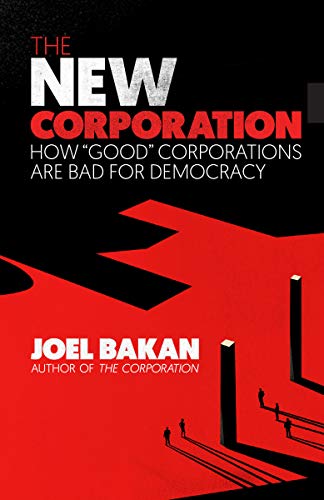
Nouvel ouvrage : The New Corporation: How « Good » Corporations Are Bad for Democracy
Ivan Tchotourian 16 septembre 2020 Ivan Tchotourian
Le professeur de UBC Joel Bakan nous gâte avec un nouvel ouvrage intitulé : « The New Corporation: How « Good » Corporations Are Bad for Democracy » (Allen Lane).
Résumé :
From the author of The Corporation: The Pathological Pursuit of Profit and Power comes this deeply informed and unflinching look at the way corporations have slyly rebranded themselves as socially conscious entities ready to tackle society’s problems, while CEO compensation soars, income inequality is at all-time highs, and democracy sits in a
precarious situation.
Over the last decade and a half, business leaders, Silicon Valley executives, and the Davos elite have been calling for a new kind of capitalism. The writing was on the wall. With income inequality soaring, wages stagnating, and a
climate crisis escalating, it was no longer viable to justify harming the environment and ducking taxes in the name of shareholder value. Business leaders realized that to get out in front of these problems, they had to make
social and environmental values the very core of their messaging. Their essential pitch was: Who could be better suited to address major societal issues than efficiently run corporations? There is just one small problem with their
doing well by doing good pitch. Corporations are still, ultimately, answerable to their shareholders, and doing well always comes first.
This essential truth lies at the heart of Joel Bakan’s argument. In lucid and engaging prose, Bakan lays bare a litany of immoral corporate actions and documents corporate power grabs dressed up as social initiatives. He makes
clear the urgency of the problem of the corporatization of society itself and shows how people are fighting back and making gains on a grassroots level.
À la prochaine…
autres publications Publications Responsabilité sociale des entreprises
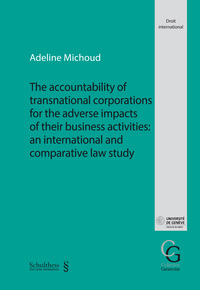
Nouvel ouvrage : The accountability of transnational corporations for the adverse impacts of their business activities
Ivan Tchotourian 16 septembre 2020 Ivan Tchotourian
Mme Adeline Michoud vient de publier sa thèse chez Schulthess Verlag dans la collection Genevoise sous le titre : « The accountability of transnational corporations for the adverse impacts of their business activities: an international and comparative law study ». Nul doute que cet ouvrage intéressera nos lectrices et lecteurs du blogue !
Résumé :
In the last decades, transnational corporate activities have given rise to serious human rights abuses. In this doctoral thesis, the author provides an exhaustive account of the obstacles preventing the implementation of an effective corporate social responsibility system. The first chapter analyses the mechanisms developed in public international law to introduce corporate regulation. The second chapter explains the inadequacies of both American and European private international law systems to receive victims’ claims. Finally, the third chapter elaborates a comparative study of the different national law mechanisms to establish the responsibility of transnational corporations. The present book is addressed to all lawyers and more generally to all readers interested in the question of business and human rights.
À la prochaine…
Base documentaire loi et réglementation
Tracer l’avenir de la gouvernance d’entreprise au Canada
Ivan Tchotourian 16 septembre 2020 Ivan Tchotourian
Sur son blogue que nous conseillons grandement, mon collègue Stéphane Rousseau a diffusé une nouvelle qui ne va pas passer inaperçu : le 14 août dernier, nous apprenions que le Groupe TMX et l’Institut des administrateurs de sociétés lançaient une nouvelle initiative visant à tracer l’avenir de la gouvernance d’entreprise au Canada.
Voici la lettre de mission (ici) :
Madame, Monsieur,
Au cours des prochains mois, le Groupe TMX* et l’Institut des administrateurs de sociétés (IAS) lanceront une nouvelle initiative importante visant à tracer l’avenir de la gouvernance des sociétés au Canada. En tant que membre de l’IAS, participant, participante ou partie prenante des marchés financiers canadiens, nous souhaitons que votre soutien et votre contribution éclairent nos travaux.
Il y a plus de 25 ans que le comité de la gouvernance de sociétés de la Bourse de Toronto a publié des lignes directrices (document connu sous le nom de « Rapport Dey ») qui constituent toujours aujourd’hui le fondement de la gouvernance des conseils d’administration des sociétés publiques canadiennes.
Depuis ce temps, le rôle du conseil d’administration a beaucoup évolué et de nouveaux concepts relatifs aux objectifs des entreprises et aux obligations des administrateurs font leur apparition. Alimentées par le rythme accéléré de l’innovation technologique, et dans le contexte d’une pandémie mondiale, les entreprises canadiennes font face à un nouvel ensemble de risques, de défis et d’occasions. Parmi ceux-ci, on peut citer une structure géopolitique en mutation, les changements climatiques et le développement durable, de nouvelles formes d’activisme de la part des parties prenantes, l’intelligence artificielle, ainsi que des appels à une plus grande équité, diversité et inclusion.
L’environnement des entreprises se transforme radicalement. La gouvernance de sociétés doit suivre le rythme et tracer une voie pour l’avenir. La question est de savoir comment y arriver.
Afin d’explorer cette question et de superviser la création de directives actualisées concernant les meilleures pratiques en matière de gouvernance de sociétés au Canada, le Groupe TMX et l’IAS mettent sur pied le « Comité sur l’avenir de la gouvernance des sociétés au Canada ».
Le comité, qui sera présenté cet automne, sera composé d’un groupe diversifié d’administrateurs et d’administratrices de sociétés publiques canadiennes chevronnés. Ses travaux se concentreront en particulier sur les domaines de surveillance dans lesquels le leadership des administrateurs peut contribuer à améliorer la résilience et la performance durable à long terme des entreprises, tout en tenant compte des défis que représente le fardeau réglementaire actuel pour les entreprises canadiennes.
Pour atteindre son objectif, le comité consultera et sollicitera la contribution d’un large éventail de parties prenantes, notamment des investisseurs, des organismes de réglementation, des universitaires et d’autres personnes et organisations. Le comité commencera ses travaux en septembre et prévoit la tenue de réunions virtuelles au cours de l’automne 2020 et de l’hiver 2021.
À la suite de ces réunions, un rapport périodique sera publié et soumis à la consultation publique. Le comité encourage toutes les parties prenantes, y compris les membres de l’IAS, intéressées par cette initiative à faire part de leurs commentaires sur ce rapport intermédiaire qui devrait être publié au début de 2021. L’IAS et le Groupe TMX sont très heureux de bénéficier pour cette initiative du soutien d’Osler, Hoskin & Harcourt S.E.N.C.R.L. qui a également fourni une assistance juridique au comité initial du Groupe TSX.
Nous pensons que l’actualisation des lignes directrices en matière de gouvernance pour qu’elles reflètent les réalités actuelles et les défis futurs aura des avantages durables et significatifs pour le Canada. Nous nous réjouissons à l’idée de communiquer davantage d’informations lorsque nous lancerons officiellement le projet et au cours de l’année à venir.
Gouvernance normes de droit Responsabilité sociale des entreprises
Raison d’être ou entreprise à mission, le faux débat
Ivan Tchotourian 16 septembre 2020 Ivan Tchotourian
C’est sous ce titre (« Raison d’être ou entreprise à mission, le faux débat », La Tribune, 2 septembre 2020) que M. Patrick d’Humières propose une lecture de la raison d’être et du statut d’entreprise à mission qui, selon lui, vont se rejoindre dans une trajectoire commune.
Extrait :
En apparence, le statut d’entreprise à mission rencontre un succès d’estime avec une cinquantaine d’entreprises très différentes, d’agences conseils à des sociétés mutuelles, qui l’ont adopté. Ce n’est pas le cas du statut de raison d’être, au bilan beaucoup plus mitigé, car les démarches que l’on connaît expriment des positionnements déclaratifs dans la veine de « la RSE de bonne volonté » qui ne s’accompagnent pas de mécanisme de mesure, de pression et de transparence garantissant de vrais changements d’orientation des modèles.
À la décharge des entreprises qui ont fait preuve d’initiative en la matière, il faut dire que le dispositif légal proposé comporte de considérables faiblesses. L’essentiel du changement juridique porté par la loi réside dans la modification de l’article 1833 du Code civil qui enjoint à toutes les entreprises de « prendre en considération les enjeux sociaux et environnementaux » au côté de l’intérêt social de l’entreprise, dont on n’a pas tiré les implications fondamentales. Les organisations professionnelles concernées ont fait preuve d’un souci défensif, pour limiter la mise en cause conséquente de cette assertion fondamentale, qui acte la nouvelle mission de l’entreprise, à savoir créer de la valeur dans le respect des enjeux sociétaux ; mais ni les juges, ni la puissance publique n’ont eu encore le souci d’accompagner ce cadre, cherchant plutôt à le minimiser, alors même que c’est une innovation majeure : il articule l’économie de marché avec la stratégie nationale de développement durable (ODD) et il crée le socle de ce qu’on appelle désormais « l’économie responsable », consacrée par la nomination pertinente d’une ministre en charge du sujet, qu’on aurait pu ou du appeler aussi « l’économie durable » dans un souci de cohérence politique.
Le texte de loi appelle des transformations de fond dans la gouvernance des entreprises qui devrait se poser des questions à cet effet, sans attendre qu’une jurisprudence fasse le travail pour dire qu’un Conseil d’administration ou une direction générale a mesestimé les enjeux sociaux et environnementaux, définis désormais de façon claire et objective (cf. indicateurs des ODD, incluant l’alignement sur l’Accord de Paris etc.).
L’entreprise dispose de tous les éléments pour établir son niveau de durabilité qui reconnaît cette prise de considération attendue des enjeux communs ; le travail de fond engagé parallèlement en Europe afin de standardiser l’information extra-financière ne pourra qu’encourager les Conseils à débattre et à décider de l’état de leur trajectoire économique au regard de leurs impacts acceptables qui sera la règle en 2025, à n’en pas douter.
Certaines entreprises ont tenu à disposer d’un cadre formel beaucoup plus structuré pour assumer cette responsabilité élargie à la Société, celui de « l’entreprise à mission » ; il constitue une facilité juridique et une aide technique qui a le plus grand intérêt pour accélérer la mutation d’un « capitalisme a-moral » vers « un capitalisme « parties prenantes ». Ce choix implique le vote par les actionnaires, le comité de suivi, l’audit de contrôle etc.. Les actionnaires n’ont pas à craindre pour autant une démission de l’engagement fiduciaire, à leur détriment, car le contrat est explicite, même s’il gagnerait encore à ce que les objectifs de rendement financier soient précisés au regard des objectifs d’amélioration de la création et de la répartition de la valeur globale et de leurs ROI. Ceci afin de ne pas glisser vers « le non profit » : une attention déséquilibrée en faveur de la dimension sociétale de la mission marginaliserait le dispositif, alors que les statuts coopératif, mutualiste ou solidaire sont là pour ça.
Coincé entre le droit général et le cadre précis de « la mission », « la raison d’être » aura du mal à trouver sa place, d’autant que la loi Pacte ne dit rien sur le comment, laissant l’entreprise libre de son engagement, de son inclusion ou non dans les statuts, ce qui en fait un process au mieux pédagogique et au pire de communication ; les parties prenantes ne voient pas les conclusions qu’on en tire sur les conditions nouvelles de production et de répartition de la valeur – objectifs et indicateurs à l’appui- pour exclure ce qui n’est pas « durable » dans l’offre et équilibrer l’allocation des résultats, voire la négocier, s’il existe un mécanisme ad hoc en amont de « l’arbitraire » des conseils. On voit bien qu’une Raison d’Etre bien posée conduit à terme au mécanisme de l’entreprise à mission et que dans le cas contraire l’entreprise ne fait que s’exposer à des critiques et frustrations qui mettent sa stratégie au défi de la cohérence et de la constance d’une gouvernance qui voudrait avancer sans oser le demander à ses actionnaires…
Cette décantation se fera inévitablement dans le temps, au détriment des entreprises « superficielles » et à l’avantage des entreprises authentiques. Le dispositif de Raison d’Etre va devenir un statut intermédiaire, de transition vers « l’entreprise à mission » ; il pousse à la construction d’un droit des sociétés qui recherche le changement profond de la gouvernance actionnariale, comme vient de le proposer la Commission Européenne dans un rapport très critique sur l’engagement insuffisant des gouvernances qui s’abritent derrière des intentions pour répondre aux pressions, rendant leur projet illisible ! Mais rien n’empêche les gouvernances d’accélérer par elles-mêmes sans attendre un règlement européen et éviter les malentendus autour d’une « raison d’être incantatoire » qui mine la crédibilité des initiatives sociétales des entreprises ; dans un monde périlleux, les gouvernances doivent « choisir leur camp » !
À la prochaine…
actualités internationales Gouvernance Normes d'encadrement normes de droit objectifs de l'entreprise Responsabilité sociale des entreprises Valeur actionnariale vs. sociétale
50 years later, Milton Friedman’s shareholder doctrine is dead
Ivan Tchotourian 16 septembre 2020 Ivan Tchotourian
Belle tribune dans Fortune de MM. Colin Mayer, Leo Strine Jr et Jaap Winter au titre clair : « 50 years later, Milton Friedman’s shareholder doctrine is dead » (13 septembre 2020).
Extrait :
Fifty years ago, Milton Friedman in the New York Times magazine proclaimed that the social responsibility of business is to increase its profits. Directors have the duty to do what is in the interests of their masters, the shareholders, to make as much profit as possible. Friedman was hostile to the New Deal and European models of social democracy and urged business to use its muscle to reduce the effectiveness of unions, blunt environmental and consumer protection measures, and defang antitrust law. He sought to reduce consideration of human concerns within the corporate boardroom and legal requirements on business to treat workers, consumers, and society fairly.
Over the last 50 years, Friedman’s views became increasingly influential in the U.S. As a result, the power of the stock market and wealthy elites soared and consideration of the interests of workers, the environment, and consumers declined. Profound economic insecurity and inequality, a slow response to climate change, and undermined public institutions resulted. Using their wealth and power in the pursuit of profits, corporations led the way in loosening the external constraints that protected workers and other stakeholders against overreaching.
Under the dominant Friedman paradigm, corporations were constantly harried by all the mechanisms that shareholders had available—shareholder resolutions, takeovers, and hedge fund activism—to keep them narrowly focused on stockholder returns. And pushed by institutional investors, executive remuneration systems were increasingly focused on total stock returns. By making corporations the playthings of the stock market, it became steadily harder for corporations to operate in an enlightened way that reflected the real interests of their human investors in sustainable growth, fair treatment of workers, and protection of the environment.
Half a century later, it is clear that this narrow, stockholder-centered view of corporations has cost society severely. Well before the COVID-19 pandemic, the single-minded focus of business on profits was criticized for causing the degradation of nature and biodiversity, contributing to global warming, stagnating wages, and exacerbating economic inequality. The result is best exemplified by the drastic shift in gain sharing away from workers toward corporate elites, with stockholders and top management eating more of the economic pie.
Corporate America understood the threat that this way of thinking was having on the social compact and reacted through the 2019 corporate purpose statement of the Business Roundtable, emphasizing responsibility to stakeholders as well as shareholders. But the failure of many of the signatories to protect their stakeholders during the coronavirus pandemic has prompted cynicism about the original intentions of those signing the document, as well as their subsequent actions.
Stockholder advocates are right when then they claim that purpose statements on their own achieve little: Calling for corporate executives who answer to only one powerful constituency—stockholders in the form of highly assertive institutional investors—and have no legal duty to other stakeholders to run their corporations in a way that is fair to all stakeholders is not only ineffectual, it is naive and intellectually incoherent.
What is required is to match commitment to broader responsibility of corporations to society with a power structure that backs it up. That is what has been missing. Corporate law in the U.S. leaves it to directors and managers subject to potent stockholder power to give weight to other stakeholders. In principle, corporations can commit to purposes beyond profit and their stakeholders, but only if their powerful investors allow them to do so. Ultimately, because the law is permissive, it is in fact highly restrictive of corporations acting fairly for all their stakeholders because it hands authority to investors and financial markets for corporate control.
Absent any effective mechanism for encouraging adherence to the Roundtable statement, the system is stacked against those who attempt to do so. There is no requirement on corporations to look after their stakeholders and for the most part they do not, because if they did, they would incur the wrath of their shareholders. That was illustrated all too clearly by the immediate knee-jerk response of the Council of Institutional Investors to the Roundtable declaration last year, which expressed its disapproval by stating that the Roundtable had failed to recognize shareholders as owners as well as providers of capital, and that “accountability to everyone means accountability to no one.”
If the Roundtable is serious about shifting from shareholder primacy to purposeful business, two things need to happen. One is that the promise of the New Deal needs to be renewed, and protections for workers, the environment, and consumers in the U.S. need to be brought closer to the standards set in places like Germany and Scandinavia.
But to do that first thing, a second thing is necessary. Changes within company law itself must occur, so that corporations are better positioned to support the restoration of that framework and govern themselves internally in a manner that respects their workers and society. Changing the power structure within corporate law itself—to require companies to give fair consideration to stakeholders and temper their need to put profit above all other values—will also limit the ability and incentives for companies to weaken regulations that protect workers, consumers, and society more generally.
To make this change, corporate purpose has to be enshrined in the heart of corporate law as an expression of the broader responsibility of corporations to society and the duty of directors to ensure this. Laws already on the books of many states in the U.S. do exactly that by authorizing the public benefit corporation (PBC). A PBC has an obligation to state a public purpose beyond profit, to fulfill that purpose as part of the responsibilities of its directors, and to be accountable for so doing. This model is meaningfully distinct from the constituency statutes in some states that seek to strengthen stakeholder interests, but that stakeholder advocates condemn as ineffectual. PBCs have an affirmative duty to be good corporate citizens and to treat all stakeholders with respect. Such requirements are mandatory and meaningful, while constituency statutes are mushy.
The PBC model is growing in importance and is embraced by many younger entrepreneurs committed to the idea that making money in a way that is fair to everyone is the responsible path forward. But the model’s ultimate success depends on longstanding corporations moving to adopt it.
Even in the wake of the Roundtable’s high-minded statement, that has not yet happened, and for good reason. Although corporations can opt in to become a PBC, there is no obligation on them to do so and they need the support of their shareholders. It is relatively easy for founder-owned companies or companies with a relatively low number of stockholders to adopt PBC forms if their owners are so inclined. It is much tougher to obtain the approval of a dispersed group of institutional investors who are accountable to an even more dispersed group of individual investors. There is a serious coordination problem of achieving reform in existing corporations.
That is why the law needs to change. Instead of being an opt-in alternative to shareholder primacy, the PBC should be the universal standard for societally important corporations, which should be defined as ones with over $1 billion of revenues, as suggested by Sen. Elizabeth Warren. In the U.S., this would be done most effectively by corporations becoming PBCs under state law. The magic of the U.S. system has rested in large part on cooperation between the federal government and states, which provides society with the best blend of national standards and nimble implementation. This approach would build on that.
Corporate shareholders and directors enjoy substantial advantages and protections through U.S. law that are not extended to those who run their own businesses. In return for offering these privileges, society can reasonably expect to benefit, not suffer, from what corporations do. Making responsibility in society a duty in corporate law will reestablish the legitimacy of incorporation.
There are three pillars to this. The first is that corporations must be responsible corporate citizens, treating their workers and other stakeholders fairly, and avoiding externalities, such as carbon emissions, that cause unreasonable or disproportionate harm to others. The second is that corporations should seek to make profit by benefiting others. The third is that they should be able to demonstrate that they fulfill both criteria by measuring and reporting their performances against them.
The PBC model embraces all three elements and puts legal, and thus market, force behind them. Corporate managers, like most of us, take obligatory duties seriously. If they don’t, the PBC model allows for courts to issue orders, such as injunctions, holding corporations to their stakeholder and societal obligations. In addition, the PBC model requires fairness to all stakeholders at all stages of a corporation’s life, even when it is sold. The PBC model shifts power to socially responsible investment and index funds that focus on the long term and cannot gain from unsustainable approaches to growth that harm society.
Our proposal to amend corporate law to ensure responsible corporate citizenship will prompt a predictable outcry from vested interests and traditional academic quarters, claiming that it will be unworkable, devastating for entrepreneurship and innovation, undermine a capitalist system that has been an engine for growth and prosperity, and threaten jobs, pensions, and investment around the world. If putting the purpose of a business at the heart of corporate law does all of that, one might well wonder why we invented the corporation in the first place.
Of course, it will do exactly the opposite. Putting purpose into law will simplify, not complicate, the running of businesses by aligning what the law wants them to do with the reason why they are created. It will be a source of entrepreneurship, innovation, and inspiration to find solutions to problems that individuals, societies, and the natural world face. It will make markets and the capitalist system function better by rewarding positive contributions to well-being and prosperity, not wealth transfers at the expense of others. It will create meaningful, fulfilling jobs, support employees in employment and retirement, and encourage investment in activities that generate wealth for all.
We are calling for the universal adoption of the PBC for large corporations. We do so to save our capitalist system and corporations from the devastating consequences of their current approaches, and for the sake of our children, our societies, and the natural world.
À la prochaine…
actualités internationales Gouvernance Normes d'encadrement place des salariés rémunération
Entreprises européennes, salariés et dividendes : tendance
Ivan Tchotourian 16 septembre 2020 Ivan Tchotourian
Dans un article du Financial Times (« European companies were more keen to cut divis than executive pay », 9 septembre 2020), il est observé que les assemblées annuelles de grandes entreprises européennes montrent des disparités concernant la protection des salariés et la réduction des dividendes.
Extrait :
Businesses in Spain, Italy, the Netherlands and the UK were more likely to cut dividends than executive pay this year, despite calls from shareholders for bosses to share the financial pain caused by the pandemic.
More than half of Spanish businesses examined by Georgeson, a corporate governance consultancy, cancelled, postponed or reduced dividends in 2020. Only 29 per cent introduced a temporary reduction in executive pay. In Italy, 44 per cent of companies changed their dividend policies because of Covid-19, but just 29 per cent cut pay for bosses, according to the review of the annual meeting season in Europe.
This disparity between protection of salaries and bonuses at the top while shareholders have been hit with widespread dividend cuts is emerging as a flashpoint for investors. Asset managers such as Schroders and M&G have spoken out about the need for companies to show restraint on pay if they are cutting dividends or receiving government support. “Executive remuneration remains a key focal point for investors and was amongst the most contested resolutions in the majority of the markets,” said Georgeson’s Domenic Brancati.
But he added that despite this focus, shareholder revolts over executive pay had fallen slightly across Europe compared with 2019 — suggesting that investors were giving companies some leeway on how they dealt with the pandemic. Investors could become more vocal about this issue next year, he said.
One UK-based asset manager said it was “still having lots of conversations with companies around pay” but for this year had decided not to vote against companies on the issue. But it added the business would watch remuneration and dividends closely next year.
Companies around the world have cut or cancelled dividends in response to the crisis, hitting income streams for many investors. According to Janus Henderson, global dividends had their biggest quarterly fall in a decade during the second quarter, with more than $100bn wiped off their value. The Georgeson data shows that almost half of UK companies changed their dividend payout, while less than 45 per cent altered executive remuneration. In the Netherlands, executive pay took a hit at 29 per cent of companies, while 34 per cent adjusted dividends. In contrast, a quarter of Swiss executives were hit with a pay cut but only a fifth of companies cut or cancelled their dividend.
The Georgeson research also found that the pandemic had a significant impact on the AGM process across Europe, with many companies postponing their annual meetings or stopping shareholders from voting during the event.
À la prochaine…
engagement et activisme actionnarial Gouvernance Normes d'encadrement normes de marché place des salariés
Activisme des salariés actionnaires : une menace ?
Ivan Tchotourian 2 septembre 2020 Ivan Tchotourian
Article à lire de M. Ashwell dans Corporate Secretary : « The threat of employee shareholder activism » (7 août 2020). Intéressante perspective sur l’activisme poussé de manière indirecte par la situation des salariés des entreprises.
Extrait :
Facing an employee-backed or employee-led shareholder proposal generates media attention and causes embarrassment for senior management. But are these recent examples a flash in the pan, or should more companies be bracing for employee-shareholder activism?
A confluence of circumstances
Pat Tomaino is director of socially responsible investing at Zevin Asset Management and has filed shareholder proposals at Alphabet and Amazon, as well as other large technology companies, in recent years. He worked with an employee group at Alphabet, following a mass employee walkout at Google in 2018.
‘It’s a strategy that we as impact investors want to leverage more in the future, but it really depends on a confluence of circumstances,’ he says. ‘We’re not in the business of instigating employee activity inside companies – that’s not the role of investors. We have a stake in the financial outlook of the company. We’re not creating employee activism but, where we do see that it exists, we take that into account. What are employees asking for and why are they acting that way? What signal should we take for how companies are handling their long-term ESG goals?’
Tomaino says that when he has talked to employee groups at large technology companies about shareholder proposals, there’s a feeling that they have tried other avenues of feedback and activism internally. ‘These employees had tried the usual channels and were looking for levers to make change,’ he says. ‘They’d done direct action, they’d talked to the press and they’d noticed that there’s power through shareholder proposals.’
In Germany, employee-shareholder activism is much more established. Labor groups have experimented with shareholder proposals since the early 1990s, according to an academic report from Natascha van der Zwan, assistant professor of public administration at Leiden University. One particularly notable example she highlights is the Deutsche Telecom annual meeting in 2007, when around 1,000 employees entered the meeting to voice discontent about increased working hours and pay cuts as part of a corporate restructuring. Employee-shareholders reportedly signed their voting rights over to local labor unions to oppose the restructuring, as part of a broader campaign involving employee walkouts and labor union protests.
For board directors in the US, Gillian Emmett Moldowan, partner at Shearman & Sterling, says it’s never been more important to receive meaningful updates about nonexecutive employees.
‘Employee campaigns of any nature get significant press attention,’ she explains. ‘Boards have historically been more separated from non-executive employee issues, whether it’s compensation or workers’ issues, or how employees feel about the firm as a whole. I would encourage boards to get an understanding from those who report into the board of human capital management risk and enterprise risks, as well as an understanding of what the company is doing to assess and mitigate those risks.
‘If boards have not historically received information about employee satisfaction and employee sentiment about the company management, then getting hold of that information is a good first step.’
Structural issues
Instances of recent employee shareholder activism have defining traits that may not be replicated elsewhere. For instance, Tomaino explains that many Alphabet employees involved in the shareholder action feel aggrieved at how they think the company’s mission has changed. Google’s motto in its IPO documents was ‘Don’t be evil’, but it has since dropped the slogan and employees have expressed concerns about the direction the company is moving, including in its bidding for national defense contracts.
Aalap Shah, managing director at Pearl Meyer, highlights several structural issues that may make companies more at risk of employee shareholder activism in the future.
‘Part of the issue is the power some companies have given to their employees through equity,’ he explains. ‘In addition, many of these companies are recruiting from the same talent pool, where there’s a desire to work for a company that has some sort of positive purpose. There is significantly more desire [on the part of] millennials and Gen Z to be part of an organization that has purpose, and you’re going to have to compete for that top talent by giving them equity.’
Tomaino says employees with large amounts of their personal net worth tied up in company stock will view themselves as engaged investors as much as employees. But Moldowan says this shouldn’t make companies think differently about granting stock options to employees as part of their compensation packages.
‘Shareholders can bring a proposal if they qualify to do so under the proxy rules, and those shares can be bought on the market – they need not come from an equity compensation plan,’ she says. ‘Not giving equity awards won’t stop an employee acquiring equity by other means.’
An Amazon employee group recently filed a comment letter with the SEC expressing concerns and opposition to proposed changes to Rule 14a-8, on the grounds that planned shifts to share ownership and proposal resubmission thresholds would make it harder for employee groups to advocate for change.
All of the interviewees for this article agree that it’s important for boards to receive information about employee sentiment and for boards or management to be seen to respond appropriately when employee groups express significant levels of discontent. Tomaino acknowledges that it’s unlikely large passive investors would vote in favor of employees and against management – unless the proposal was on something truly egregious – but that a proposal can help cause embarrassment for management that may drive change.
As Covid-19 shines a greater light on the treatment and recognition of employees, and the Business Roundtable’s statement equally prompts stakeholders to question companies when they feel they’re not being given a fair hearing, this may not be the last we see of employee participation in shareholder proposals in the US.
À la prochaine…