Archives
Divulgation divulgation extra-financière Normes d'encadrement normes de droit
Rapport extra-financier en France : un bilan en demi-teinte
Ivan Tchotourian 29 août 2020 Ivan Tchotourian
Dans un article paru dans Alternatives Économiques de juillet 2020, Bénédicte Weiss livre une analyse critique du reporting extra-financier en France : « Les rapports environnementaux des entreprises laissent à désirer ».
Résumé :
Les grandes entreprises françaises sont tenues de faire auditer leurs risques sociaux et environnementaux depuis la loi Grenelle II. Mais bien que le législateur français soit en avance sur la plupart des autres pays, l’absence de standardisation des informations requises rend leurs déclarations inégales.
À la prochaine…
Gouvernance parties prenantes Responsabilité sociale des entreprises
Vers le stakeholderism
Ivan Tchotourian 29 août 2020 Ivan Tchotourian
Article à lire sur l’Harvard Law School Forum on Corporate Governance : « An Inflection Point for Stakeholder Capitalism » (de Seymour Burchman et Seamus O’Toole).
Extrait :
From the Business Roundtable to BlackRock, there’s growing pressure on companies to respect all major stakeholders—employees, customers, suppliers and local communities, as well as investors. Meanwhile, a variety of innovations are effectively making these stakeholders central to long-term company success. Digital technologies, new ways of organizing work and transactions, and the shift to the service economy have forced businesses to prioritize the interests of all stakeholders—adding significant opportunities and risks.
As a result, unless the company’s survival is in question, stakeholder-centricity is becoming essential to its overall management. Even under short-term pressures such as pandemics, executives and directors will need to view the company as operating within an integrated ecosystem. Only by supporting all major stakeholders, through calibrated and balanced incentives, will companies achieve sustained success.
(…)
Reinforcing stakeholder-centricity through compensation
Through trial and error, Acme has been fine-tuning its approach. In our work with the boards of Acme, and of other companies, we’ve found four principles for making it all work.
Emphasize the long-term. It’s impossible to attend to all stakeholders equally in the short term. Companies are constantly making near-term trade-offs while still optimizing outcomes for all over the long-run. Investments in customer experience today might squeeze suppliers or reduce profitability in the near-term, for example, but boost the value proposition and expand revenues and margins in the future.
Any pay program tied to short-term outcomes will subconsciously influence how leaders balance these trade-offs. Accordingly, Acme has emphasized an ownership culture with greater equity compensation, broad participation, and policies that promote longer employee holding periods. It also steered clear of the usual practice of overlapping three-year performance cycles, as the overlaps effectively create a series of one-year cliffs that emphasize short-term thinking. While Acme has continued to use a short-term, cash-based bonus, it reduced that element’s weight relative to the rest of executive compensation. (Although a clear minority, some companies looking to prioritize long-term, balanced stakeholder outcomes have eliminated bonuses entirely.)
Explicitly tie pay to outcomes for all stakeholders. Acme wanted to keep the cash-based bonus tied to short-term profit and revenue goals, but was concerned that these would keep employees from weighing the stakeholder tradeoffs discussed above. So the company balanced the investor-focused metrics for the bonus with stakeholder-oriented goals such as employee engagement, customer retention, and supplier satisfaction. The simple act of ‘naming’ the priorities and directly tying them to compensation boosted buy-in across the organization.
Balance metrics with discretion. Acme believed that stakeholder dynamics were too fluid to be captured in a typical bonus construct, where ‘hard’ goals were established at the beginning of the year and performance measured formulaically twelve months later. The board set specific priorities and definitions of success, but allowed for discretion in the actual assessments and payouts. They also allowed for the updating of priorities frequently to ensure continued alignment with the strategy.
Stick to your guns. Finally, and perhaps most difficult, boards need to build up the resolve to align compensation outcomes with the stakeholder model. That means letting cash-based incentive awards follow stakeholder outcomes even when short-term financials are weak. And conversely, it means pulling back on pay when stakeholder priorities weren’t achieved, even if financial performance was strong. Note that executives will still be motivated to respect investor interests, as much of their pay will be in stock.
Boards must build the credibility to diverge from the “one-size-fits-all” status quo on pay for today’s U.S. public companies. They have to stand firm in the face of external pressure from impatient investors and shareholder advisory groups to align with their guidelines, most of which are anchored in and promote a shareholder-centric perspective. Some investors won’t agree with this philosophy and decide to select out, but others will take their place if they find the company’s mission, strategy, and execution compelling and in shareholders’ interests long-term. This will require boards to be consistent, symmetrical, proportional, and transparent in their compensation decisions. If the tie always goes to the executive, or if the company applies its philosophy selectively, the board will lose credibility and struggle to operate outside the typical investor-centric norms.
Finally, to sustain and optimize incentives that align with the stakeholder-centric model, boards must be relentless about communication, internal and external. They need to dialogue continually with investors and employees. They can emphasize the mission and strategy, how they’re balancing stakeholder needs over the long-term (even as they make trade-offs in the short term), and how the incentives align.
À la prochaine…
Gouvernance normes de droit
COVID-19 et corporate law
Ivan Tchotourian 14 août 2020 Ivan Tchotourian
Sur l’Oxford Business Law Blog, le professeur Luca Enriques publie une synthèse bien intéressante à celles et ceux qui cherchent à faire le point sur les conséquences de la COVID-19 sur le droit des sociétés par actions : « GCGC/ECGI Global Webinar Series – Extreme times, Extreme Measures: Pandemic-Resistant Corporate Law » (22 avril 2020).
Extrait :
These are exceptional times. Almost everywhere, policymakers are taking exceptional measures. Most of these measures are in the domains of public health, public finance and public law. Among the latter, of great relevance to corporate governance are the rules broadening governments’ powers to authorize large share block purchases (eg, in Germany and Italy). Even stronger proposals are being aired, and in some cases already adopted, in the direction of injecting public funds into companies in exchange for equity (Germany), if not of nationalising businesses altogether (France).
But some incursions into private law have also been made. This is especially true with regard to insolvency (or bankruptcy) law, as documented by Aurelio Gurrea Martinez. Some of the bankruptcy law-related measures intervene to change rules that ordinarily apply in the vicinity of insolvency and are therefore at the boundary between insolvency and corporate law. For instance, a number of countries are discussing whether to review directors’ duties in the proximity of insolvency (eg, the UK and New Zealand: see Licht) or have already done so (eg, Australia, Spain and Germany).
Similarly, some of the jurisdictions still providing for the ‘recapitalize or liquidate’ rule (which requires directors to promote a recapitalization of the company, convert it into an unlimited liability partnership or liquidate it, if net assets fall below a given threshold), such as Spain, Italy and Ecuador, have chosen to suspend its application during the crisis. Finally, in Italy rules on the subordination of shareholders loans have also been suspended.
This post asks the question of whether company law rules not specifically dealing with companies in the twilight zone should also be tweaked to face the emergency. One obvious focus are rules dealing with how general meetings must be held (see eg the UK and Italy). Such rules may be at odds with social distancing provisions wherever they don’t allow for virtual meetings or forms of collective representation of the shareholders. But one can think more broadly about how corporate law should be amended in order to avoid economic rather than viral contagion and keep companies afloat in these exceptional times. Below are some general considerations to guide policymakers’ choices in this area, followed by examples of temporary corporate law interventions for the emergency. This post concludes with some thoughts about how to prepare for a similar emergency in the future.
À la prochaine…
actualités internationales normes de droit Responsabilité sociale des entreprises
Taxer les GAFA : un sujet toujours difficile
Ivan Tchotourian 14 août 2020 Ivan Tchotourian
La taxation des géants du numérique est toujours un sujet d’actualité : « La taxation du numérique dans l’impasse » (Le Devoir, 19 juin 2020).
Extrait :
Les négociations internationales sur la taxation du numérique, pomme de discorde récurrente entre Washington et Paris, se retrouvent dans l’impasse après la « pause » annoncée par les États-Unis, au risque de déclencher une guerre commerciale comme le craint l’OCDE.
Pour rappel, dans le cadre de ses recherches, TaxCOOP a analysé les documents constitutifs de plus de 190 pays à la recherche de dispositions fiscales créant l’obligation pour toute personne de payer sa « juste part » d’impôt. Il appert que les constitutions de trente-huit pays contiennent des dispositions à cet effet. Cet important constat soulève la question suivante : l’évitement fiscal est-il vraiment légal ou pourrait-il plutôt être inconstitutionnel? Ces dispositions fiscales inscrites au sein des documents considérés comme première source du droit pourraient-elles limiter l’utilisation de stratagèmes fiscaux et ainsi assurer que l’ensemble des contribuables paient leur « juste part »?
À la prochaine…
actualités internationales devoirs des administrateurs Gouvernance normes de droit Responsabilité sociale des entreprises
Sustainable Value Creation Within Planetary Boundaries—Reforming Corporate Purpose and Duties of the Corporate Board
Ivan Tchotourian 14 août 2020 Ivan Tchotourian
Ma collègue Beate Sjåfjell nous gâte encore avec un très bel article (accessible en ligne !) : « Sustainable Value Creation Within Planetary Boundaries—Reforming Corporate Purpose and Duties of the Corporate Board » (Sustainibility, 2020, Vol. 12, Issue 15). Je vous conseille vivement la lecture de cet article…
Résumé :
Business, and the dominant legal form of business, that is, the corporation, must be involved in the transition to sustainability, if we are to succeed in securing a safe and just space for humanity. The corporate board has a crucial role in determining the strategy and the direction of the corporation. However, currently, the function of the corporate board is constrained through the social norm of shareholder primacy, reinforced through the intermediary structures of capital markets. This article argues that an EU law reform is key to integrating sustainability into mainstream corporate governance, into the corporate purpose and the core duties of the corporate board, to change corporations from within. While previous attempts at harmonizing core corporate law at the EU level have failed, there are now several drivers for reform that may facilitate a change, including the EU Commission’s increased emphasis on sustainability. Drawing on this momentum, this article presents a proposal to reform corporate purpose and duties of the board, based on the results of the EU-funded research project, Sustainable Market Actors for Responsible Trade (SMART, 2016–2020).
À la prochaine…
Nouvelles diverses Responsabilité sociale des entreprises Structures juridiques
L’entreprise, un bien commun ?
Ivan Tchotourian 14 août 2020 Ivan Tchotourian
Sympathique article « L’entreprise comme bien commun » de MM. Desreumaux et Bréchet dans la RIMHE : Revue Interdisciplinaire Management, Homme & Entreprise (2013/3 (n°7), pages 77 à 93). Pourquoi pas ?
Extrait :
Compte tenu des enjeux associés à la représentation en action de l’entreprise (questions de création et de répartition de valeur, de santé et de dynamisme d’une nation, de conception du rôle et des responsabilités des dirigeants, de gouvernance, de responsabilité sociale, de justice, etc.), il apparaît nécessaire de trouver un fondement cohérent pour une représentation dépassant les limites respectives des métaphores déjà disponibles dont l’inventaire et le reclassement mettent au jour l’opposition de visions contractualistes et « sociocognitives ». Pour de multiples raisons, la métaphore du bien commun constitue une piste potentiellement féconde. Pour l’explorer, on posera quelques repères fondamentaux sur la notion de bien commun avant d’envisager ce qui justifie d’aborder l’entreprise sur cette base. Les filiations plurielles que nous privilégierons nous conduiront ensuite à exposer plus précisément notre point de vue et à proposer une grille de lecture propre à restituer l’entreprise en termes dynamiques, exprimant les enjeux, les tensions, la façon dont se construit le bien commun : le bien commun de l’entreprise c’est le projet d’entreprise dans le cadre de la théorie de l’entreprise fondée sur le projet ou Project-Based View. C’est donc le projet dans le cadre d’une lecture processuelle, subjectiviste et multidimensionnelle.
Le projet de l’entreprise se comprend dans le cadre de la théorie de l’entreprise ou de l’action collective fondée sur le projet, ou Project-Based View (PBV), qui se présente comme une lecture subjectiviste, multidimensionnelle et développementale (Desreumaux et Bréchet, 2009). Elle représente une vision de l’entreprise fondée sur le projet à caractère englobant. Les théories dites de la firme, d’inspiration économique, ne traitent pas directement de l’entreprise réelle et de ses préoccupations de management. La théorie de l’agence ou la théorie des coûts de transaction, qui privilégient les facettes d’allocation, d’efficience et de coût, délaissent les dimensions de conception et de production de biens et de services, de même que les comportements entrepreneuriaux (Desreumaux et Bréchet, 1998 ; Bréchet et Prouteau, 2010). Elles restent pourtant largement mobilisées par les chercheurs en gestion. Les théories d’inspiration évolutionniste, qui portent leur attention sur les compétences et les connaissances de l’entreprise, nourrissent, de ce fait, une perspective plus riche. Pour autant, elles n’épuisent pas les questions d’émergence des organisations ni celles ayant trait, par exemple, aux dimensions de politique générale. Ce que propose la théorie de l’entreprise fondée sur le projet ou Project-Based View, c’est de considérer l’entreprise comme un projet collectif possédant tout à la fois un contenu éthico-politique, un contenu technico-économique (les besoins ou missions que l’entreprise entend satisfaire à travers le métier qu’elle choisit d’exercer et les compétences qu’il recouvre) et un contenu organisationnel (les voies et moyens de l’action). Considérer l’entreprise sur cette base, revient à instruire les questions des pourquoi, des quoi et des comment de l’action qui se trouvent au cœur de la constitution d’un collectif.
À la prochaine…
finance sociale et investissement responsable Nouvelles diverses
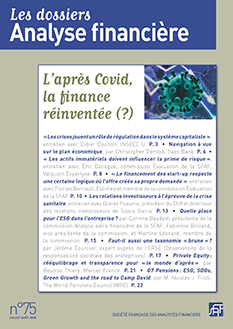
L’après Covid, la finance réinventée (?)
Ivan Tchotourian 14 août 2020 Ivan Tchotourian
La revue Analyse financière propose un Dossier numérique n°75 intéressant : « L’après Covid, la finance réinventée (?) ».
Au sommaire :
« Les crises jouent un rôle de régulation dans le système capitaliste »
Entretien avec Didier Coutton, INSEEC U
Navigation à vue sur le plan économique
Par Christopher Dembik, Saxo Bank
« Les actifs immatériels doivent influencer la prime de risque »
Entretien avec Éric Galiègue, commission Évaluation de la SFAF, Valquant Expertyse
« Le financement des start-up respecte une certaine logique où l’offre créée sa propre demande »
Entretien avec Florian Bercault, Estimeo et membre de la commission Évaluation de la SFAF
Les relations investisseurs à l’épreuve de la crise sanitaire
Entretien avec Olivier Psaume, président du Cliff et directeur des relations investisseurs de Sopra Steria
Quelle place pour l’ESG dans l’entreprise ?
Par Corinne Baudoin, présidente de la commission Analyse extra-financière de la SFAF, Fabienne Brilland, vice-présidente de la commission, et Martine Léonard, membre de la commission
Faut-il aussi une taxonomie « brune » ?
Par Jérôme Courcier, expert auprès de l’ORSE (Observatoire de la responsabilité sociétale des entreprises)
Private Equity : rééquilibrage et transparence pour « le monde d’après »
Par Boutros Thiery, Mercer France
G7 Pensions : ESG, SDGs, Green Growth and the road to Camp David
Par M. Nicolas J. Firzli, The World Pensions Council (WPC)
À la prochaine…