normes de droit Nouvelles diverses objectifs de l'entreprise Valeur actionnariale vs. sociétale
Primauté actionnariale et Benefit corporation
Ivan Tchotourian 9 janvier 2017
Le Harvard Law School Forum on Corporate Governance and Financial Regulation propose un bel article sous la plume de Frederick Alexander : « Moving Beyond Shareholder Primacy: Can Mammoth Corporations Like ExxonMobil Benefit Everyone? ». Une belle occasion de revenir sur le thème de la Benefit Corporation et de la remise en cause de la primauté actionnariale dont elle peut être la cause…
The New York Times recently took issue with Rex Tillerson, the President-elect’s nominee for Secretary of State, and the current CEO of ExxonMobil. Why? “Tillerson Put Company’s Needs Over U.S. Interests,” accused the front page headline. The article details how the company puts shareholders’ interests before the interests of the United States and of impoverished citizens of countries around the world.
In response, a company spokesman insisted that all laws were followed, and that “‘[a]bsent a law prohibiting something, we evaluate it on a business case basis.’” As one oil business journalist puts it in the article: “‘They are really all about business and doing what is best for shareholders.’” Thus, as long as a decision improves return to shareholders, its effect on citizens, workers, communities or the environment just doesn’t rank.
Unfortunately, this idea—evaluate the “business” case, without regard to collateral damage, permeates the global capital system. Corporations are fueled by financial capital, which ultimately comes from our bank accounts, pension plans, insurance premiums and mutual funds, and from foundations and endowments created for public benefit—in other words, our money. And yet when that capital is invested in companies that ignore societal and environmental costs, we all suffer: Corporations use our savings to drive climate change, increase political instability, and risk our future in myriad ways.
The good news is that structures like “benefit corporations” can help us repair our broken system of capital allocation—but the clock is ticking.
À la prochaine…
Ivan Tchotourian
Gouvernance mission et composition du conseil d'administration Nouvelles diverses
Avez-vous un expert de conformité dans votre CA ?
Ivan Tchotourian 5 janvier 2017
« Why Every Board Should Have a Compliance Expert » (22 décembre 2016), c’est sous ce titre que Thomas Fox propose une analyse sur la nécessité d’avoir un expert de la conformité au sein des CA.
Petit extrait :
An arm of the US government has recognized the need for such expertise at the Board level. In 2015 the Office of Inspector General (OIG), in a publication entitled “Practical Guidance for Health Care Governing Boards”, called for greater compliance expertise at the Board level. The OIG said that a Board can raise its level of substantive expertise with respect to regulatory and compliance matters by adding to the Board, a compliance member. The presence of a such a compliance professional with subject matter expertise “on the Board sends a strong message about the organization’s commitment to compliance, provides a valuable resource to other Board members, and helps the Board better fulfill its oversight obligations.”
À la prochaine…
Ivan Tchotourian
Nouvelles diverses
OPA : un retour en force
Ivan Tchotourian 3 janvier 2017
La France démontre que les OPA hostiles ont été à la mode en 2016 : « Les offres hostiles font leur retour en force » (Le Monde, 3 janvier 2017).
Il arrive que les dirigeants d’une entreprise reçoivent de façon inopinée une telle proposition, par courrier ou par un simple coup de fil, émanant d’un de leurs concurrents. Dans le monde des affaires, où le politiquement correct règne également en maître, on ne parle pas alors d’approche « hostile » mais de démarche « non sollicitée ». Et ces derniers temps, la méthode fait florès.
C’est ainsi que l’allemand Bayer, parti sabre au clair en mai à l’assaut d’un Monsanto récalcitrant, est parvenu en septembre à racheter le géant de semences pour 59 milliards d’euros. De son côté, le petit français Loxam, spécialiste de la location de matériels, bataille depuis des mois outre-Manche pour prendre le contrôle de son homologue britannique Lavendon, convoité également par le Belge TVH. En juillet, la Fnac a obtenu le feu vert de l’Autorité de la concurrence pour avaler Darty, conquis de haute lutte après une attaque au débotté sur le distributeur coté à la Bourse de Londres.
En sera-t-il de même en 2017 ?
À la prochaine…
Ivan Tchotourian
Gouvernance Nouvelles diverses
Gouvernance d’entreprise : mettez-vous à jour sur des questions d’actualité
Ivan Tchotourian 3 janvier 2017
Bonjour à toutes et à tous, quelle belle initiative de l’ECGI !
La seconde conférence de l’ECGI qui s’est tenue en Suède en juin 2016 est maintenant disponible. Vidéos, papiers et diaporamas sont maintenant disponibles au lien suivant : http://gcgc.global/events/stockholm-2016/#presentations.
Le programme était alléchant. Le voici :
- Commitment and Entrenchment in Corporate Governance
Prof. Simone Sepe University of Arizona
- Contracts versus Institutions: A Critique of Corporate Governance Theory
Prof. Martin Hellwig Max Planck Institute for Research on Collective Goods
- Price and Probability: Decomposing the Takeover Effects of Anti-Takeover Provisions
Prof. Vicente Cunat London School of Economics
- Can Staggered Boards Improve Value? Evidence from the Massachusetts Natural Experiment
Prof. Robert Daines Stanford University
- Corporate Leverage and Employee Protection in Bankruptcy
Prof. Marco Pagano University of Naples
Prof. Mark Roe Harvard Law School
- Political Determinants of Competition
Prof. Luigi Zingales University of Chicago Booth School of Business
- Panel: The Corporate Governance of Infrastructure
Prof. Erik Berglof London School of Economics Mr. Gordon Bajnai Meridiam Prof. Patrick Bolton Columbia Business School Dr. Rajiv B. Lall IDFC Bank, India
- Are Foreign Investors Locusts? The Long-Term Effects of Foreign Institutional Ownership
Prof. Pedro Matos University of Virginia
- Does Majority Voting Improve Board Accountability?
Prof. Jill Fisch University of Pennsylvania
- Bonded to the State: A Network Perspective on China’s Corporate Debt Market
Prof. Curtis Milhaupt Columbia Law School
- Corporate Governance Indices and Construct Validity
Prof. Bernard Black Kellogg School of Management
- Panel: The Governance of Business Groups
Prof. Gerard Hertig ETZ Ms. Claudia Biedermann Zurich Insurance Group AG Ms. Petra Hedengran Investor AB Ms. Daniela Weber-Rey Deutsche Bank AG
- Are CEOs Different? Characteristics of Top Managers
Prof. Steven Kaplan University of Chicago Booth School of Business
- Executive Remuneration Standards and the “Conformity Gap” at Controlled Corporations
Prof. Guido Ferrarini University of Genoa
- The Responsibility of Business is to Pursue Shareholder Value: True or False?
Prof. Oliver Hart Harvard University
À la prochaine…
Ivan Tchotourian
Gouvernance Nouvelles diverses Valeur actionnariale vs. sociétale
Court-termisme : les propositions de The Aspen Institute
Ivan Tchotourian 2 janvier 2017
The Aspen Institute (par l’intermédiaire de The American Prosperity Project Working Group) vient de publier un rapport proposant de contrer le court-termisme qui gangrène les entreprises américaines. Dans « The American Prosperity Project: Policy Framework », le groupe de travail propose 3 pistes de solutions qui sont les suivantes :
- Focus government investment on recognized drivers of long-term productivity growth and global competitiveness—namely, infrastructure, basic science research, private R&D, and skills training—in order to close the decades-long investment shortfall in America’s future. Building this foundation will support good jobs and new business formation, support workers affected by globalization and technology, and better position America to address the national debt through long-term economic growth.
- Unlock business investment by modernizing our corporate tax system to achieve one that is simpler, fair to businesses across the spectrum of size and industry, and supportive of both productivity growth and job creation. Changes to the corporate tax system could reduce the federal corporate statutory tax rate (at 35%, the highest in the world), broaden the base of corporate tax payers, bring off-shore capital back to the US, and reward long-term investment, and help provide revenues to assure that America’s long-term goals can be met.
- Align public policy and corporate governance protocols to facilitate companies’ and investors’ focus on long-term investment. Complex layers of market pressures, governance regulations, and business norms encourage short-term thinking in business and finance. The goal is a better environment for long-term investing by business leaders and investors, and to provide better outcomes for society.
Pour une synthèse de ce rapport de travail, vous pourrez lire cet excellent article d’Alana Semuels dans The Atlantic « How to Stop Short-Term Thinking at America’s Companies » (30 décembre 2016).
There was a time, half a century ago, when what was good for many American corporations tended to also be good for America. Companies invested in their workers and new technologies, and as a result, they prospered and their employees did too.
Now, a growing group of business leaders is worried that companies are too concerned with short-term profits, focused only on making money for shareholders. As a result, they’re not investing in their workers, in research, or in technology—short-term costs that would reduce profits temporarily. And this, the business leaders say, may be creating long-term problems for the nation.
“Too many CEOs play the quarterly game and manage their businesses accordingly,” Paul Polman, the CEO of the British-Dutch conglomerate Unilever, told me. “But many of the world’s challenges can not be addressed with a quarterly mindset.”
Polman is one of a group of CEOs and business leaders that have signed onto the American Prosperity Project, an initiative spearheaded by the Aspen Institute, to encourage companies and the nation to engage in more long-term thinking. The group, which includes CEOs such as Chip Bergh of Levi Strauss and Ian Read of Pfizer, board directors such as Janet Hill of Wendy’s and Stanley Bergman of Henry Schein, Inc., and labor leaders such as Damon Silvers of the AFL-CIO, have issued a report encouraging the government to make it easier for companies to think in the long-term by investing in infrastructure and changing both the tax code and corporate governance laws.
À la prochaine…
Ivan Tchotourian
autres publications Gouvernance mission et composition du conseil d'administration Nouvelles diverses
Administrateur activiste : le dernier ouvrage de Millstein
Ivan Tchotourian 2 janvier 2017
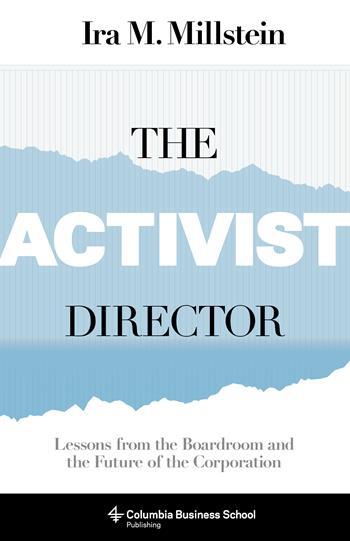
En cette période de fêtes qui se termine, pourquoi ne pas vous offrir le dernier ouvrage d’Ira M. Millstein sur la gouvernance d’entreprise ? Intitulé « The Activist Director: Lessons from the Boardroom and the Future of the Corporation » (Columbia University Press, décembre 2016), je ne peux que vous le recommander. Pour ma part, il est commandé, je n’attends plus que de le recevoir !
Voici le résumé :
Some of the worst corporate meltdowns over the past sixty years can be traced to passive directors who favored operational shortcuts over quality growth strategies. Thinking primarily about placating institutional investors, selective stockholders, proxy advisors, and corporate management, these inattentive and deferential board members have relied on short-term share price increases to sustain their companies long term. Driven by a desire for prosperity, not posterity, these actions can doom any company.
In The Activist Director, attorney Ira M. Millstein looks back at fifty years of counseling companies, nonprofits, and governments to actively govern their corporations and constituencies. From the threat of bankruptcy and the ConEd blackout of 1970s New York City, to the meltdown of Drexel Burnham Lambert in the late 1980s, to the turnaround of General Motors in the mid-1990s, Millstein takes readers into the boardrooms of several of the greatest catastrophes and success stories of America’s best-known corporations.
His solution lies at the top: a new breed of activist directors who partner with management and reject short-term outlooks, plan a future based on growth and innovation, and take responsibility for corporate organization, strategy, and efficiency. What questions should we ask of potential board members and how do we know they’ll be active? Millstein offers pragmatic suggestions for recruiting activist directors to the boardroom to secure the future of the corporation.
Pour en savoir plus sur ce livre, cliquez ici.
À la prochaine…
Ivan Tchotourian
divulgation financière Gouvernance Nouvelles diverses
RSE : comment bien communiquer ?
Ivan Tchotourian 2 janvier 2017
Bonjour à toutes et à tous, en cette nouvelle année, je commence par un article intéressant de Ph2C (Philippe Cornet Conseil) publié le 15 décembre 2016 portant directement sur le thème de la responsabilité sociétale des entreprises et intitulé : « Reporting et communication extrafinancière, la RSE sera-t-elle victime d’infobésité ? « . L’auteur y revient sur le risque de produire trop d’informations rendant illisible cette dernière. Il en profite pour y livrer son expérience et rappeler quelques principes de base.
Envahi, surchargé, submergé par la quantité d’information… Déçu par sa pertinence, sa qualité. La RSE (Responsabilité Sociétale des Entreprises), porteuse des enjeux sociaux, environnementaux et sociétaux, court le risque d’être l’excroissance organisationnelle qui produit le « pavé annuel ». L’avènement du big data pourrait nous faire oublier les principes les plus simples.
Plus récemment, dans son rapport 2016 sur la responsabilité sociale, sociétale et environnementale de novembre 2016, l’AMF [Autorité des Marchés Financiers] précise « d’un point de vue purement formel, un nombre moyen de pages (moyenne : 33 pages ; minimum : 3 pages ; maximum : 117 pages) consacrées à la RSE en très nette augmentation, progressant en moyenne de près de 40 %. », ce depuis le précédent rapport de novembre 2013.
L’AMF forte de ses constats précise « Le volume croissant de l’information extra-financière devrait conduire les sociétés à privilégier des démarches visant tant à sa simplification qu’au renforcement de sa pertinence, ce qui implique sans doute un effort de concision des messages et de sélection des indicateurs. »
Toujours parmi les publications récentes, Paris Europlace, dans un position paper du 8 décembre 2016 « Création de valeur et reporting des entreprises » recommande « Pour les entreprises, simplifier leur cadre institutionnel de communication et limiter le volume et le foisonnement des documents produits, en se concentrant sur les enjeux matériels et sur l’intégration des données financières et extra-financières. »
Quelles sont les préconisations faites par l’auteur ?
Un parcours, une intention, un temps à passer, un niveau d’expertise. Tout concourt à se reposer la question du point de vue du destinataire, de la cible et pas de l’émetteur. Tout concourt à travailler dans le sens de plus de pertinence, pour chacune des cibles. Tout concourt à sortir de logique d’émetteur – c’est de l’information – pour aller vers une logique de l’échange – c’est de la communication.
À la prochaine…
Ivan Tchotourian