autres publications Nouvelles diverses
The Anatomy of Corporate Law : nouvelle édition
Ivan Tchotourian 16 janvier 2017
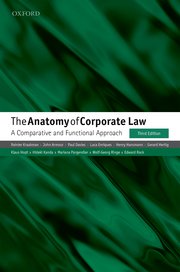
Voici une bible dont la 3e édition vient d’être publiée : « The Analtomy of Corporate Law » (Oxford University Press). Si vous ne l’avez pas encore dans votre bibliothèque, c’est le moment de l’acheter ! C’est un incontournable pour qui s’intéresse à la gouvernance d’entreprise dans une perspective comparative.
This is the long-awaited third edition of this highly regarded comparative overview of corporate law. This edition has been comprehensively revised and updated to reflect the profound changes in corporate law and governance practices that have taken place since the previous edition. These include numerous regulatory changes following the financial crisis of 2007-09 and the changing landscape of governance, especially in the US, with the ever more central role of institutional investors as (active) owners of corporations. The geographic scope of the coverage has been broadened to include an important emerging economy, Brazil. In addition, the book now incorporates analysis of the burgeoning use of corporate law to protect the interests of « external constituencies » without any contractual relationship to a company, in an attempt to tackle broader social and economic problems.
The authors start from the premise that corporations (or companies) in all jurisdictions share the same key legal attributes: legal personality, limited liability, delegated management, transferable shares, and investor ownership. Businesses using the corporate form give rise to three basic types of agency problems: those between managers and shareholders as a class; controlling shareholders and minority shareholders; and shareholders as a class and other corporate constituencies, such as corporate creditors and employees. After identifying the common set of legal strategies used to address these agency problems and discussing their interaction with enforcement institutions, The Anatomy of Corporate Law illustrates how a number of core jurisdictions around the world deploy such strategies. In so doing, the book highlights the many commonalities across jurisdictions and reflects on the reasons why they may differ on specific issues.
The analysis covers the basic governance structure of the corporation, including the powers of the board of directors and the shareholder meeting, both when management and when a dominant shareholder is in control. It then analyses the role of corporate law in shaping labor relationships, protection of external stakeholders, relationships with creditors, related-party transactions, fundamental corporate actions such as mergers and charter amendments, takeovers, and the regulation of capital markets.
À la prochaine…
Ivan Tchotourian
Base documentaire doctrine Gouvernance normes de droit Nouvelles diverses
Différends entre actionnaires : en savoir plus
Ivan Tchotourian 16 janvier 2017
Bonjour à toutes et à tous, la Revue du Barreau canadien publie un bel article sur le thème riche des différends entre actionnaires sous la plume de Me Nadeau et Desalliers : « L’impasse (deadlock) en matière de différends entre actionnaires au Québec ». Une belle étude qui rejoint certains thèmes qui sont abordés dans le cours DRT-2006 Droit des sociétés par actions
Pour en savoir plus, rendez-vous sur le site de la Revue du barreau canadien : https://cbaapps.org/cba_barreview/Search.aspx?VolDate=12/01/2016
Les sociétés qui ont un petit nombre d’actionnaires font parfois face à des situations lors desquelles un différend risque de perturber, voire même d’interrompre le fonctionnement de la société. Ce scénario, connu en tant qu’« impasse », présente un défi particulier pour ces sociétés et pourrait nécessiter l’intervention des tribunaux. Cet article envisage les deux recours principaux permettant de résoudre l’impasse, soit la dissolution et le recours en redressement pour cause d’abus, et examine les critères utilisés par les tribunaux pour déterminer laquelle de ces mesures doit être appliquée. Il discute également des diverses ordonnances provisoires et définitives à la disposition des tribunaux.
À la prochaine…
Ivan Tchotourian
autres publications engagement et activisme actionnarial Gouvernance normes de droit Nouvelles diverses
Hedge fund et activisme : un ouvrage
Ivan Tchotourian 10 janvier 2017
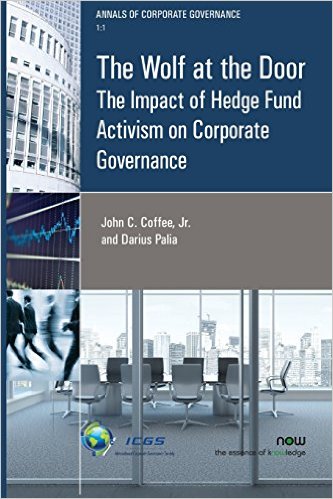
Bonjour à toutes et à tous, je signale cet ouvrage de John C Coffee Jr et Darius Palia sur l’activisme des fonds de couverture : « The Wolf at the Door: The Impact of Hedge Fund Activism on Corporate Governance ». Un bel ouvrage pour compléter une bibliothèque.
The Wolf at the Door: The Impact of Hedge Fund Activism on Corporate Governance has three basic aims: (1) to understand and explain the factors that have caused the recent explosion in hedge fund activism; (2) to examine the impact of this activism, including whether it is shortening investment horizons and discouraging investment in research and development; and (3) to survey and evaluate possible legal interventions with an emphasis on the least restrictive alternative. Although there have been other lengthy surveys, the landscape of activism is rapidly changing and this brings into doubt the relevance of empirical papers that study hedge fund activism in earlier decades. The authors suspect that the recent success of such activism may be fueling a current « hedge fund bubble » under which an increasing number of activist funds are pursuing a decreasing, or at least static, number of companies that have overinvested. This monograph is particularly focused on those markets and the legal forces that may be driving this bubble. After an introduction, Section 2 begins with an analysis of those factors that have spurred greater activism on the part of hedge funds. Section 3 considers evidence suggesting that as the composition of a firm’s shareholder population shift towards more « transient » holders, its investment horizon shortens. Section 4 surveys recent studies to reach assessments about who the targets of hedge fund activism are; the stock price returns from hedge fund activism and the distribution of those returns; the degree to which wealth transfers explain the positive stock price returns to activism; the post-intervention evidence about changes in operating performance of hedge fund targets; and the holding periods and exit strategies of hedge fund activists. Section 5 evaluates some policy options looking for the least drastic means of accomplishing policy goals. Finally, Section 6 offers a brief conclusion that surveys how the changing structure of shareholder ownership and the recent appearance of temporary shareholder majorities complicate corporate governance, both empirically and normatively.
À la prochaine…
Ivan Tchotourian
Nouvelles diverses Structures juridiques
Bénéfices financiers : la voie des banques
Ivan Tchotourian 9 janvier 2017
Dans le journal Les affaires, M. François Rémy revient sur l’intérêt d’investir dans les banques en raison du versement des dividendes dans un intéressant article « Les banques canadiennes, temples des dividendes » (26 décembre 2016).
Pour les investisseurs en quête de dividendes croissants offerts par des entreprises avec un excellent historique en la matière, rien de tel que le secteur bancaire canadien, avance-t-on sur le site participatif d’analyse financière Seeking Alpha.
Ou plutôt les «Big Five» comme on dit dans le milieu: la Banque Royale du Canada (Tor., RY), la Banque Toronto-Dominion (Tor., TD), la Banque Scotia (Tor., BNS), la Banque de Montréal (Tor., BMO) et la Banque canadienne impériale de commerce (Tor., CM).
Le plaidoyer pour le moins flatteur de l’internaute «Cash-centered Creep» s’articule autour de 3 arguments: l’ancienneté de la pratique, l’hermétisme du marché bancaire canadien et la valorisation actuelle des titres du secteur.
À la prochaine…
Ivan Tchotourian
normes de droit Nouvelles diverses objectifs de l'entreprise Valeur actionnariale vs. sociétale
Primauté actionnariale et Benefit corporation
Ivan Tchotourian 9 janvier 2017
Le Harvard Law School Forum on Corporate Governance and Financial Regulation propose un bel article sous la plume de Frederick Alexander : « Moving Beyond Shareholder Primacy: Can Mammoth Corporations Like ExxonMobil Benefit Everyone? ». Une belle occasion de revenir sur le thème de la Benefit Corporation et de la remise en cause de la primauté actionnariale dont elle peut être la cause…
The New York Times recently took issue with Rex Tillerson, the President-elect’s nominee for Secretary of State, and the current CEO of ExxonMobil. Why? “Tillerson Put Company’s Needs Over U.S. Interests,” accused the front page headline. The article details how the company puts shareholders’ interests before the interests of the United States and of impoverished citizens of countries around the world.
In response, a company spokesman insisted that all laws were followed, and that “‘[a]bsent a law prohibiting something, we evaluate it on a business case basis.’” As one oil business journalist puts it in the article: “‘They are really all about business and doing what is best for shareholders.’” Thus, as long as a decision improves return to shareholders, its effect on citizens, workers, communities or the environment just doesn’t rank.
Unfortunately, this idea—evaluate the “business” case, without regard to collateral damage, permeates the global capital system. Corporations are fueled by financial capital, which ultimately comes from our bank accounts, pension plans, insurance premiums and mutual funds, and from foundations and endowments created for public benefit—in other words, our money. And yet when that capital is invested in companies that ignore societal and environmental costs, we all suffer: Corporations use our savings to drive climate change, increase political instability, and risk our future in myriad ways.
The good news is that structures like “benefit corporations” can help us repair our broken system of capital allocation—but the clock is ticking.
À la prochaine…
Ivan Tchotourian
Gouvernance mission et composition du conseil d'administration Nouvelles diverses
Avez-vous un expert de conformité dans votre CA ?
Ivan Tchotourian 5 janvier 2017
« Why Every Board Should Have a Compliance Expert » (22 décembre 2016), c’est sous ce titre que Thomas Fox propose une analyse sur la nécessité d’avoir un expert de la conformité au sein des CA.
Petit extrait :
An arm of the US government has recognized the need for such expertise at the Board level. In 2015 the Office of Inspector General (OIG), in a publication entitled “Practical Guidance for Health Care Governing Boards”, called for greater compliance expertise at the Board level. The OIG said that a Board can raise its level of substantive expertise with respect to regulatory and compliance matters by adding to the Board, a compliance member. The presence of a such a compliance professional with subject matter expertise “on the Board sends a strong message about the organization’s commitment to compliance, provides a valuable resource to other Board members, and helps the Board better fulfill its oversight obligations.”
À la prochaine…
Ivan Tchotourian
Nouvelles diverses
OPA : un retour en force
Ivan Tchotourian 3 janvier 2017
La France démontre que les OPA hostiles ont été à la mode en 2016 : « Les offres hostiles font leur retour en force » (Le Monde, 3 janvier 2017).
Il arrive que les dirigeants d’une entreprise reçoivent de façon inopinée une telle proposition, par courrier ou par un simple coup de fil, émanant d’un de leurs concurrents. Dans le monde des affaires, où le politiquement correct règne également en maître, on ne parle pas alors d’approche « hostile » mais de démarche « non sollicitée ». Et ces derniers temps, la méthode fait florès.
C’est ainsi que l’allemand Bayer, parti sabre au clair en mai à l’assaut d’un Monsanto récalcitrant, est parvenu en septembre à racheter le géant de semences pour 59 milliards d’euros. De son côté, le petit français Loxam, spécialiste de la location de matériels, bataille depuis des mois outre-Manche pour prendre le contrôle de son homologue britannique Lavendon, convoité également par le Belge TVH. En juillet, la Fnac a obtenu le feu vert de l’Autorité de la concurrence pour avaler Darty, conquis de haute lutte après une attaque au débotté sur le distributeur coté à la Bourse de Londres.
En sera-t-il de même en 2017 ?
À la prochaine…
Ivan Tchotourian