autres publications mission et composition du conseil d'administration Normes d'encadrement responsabilisation à l'échelle internationale
Droits de l’homme et CA : un guide en 5 étapes
Ivan Tchotourian 24 mai 2016
L’EHRC vient de publier un guide « Business and human rights – A five-step guide for company boards » bien intéressant pour les CA. Comme le précise ce document : « We recommend that boards should follow five steps to ensure that their company is fulfilling its responsibility to respect human rights in a robust and coherent manner that meets the expectations of the UN Guiding Principles and UK statutory reporting obligations. Boards should be aware of the company’s salient, or most severe, human rights risks, and ensure ».
The following are the five steps that it is recommended boards should follow to ensure that their company is fulfilling its responsibility to meet human rights in a robust and coherent manner that meets the expectations of the UN Guiding Principles and UK statutory reporting obligations:
- the company should embed the responsibility to respect human rights into its culture, knowledge and practices;
- the company should identify and understands its salient, or most severe, risks to human rights;
- the company should systematically address its salient, or most severe, risks to human rights and provide for remedies when needed;
- the company should engage with stakeholders to inform its approach to addressing human rights risks; and
- the company should report on its salient, or most severe, human rights risks and meet regulatory reporting requirements.
Attention : encore une fois, tout cela n’est que du droit international et donc du droit « mou ». Ce guide l’exprime très bien en ces termes : « The Guiding Principles do not create any new international legal obligations on companies, but they can help boards to operate with respect for human rights and meet their legal responsibilities set out in domestic laws ».
À la prochaine…
Ivan Tchotourain
autres publications normes de droit rémunération
Toujours le Dodd-Frank Act !
Ivan Tchotourian 22 mai 2016
Bonjour à toutes et à tous, 6 agences fédérales américaines (dont la SEC) ont publié pour commentaire (jusqu’au 22 juillet 2016) leur proposition de mise en place de l’article 956 du Dodd-Frank Act visant à interdire les rémunérations incitatives qui encourageraient une prise de risque inconsidéré des institutions financières. Ce document est intitulé : « Incentive-based Compensation Arrangements ».
The OCC, Board, FDIC, FHFA, NCUA, and SEC (the Agencies) are seeking comment on a joint proposed rule (the proposed rule) to revise the proposed rule the Agencies published in the Federal Register on April 14, 2011, and to implement section 956 of the Dodd-Frank Wall Street Reform and Consumer Protection Act (Dodd-Frank Act). Section 956 generally requires that the Agencies jointly issue regulations or guidelines: (1) prohibiting incentive-based payment arrangements that the Agencies determine encourage inappropriate risks by certain financial institutions by providing excessive compensation or that could lead to material financial loss; and (2) requiring those financial institutions to disclose information concerning incentive-based compensation arrangements to the appropriate Federal regulator.
À la prochaine…
Ivan Tchotourian
autres publications engagement et activisme actionnarial
Les fonds activistes montent en puissance en Europe
Ivan Tchotourian 21 mai 2016
Le quotidien L’Agefi (ici) nous apprend qu’une étude de Conatus Finance dévoile les grandes tendances de l’activisme des fonds d’investissement européens.
Les fonds d’investissement continuent d’affirmer leur pouvoir d’influence sur les directions des entreprises dont ils sont actionnaires, y compris en Europe, selon une étude réalisée par Conatus Finance. « Le marché de l’activisme est toujours dominé par les gros fonds américains mais deux nouvelles tendances apparaissent », selon l’étude intitulée « Actionnaires actifs: un modèle d’activisme long terme adapté au marché européen ». Ces deux tendances sont résumées ainsi: un renforcement de leur action en Europe et « un focus sur le long terme ».
(…)
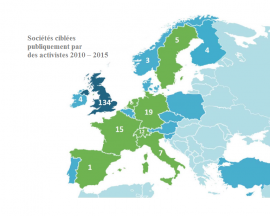
La majorité des fonds européens se concentrent d’avantage sur le long terme que les Etats-Unis mais la plupart des gros fonds activistes de long terme restent américains. En Europe, les sociétés les plus ciblées publiquement par les activistes sont très largement anglaises (134), suivies par les allemandes (19), les françaises (15) et les suisses (12).
À la prochaine…
Ivan Tchotourian
autres publications mission et composition du conseil d'administration Normes d'encadrement
Banque d’Angleterre : supervisory statement pour le CA
Ivan Tchotourian 19 mai 2016
L’Autorité prudentielle de la Banque d’Angleterre vient de publier un Supervisory Statement intitulé « Corporate governance: Board responsibilities » (SS5/16, mars 2016).
The Prudential Regulation Authority has published a policy statement and accompanying supervisory statement concerning the responsibilities of boards.
The purpose of this supervisory statement is to identify, for the boards1 of firms regulated by the Prudential Regulation Authority (PRA), those aspects of governance to which the PRA attaches particular importance and to which the PRA may devote particular attention in the course of its supervision. It is not intended to provide a comprehensive guide for boards of what constitutes good or effective governance. There are more general guidelines for that purpose, for example the UK Corporate Governance Code, published by the Financial Reporting Council.
À la prochaine…
Ivan Tchotourian
autres publications Normes d'encadrement Nouvelles diverses
Crowfunding : l’UE publie un staff working
Ivan Tchotourian 19 mai 2016
La Commission européenne vient de publier un document sur le financement participatif qui fait l’état des lieux des initiatives nationales : « COMMISSION STAFF WORKING DOCUMENT
– Crowdfunding in the EU Capital Markets Union » (SWD(2016) 154 final).
Voici la conclusion de ce document :
This report demonstrates that crowdfunding remains relatively small in the EU but is developing rapidly. It has the potential to be a key source of financing for SMEs over the long term.
Crowdfunding is one of many technological innovations that have the potential to transform the financial system. Therefore, crowdfunding warrants consideration as part of our broader approach to FinTech and the digitalisation of financial services, which is being looked at further in the Green Paper on Retail Financial Services.
As demonstrated in this report, to promote the growth of crowdfunding and appropriately protect investors, EU Member States have put in place a range of measures to regulate crowdfunding – either using the EU legislative framework where appropriate or via national regimes. These national frameworks are broadly consistent in terms of the objectives and outcomes they seek to achieve, but are tailored to local markets and domestic regulatory approaches.
Given the predominantly local nature of crowdfunding, there is no strong case for EU level policy intervention at this juncture. Crowdfunding is still relatively small and needs space to innovate and develop. Given the dynamism of crowdfunding and the potential for future cross border expansion, it will be important to monitor the development of the sector and the effectiveness, and degree of convergence of, national regulatory frameworks.
The Commission Services will therefore maintain regular dialogue, through twice yearly meetings, with the European Supervisory Authorities, Member States, and the crowdfunding sector to promote convergence, sharing of best practice and keep developments under review. We will assess the development of cross-border business and consider in particular the investor protection aspects. This will ensure the Commission is able to respond in a timely manner if further steps to support convergence of regulatory approaches are needed, both to promote the development of the sector and to ensure appropriate investor protection.
À la prochaine…
Ivan Tchotourian
autres publications Gouvernance
Volkswagen : quelle leçon pour la gouvernance ?
Ivan Tchotourian 17 mai 2016
Le professeur John Armour offre une analyse synthétique des liens entre l’affaire Volkswagen et la gouvernance d’entreprise dans un billet de blog paru sur le site de l’Université d’Oxford : « Volkswagen’s Emissions Scandal: Lessons for Corporate Governance? (Part 1) ».
At this point, it remains unclear precisely how and why VW came to do this. US law firm Jones Day have been retained by VW to conduct an internal investigation, the results of which are due in the fourth quarter of 2016. VW’s official line is that this was the result of the actions of a few engineers and programmers. Let’s call this the ‘rogue technicians’ theory. However, with such a large number of vehicles, over a period of about seven years, it seems—as was argued in a recent post by J.S. Nelson—more plausible that senior management might have been aware of the scheme (or warning signs of it) at some point prior to its revelation. Let’s call this the ‘management inaction’ theory.
J’ai hâte de lire la partie 2 !
À la prochaine…
Ivan Tchotourian
autres publications engagement et activisme actionnarial Normes d'encadrement
Shareholder stewardship et shareholder duties : article éclairant
Ivan Tchotourian 17 mai 2016
Bonjour à toutes et à tous, Iris Chiu et Dionysia Katelouzou ont publié un intéressant working paper sur SSRN intitulé : « From Shareholder Stewardship to Shareholder Duties: Is the Time Ripe? ».
In the context of the increasing institutionalisation of global equity, this chapter examines the development of the soft law of shareholder stewardship originating in the UK Stewardship Code and provides insights into its prospective evolution into hard law standards of behaviour for institutional shareholders. We argue that the time is ripe for the development of shareholder duties on the part of institutional investors. We contend that the proposed Shareholder Rights Directive is already taking a step towards that direction by introducing a semi-hard law of a fiduciary duty to demonstrate engagement at a pan-European level. We argue that such a duty is relevant to different European jurisdictions; even if ownership structures are still rather different across the EU there is a shifting balance between traditional blockholders, such as families, and institutional investors.
À la prochaine…
Ivan Tchotourian