The impact of the losses on shareholders will be significant. Investors, however, are being forced to rely on news reports to try to understand how the crisis is impacting companies in their portfolios and how those companies are responding. The SEC must act to require companies to provide consistent, reliable data to investors about the economic impact of the pandemic on their business, human capital management practices, and supply chain risks. These disclosures should include:
Workplace COVID-19 Prevention and Control Plan—Companies should disclose a written infectious disease prevention and control plan including information such as the company’s practices regarding hazard identification and assessment, employee training, and provision of personal protective equipment.
Identification, Contact Tracing, and Isolation—Companies should disclose their policies for identifying employees who are infected or symptomatic, contact tracing and notification for potentially exposed employees and customers, and leave policies for infected employees who are isolating.
Compliance with Quarantine Orders and phased reopening orders—Companies should disclose how they are complying with federal, state, and local government quarantine orders and public health recommendations to limit operations.
Financial Implications—Companies should disclose the impact of the COVID-19 pandemic on their cash flows and balance sheet as well as steps taken to preserve liquidity such as accessing credit facilities, government assistance, or the suspension of dividends and stock buybacks.
Executive Compensation—Companies should promptly disclose the rationale for any material modifications of senior executive compensation due to the COVID-19 pandemic, including changes to performance targets or issuance of new equity compensation awards.
Employee Leave—Companies should disclose whether or not they provide paid sick leave to encourage sick workers to stay home, paid leave for quarantined workers, paid leave at any temporarily closed facilities, and family leave options to provide for childcare or sick family
Health Insurance—Companies should disclose the health insurance coverage ratio of their workforce and whether the company has a policy to provide employer-paid health insurance for any employees who are laid off during the COVID-19 pandemic.
Contingent Workers—Companies should disclose if part-time employees, temporary workers, independent contractors, and subcontracted workers receive all the protections and benefits provided to full-time company employees, including those outlined above.
Supply Chains-Companies should disclose whether they are current on payments to their supply chain vendors. Timely and prompt payments to suppliers will help retain suppliers’ workforces and ensure that a stable supply chain is in place for business operations going forward.
Workers’ Rights-Companies should disclose their policies for protecting employees who raise concerns about workplace health and safety from retaliation, including whistleblower protections and contractual provisions protecting workers’ rights to raise concerns about workplace conditions.
Political activity—Companies should disclose all election spending and lobbying activity, especially money spent through third parties like trade associations and social welfare 501(c)4 organizations.
Prior to the onset of COVID-19, it was often argued that human rights, worker protection and supply chain matters were moral issues not relevant to a company’s financial performance. As millions of workers are laid off and supply chains unravel, the pandemic has proven that view wrong. Businesses that protect workers and consumers will be better positioned to continue operations and respond to consumer demand throughout the pandemic. The disclosures outlined above will provide investors with important information to help them understand how COVID-19 is impacting the companies they are invested in. In addition, by requiring these disclosures, the Commission has the opportunity to encourage companies to review their current practices and consider whether updates are necessary in light of recent events. The process of preparing these disclosures may help some public companies to recognize that their current practices are not sufficiently robust to protect their workers, consumers, supply chains and, as a result, their investors’ capital given the impact of the pandemic.
Intéressant billet sur le Harvard Law School Forum on Corporate Governance mettant en avant l’importance prise par le « S » des critères ESG : « Time to Rethink the S in ESG » (Jonathan Neilan, Peter Reilly, et Glenn Fitzpatrick, 28 juin 2020).
Extrait :
In advising companies on protecting and enhancing corporate reputation—through good and bad times—our guiding principle is to ‘do the right thing’. Simple as it sounds, it is reflected in the adage that ‘good PR starts with good behaviour’. This guiding principle also translates to building your ‘S’ credentials. While the various ESG criteria of the reporting frameworks and ratings agencies are a useful guide, our consistent approach in advising companies is for them to take the steps they believe are genuinely in the best interest of the company and its wider stakeholders. Not every decision will meet the expectations of every stakeholder; but it’s a good place to start.
As the wider sustainability agenda also drives more rapid and fundamental change in global markets and technology innovation, properly considering the pressure from public policy and evolving legal requirements, as well as the needs of key stakeholders, is key to understanding what is (and will be seen as) ‘good behaviour’.
As the focus on the ‘S’ grows, companies will need to shift from a reactive to a proactive position. While governance and environmental data is readily available for most companies, the same is not true of the ‘S’. The leeway companies have been afforded on the ‘S’ in the past is unlikely to continue; and, expectations of (and measurement by) rating agencies and investors will continue to increase.
In light of the economic shocks and social upheaval across the globe, demands from stakeholders—most pressingly investors and Governments—will reach a crescendo over the coming six months. As the sole arbiter of much of the information needed to value the ‘S’ in ESG, companies have an opportunity to demonstrate a willingness to shift levels of transparency before they are forced to do so. Companies understandably tend to highlight the efforts they make, often through their corporate social responsibility or communications departments, rather than the higher-cost, higher-risk analysis of the effectiveness of those efforts. Fundamentally, hastened by the emergence of a global pandemic, the world recognises the significance of the risk that failure to address stakeholder interests and expectations represents to business. That shift can be identified as demand for evidence of positive outcomes as opposed to simply efforts or policies.
As we noted in our 2019 Paper, ESG will never replace financial performance as the primary driver of company valuations. Increasingly, however, it is proving to drive the cost of capital down for companies while playing a hugely important role in companies’ risk management frameworks. Most immediately, companies should get a firm handle on how comprehensive their policies, procedures and data are in the five areas listed through a candid audit, as well as other factors material to their businesses’ long-term success. However, this is just a first step and companies must build a narrative and strategy around disclosure for all future annual reports and, where appropriate, market communications. Investors of all sizes are increasingly driving this factor home to Boards and management. In just one week at the end of April, human capital management proposals from As You Sow, a non-for-profit foundation, received 61% and 79% support at two S&P 500 companies, Fastenal and Genuine Parts, respectively. The two companies must now prepare reports on diversity and inclusion, and describe the company’s policies, performance, and improvement targets related to material human capital risks and opportunities as designed by a small shareholder—as opposed to crafting an approach and associated disclosure themselves.
What has become clear over the past three months is that a host of stakeholders, including many investors, will expect a sea-change in their access to information and company practices. While there is no requirement to be the first mover on this, those that are laggards will face avoidable challenges and a rising threat to their ‘licence to operate’.
La mondialisation met la justice devant un dilemme : comment équilibrer les échanges et les civiliser lorsque l’on ne dispose ni d’organe régulateur, ni de gendarme, ni de puissance de surplomb ? Entretien avec Horatia Muir Watt, professeure à Sciences Po.
Plusieurs solutions se mettent difficilement en place comme un droit de coordination entre les puissances étatiques (qui était l’objet du droit international privé classique), un contrôle par le marché et la concurrence généralisée (benchmarking, scoring, rating, « red flags », etc.), une régulation de l’intérieur en embarquant le droit et la régulation dans les objets mêmes qui circulent (normes ISO), une responsabilisation des acteurs eux-mêmes – en l’occurrence des entreprises (compliance, social reporting), ou encore une justiciabilité polycentrique par laquelle des juges corrigent des acteurs qui, parfois, évoluaient en toute impunité. Nous en parlons ce soir, avec Horatia Muir Watt, professeure des Universités en droit international privé et en droit comparé à Sciences-Po et directrice de la Revue critique de droit international privé.
Une belle réflexion qui permet de s’intéresser au droit dans un contexte de mondialisation et de s’ouvrir à de nouvelles questions !
Vous pouvez l’écouter ci-dessous ou sur le site de France culture.
Le 29 avril dernier, le Commissaire européen à la Justice Didier Reynders a annoncé une initiative législative autour du devoir de vigilance lors d’une conférence en ligne (que vous pouvez visionner ci-dessus) organisée par le groupe de travail du Parlement européen sur la responsabilité des entreprises.
Celui-ci est revenu sur une étude importante menée autour du devoir de vigilance dans la chaîne d’approvisionnement et du respect des droits de l’homme. Il souhaite lancer une consultation publique autour du sujet afin de préparer une initiative législative :
The results show that voluntary action to address human rights violations, corporate climate and environmental harm, although incentivised though reporting, has not brought about the necessary behavioural change.The study found that only one in three businesses in the EU are currently undertaking due diligence which takes into account all human rights and environmental impacts. The survey asked stakeholders about their perceptions relating to possible regulatory options. 70% of business survey respondents agreed that EU-level rules on a general due diligence requirement may provide benefits for business. Those supportive of EU rules believe it would create legal certainty and a single harmonized standard in place of different approaches in the Member States. They indicate it would help levelling the playing field and increase leverage on supply chains in third counties. They also saw the benefit of due diligence as a defence, should a dispute arise. Stakeholders favoured a mandatory due diligence as a legal standard of care, and generally preferred a cross-sectoral regulatory measure, as many companies operate in multiple sectors.
The current crisis has reinforced the support for action: even business organisations, which have been split before the current crisis, come forward with statements in favour of EU action. Just last week, a coalition of investors managing 5 trillion US dollars of assets has asked for mandatory human rights and environmental due diligence legislation. We have already started consulting on the main lines of the possible initiative. The public consultation on the new sustainable finance strategy contains questions regarding sustainable corporate governance and due diligence. DG JUSTICE will also launch its own public consultation regarding the initiative.
À l’image du reporting extrafinancier, les modifications à venir au devoir de vigilance pourraient déboucher sur de nouveaux mécanismes dont du droit dur, c’est-à-dire des sanctions juridiques propres.
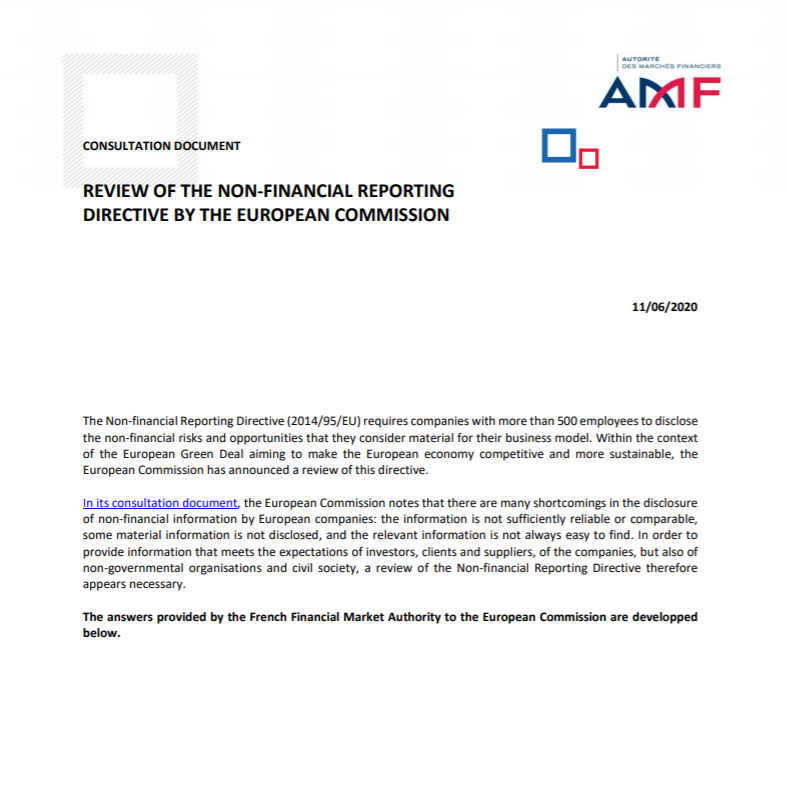
Réponse de l’AMF à la consultation publique européenne sur la revue de la directive extra-financière
La directive européenne de 2014 sur la publication d’informations non financières exige des sociétés de plus 500 salariés qu’elles communiquent les risques et opportunités extra-financiers qu’elles considèrent importants pour leur modèle d’affaire. Dans le cadre du Pacte Vert pour l’Europe (« Green deal ») visant à rendre l’économie de l’Union européenne compétitive et plus durable, la Commission européenne a annoncé la révision de cette directive. Voici les propositions que l’AMF entend porter dans le cadre de ces travaux européens.
L’AMF a identifié cinq axes majeurs :
Clarifier le concept de matérialité
Compléter les thèmes sur lesquels les entreprises sont invitées à communiquer
Etendre le périmètre des entreprises soumises à la déclaration de performance extra-financière
Améliorer la fiabilité de l’information extra-financière
Définir des règles de bonne gouvernance pour le futur standard de reporting extra-financier
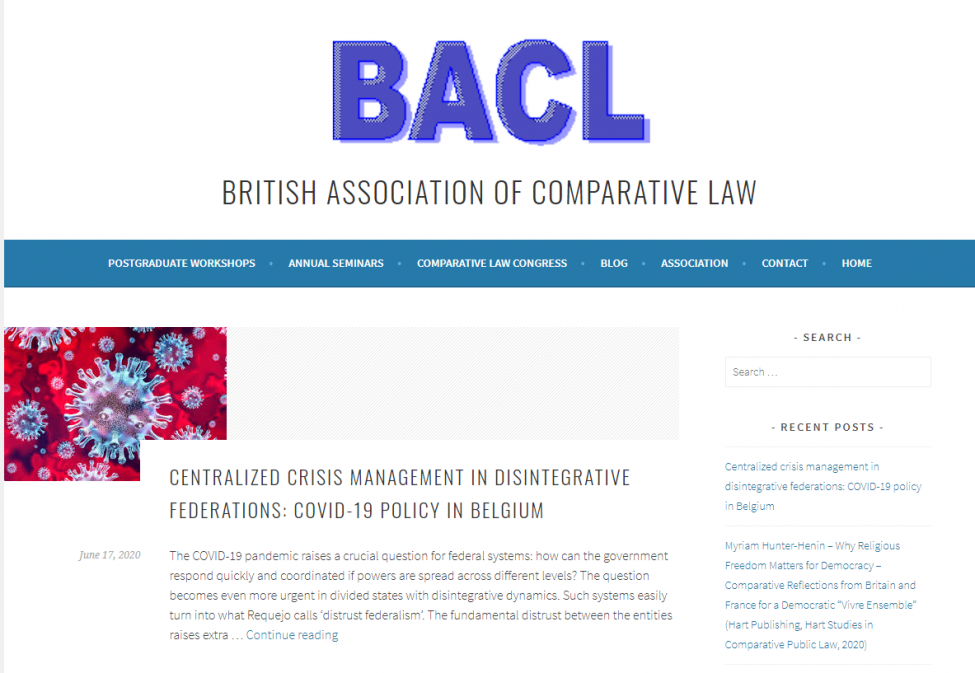
Ivan TCHOTOURIAN publie un article portant sur le COVID-19 et son impact sur les multinationales. Cet article sera accessible sur le blogue de la « British Association of Comparative Law ».
COVID-19 et multinationales : le temps du contre-pouvoir
La crise sanitaire liée à la COVID-19 amène à une réaction intéressante des États : imposer aux grandes entreprises de dessiner une économie différente construite sur l’idée de la soutenabilité. Crise sanitaire née en Asie, la COVID-19 est devenue depuis une crise économique mondiale poussant les États à fermer leurs frontières, à confiner leurs citoyens et à soutenir massivement leurs entreprises pour éviter l’effondrement de leur économie. Une des réactions des plusieurs États est d’octroyer des aides publiques en trésorerie aux entreprises. Avec la COVID-19, les États ont l’occasion de reprendre la main et de responsabiliser enfin les grandes entreprises. Mais, la comparaison de la position des États démontre une chose : l’idée de conditionner ce type d’aide à un comportement « vertueux » des entreprises n’est pas une évidence.
Dans le cadre du cours DRT-7022 Gouvernance de l’entreprise du Professeur Ivan Tchotourian, nos étudiants ont eu l’opportunité de réfléchir sur un sujet pendant toute une session. Voici le fruit de leur réflexion !
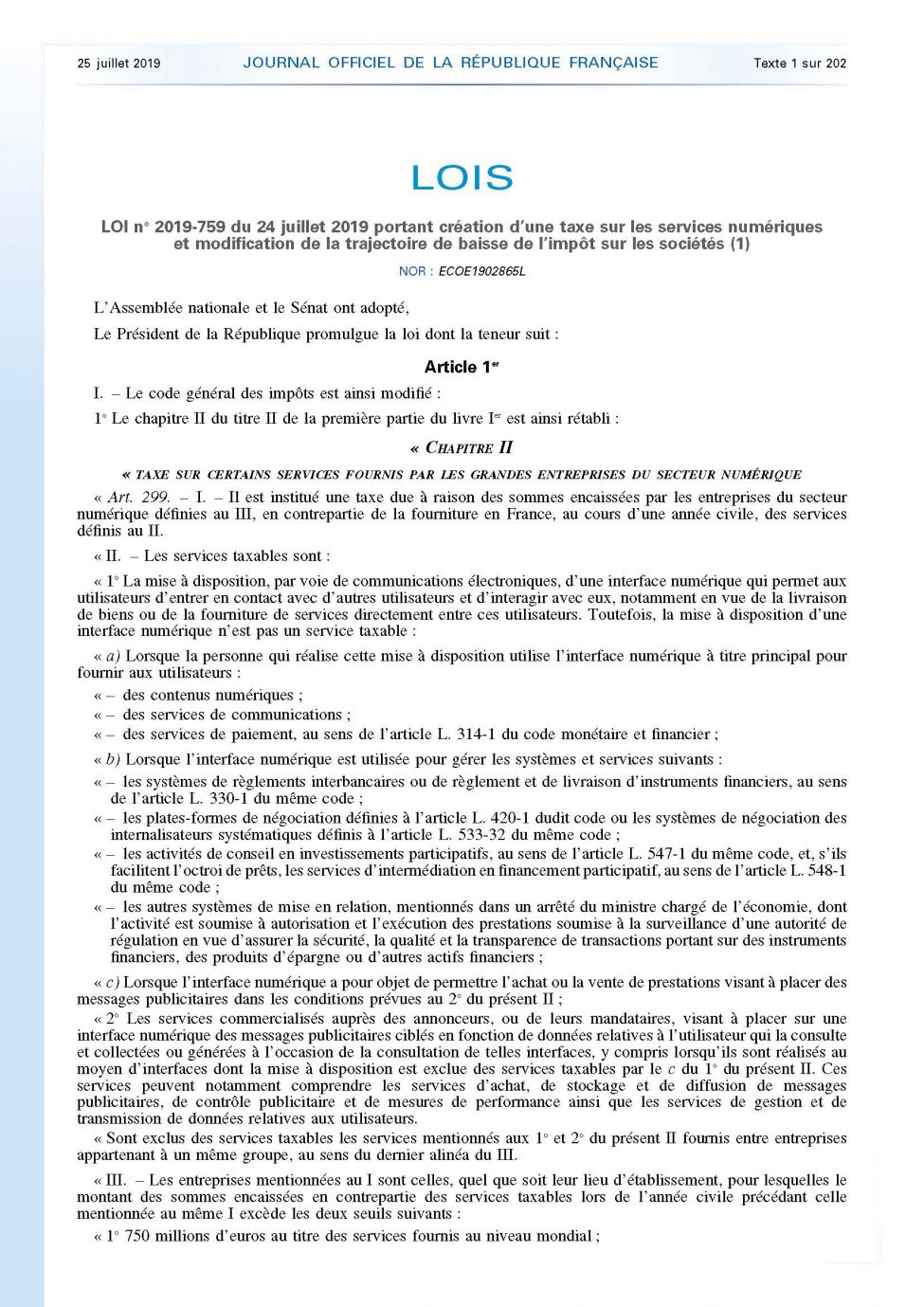
Irresponsabilité fiscale des grandes entreprises : la solution de la taxe française ?
Ce papier a pour objectif de revenir sur la taxe sur les services numériques adoptée par la France le 11 juillet 2019 pour tenter de lutter contre l’optimisation fiscale des grandes entreprises du numérique. Sa création s’explique par un contexte économique nouveau qui a remis en cause le système fiscal traditionnel. Critiquable à plusieurs titres, cette nouvelle taxe a pour intérêt de démontrer une volonté de donner une responsabilité fiscale aux entreprises à l’égard de la société. Sans faire une revue des solutions alternatives, il s’agit donc de montrer la prise de conscience internationale des États à réévaluer leur politique fiscale. Cette nouvelle réglementation ne vise pas à traiter la fiscalité à l’égard de la responsabilité sociale de l’entreprise (RSE) en tant que moyen, mais bien traiter la fiscalité comme un élément et une fin de la RSE.
The purpose of this paper is to review the digital services tax adopted by France on 11 July 2019 in an attempt to combat tax optimisation for large digital companies. Its creation is explained by a new economic context that has challenged the traditional tax system. This new tax is criticizable in several respects, and has the advantage of demonstrating a desire to give companies fiscal responsibility towards society. Without reviewing alternative solutions, it is therefore a question of showing the international awareness of States to reassess their tax policy. This new regulation does not aim to consider taxation of CSR as a means, but rather to see it as an element and an end of CSR.