normes de marché | Page 14
autres publications Gouvernance normes de droit normes de marché Structures juridiques Valeur actionnariale vs. sociétale
Pourquoi les entreprises deviendraient-elles des B Corp ?
Ivan Tchotourian 20 juin 2016
En voilà une question allez-vous me répondre et pourtant… Un récent article du Harvard Business Review de Suntae Kim, Matthew Karlesky, Christopher Myers et Todd Schifeling intitulé « Why Companies Are Becoming B Corporations » aborde la question de face.
2 raisons essentielles sont identifiées :
- First, as large established firms have ramped up their corporate social responsibility efforts, small businesses that have long been committed to social and environmental causes want to prove that they are more genuine, authentic advocates of stakeholder benefits.
- The qualitative evidence, gathered from firms’ B corporation application materials, revealed that certifying firms believed “the major crises of our time are a result of the way we conduct business,” and they became a B Corporation to “join the movement of creating a new economy with a new set of rules” and “redefine the way people perceive success in the business world.”
So why do certain firms (and not others) choose to identify as B Corporations? Individual leaders are partly why some organizations broaden their purpose beyond maximizing shareholder value. We might look to Sir Richard Branson, who in 2013 co-launched the “B Team,” publicly decrying corporations’ sole focus on short-term profits and calling for a reprioritization of people- and planet-focused performance. We might also consider leaders of firms like Ben & Jerry’s or Patagonia (both B Corporations) that have prioritized societal and environmental agendas.
Clearly, such leaders can be important catalysts of social change. However, the explosive growth of B Corporations seems also to be driven by broader trends and changes in the corporate landscape that cannot be explained by individuals’ actions alone.
Two of us (Suntae Kim and Todd Schifeling) conducted research to build a more robust understanding of the rise of B corporations. By qualitatively examining the internal motives of firms in the process of becoming a B corporation, and quantitatively testing key factors in these firms’ external industry environment – including the shareholder- and stakeholder-focused behaviors of their corporate competitors – we found that there are at least two major underlying reasons why firms choose to seek B Corporation certification.
À la prochaine…
Ivan Tchotourian
normes de marché
L’ISR peut-il être plus efficace ?
Ivan Tchotourian 10 juin 2016
Le Revenu propose deux capsules-vidéos consacrées à l’ISR autour de la question suivante : peut-il être plus efficace ? C’est M. Thierry Philipponnat (président du Forum pour l’investissement responsable, le FIR) qui s’exprime.
- Capsule-vidéo 1 : ici
- Capsule-vidéo 2 : ici
Après l’affaire de la rémunération de Carlos Ghosn, président de Renault et Nissan, faut-il aller jusqu’à désinvestir des sociétés qui prévoient des rémunérations excessives à leurs dirigeants, comme le fonds souverain norvégien (NBIM), veut désormais en donner l’exemple ? Ce fonds, qui gère près de 800 milliards d’euros d’encours, peut avoir de l’impact en désinvestissant, pas une petite société de gestion, argumente Thierry Philipponnat.
«Une société de gestion qui pèse 1% du fonds norvégien, doit être investie. Pour que les gérants fassent entendre leur voix, il faut qu’ils aillent voter aux assemblées», affirme Thierry Philipponnat. Le dialogue avec les entreprises et le vote des gérants aux assemblées reste, pour lui, la clé d’un investissement avec impact, même si d’autres préconisent le désinvestissement ou une intervention de l’État plus importante.
À la prochaine…
Ivan Tchotourian
autres publications normes de marché
L’ISR continue de croître en France
Ivan Tchotourian 1 juin 2016
Sur LinkedIn, Dominique Blanc de Novethic m’apprend que « L’ISR de conviction doit gagner du terrain ». Il profite de cette tribune pour revenir sur la dernière étude de Novethic en matière d’ISR.
Les chiffres de l’investissement responsable français publiés aujourd’hui par le centre de recherche de Novethic témoignent d’une nouvelle progression, près de 30 %. Il représente aujourd’hui quasiment 750 milliards d’euros gérés par une cinquantaine de sociétés de gestion françaises dont les plus grosses et détenus par une douzaine d’investisseurs institutionnels.
L’investissement responsable pèse à présent suffisamment lourd pour se demander jusqu’où il fait la différence en fléchant les investissements vers les entreprises les mieux disantes en termes environnementaux et sociaux, au-delà de leurs performances économiques. Pour répondre à cette question, le centre de recherche de Novethic a, pour la première fois, présenté ces chiffres en basant son analyse sur la mesure de l’impact des démarches d’investissement responsable sur les choix de gestion et la composition des portefeuilles. Son enquête montre que pour trois quarts des encours, l’impact reste limité. Il ne faut pas minimiser l’importance de ces pratiques d’investissement responsable. Elles permettent de donner de la valeur à l’analyse des entreprises qui ne repose pas exclusivement sur des données financières mais tente d’évaluer les dimensions ESG (Environnementale, Sociale et de Gouvernance) de leurs métiers.
L’enquête de Novethic quantifie pour la première fois l’ISR de conviction, celui qui assume jusqu’au bout des choix fondés sur une analyse ESG discriminante.
À la prochaine…
Ivan Tchotourian
autres publications normes de marché
En savoir plus sur l’ISR ?
Ivan Tchotourian 25 mai 2016
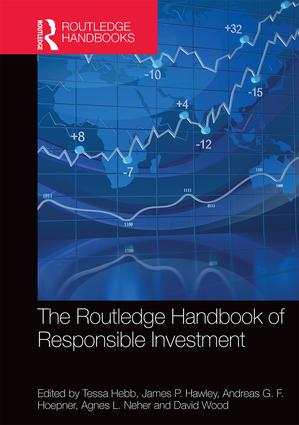
Bonjour à toutes et à tous, si la problématique si actuelle de l’investissement socialement responsable (ISR) vous intéresse, nul doute que ce bel ouvrage suscitera votre curiosité : « The Routledge Handbook of Responsible Investment » (T. Hebb, J. P. Hawley, A. G.F. HOEPNER, A. L. Neher et D. Wood) chez Routledge.
The UN-supported Principles for Responsible Investment initiative has led to around a third of the world’s financial assets being managed with a commitment to invest in a way that considers environmental, social or governance (ESG) criteria. The responsible investment trend has increased dramatically since the global financial crisis, yet understanding of this field remains at an early stage.
This handbook provides an atlas of current practice in the field of responsible investment. With a large global team of expert contributors, the book explores the impact of responsible investment on key financial actors ranging from mainstream asset managers to religious organizations.
Offering students and researchers a comprehensive introduction to current scholarship and international structures in the expanding discipline of responsible investment, this handbook is vital reading across the fields of finance, economics and accounting.
À la prochaine…
Ivan Tchotourian
normes de droit normes de marché rémunération
Retour sur un échec
Ivan Tchotourian 21 mai 2016
Un article du Financial Times (“Why it is time to curb the madness of executive pay”, 9 mai 2016) de Patrick Jenkins revient sur les contestations entourant la rémunération des hauts-dirigeants.
Earlier last week, the FT revealed that Norway’s oil fund would start making an example of companies that overpaid their bosses. In the UK, the Investment Association has asked Nigel Wilson, chief executive of Legal & General, to lead a task force on a similar issue. On Sunday, in an online debate of the FT City Network — a panel of top-rank financiers — Mr Wilson complained that the current system of executive pay was “very obviously not fit for purpose”. Participants said this was bad for shareholders, but also morally bad for society given the widening gap between executive pay and average wages. It is about time the topic gained momentum. In the US, average pay for a top chief executive is more than 300 times median salaries, according to the Economic Policy Institute. In 1965, it was just 20 times. In the UK, that multiple is now 183 times, according to the High Pay Centre.
À la prochaine…
Ivan Tchotourian
autres publications Gouvernance normes de marché rémunération
« How incentives for long-term management backfire » : cela fait réfléchir !
Ivan Tchotourian 16 mai 2016
Le Harvard Business Review propose un article intitulé : « How incentives for long-term management backfire” qui prend le contrepied de la croyance voulant que les plans incitatifs basés sur la performance à long terme seraient une cause du court-termisme de la direction des entreprises.
In the five years since the advent of Dodd-Frank regulation, corporate governance groups, with their policies requiring at least half of long-term incentives to be “performance-based,” have pushed companies to replace options with multi-year, performance plans. How could anyone object to such an effort? Hardly anyone, except here is the rub: Performance plans require performance targets, and in most companies, planning works in three-year cycles. The logical performance period for long-term incentives is one that matches those cycles. Three years has thus become the standard performance window for measuring achievement.
So a three-year horizon — not even a presidential term — has inexorably become the norm for investing hundreds of billions of dollars of money aimed at creating “long term” value. With the best of intentions, many proxy advisors and long-term investors have widely blessed three years as appropriate, adopting three-year pay for performance as their standard comparison. Today, four out of five S&P 500 companies use a three-year performance period in their long-term incentives. But executives today, who are paid on this new “long term,” typically with equity based partly on earnings-per-share performance, naturally think twice about retaining earnings for projects beyond three years. Their measurements conflict with their managerial inclinations, encouraging them to use earnings booked today to immediately return cash to shareholders.
À la prochaine…
Ivan Tchotourian
Normes d'encadrement normes de droit normes de marché
L’ISR : ça compte !
Ivan Tchotourian 13 mai 2016
Dans un récent billet intitulé « L’investissement responsable a-t-il une influence réelle sur son secteur? », Diane Bérard confirme la pertinence de l’orientation en faveur de l’ISR.
Oui, affirme Steve Lyndenberg, associé chez Domini Social Investment, créateur du Investment Integration Project et conférencier au colloque CFA Montréal.
En février dernier, la firme Morningstar annonce qu’elle ajoute une nouvelle forme d’évaluation à 20 000 fonds d’investissement. Ceux-ci seront aussi évalués selon les critères de l’investissement responsable ( ESG pour performance environnementale, sociale et de gouvernance). Chaque société composant le fonds est évaluée individuellement. Les scores sont ensuite cumulés pour obtenir le score du fonds.
À la prochaine…
Ivan Tchotourian