divulgation financière Nouvelles diverses Structures juridiques
Travail décent : la RSE malmenée
Ivan Tchotourian 28 octobre 2016
Début octobre 2016, SHARE a publié un rapport sur les pratiques de certaines grandes entreprises en matière de travail décent dans leur chaîne d’approvisionnement. Le résultat est plutôt décevant et la divulgation se montre en-deçà des attentes…
The correlation between workforce management and company performance means institutional investors have a key role to play in encouraging better workplace policies at organizations in their portfolios, particularly Canadian retail companies, according to a new report by the Shareholder Association for Research and Education.
The report, published in the lead up to the World Day for Decent Work on Oct. 7, reviewed disclosures from five Canadian and seven global retail companies, including Alimentation Couche-Tard Inc., Canadian Tire Corp., Loblaw Companies Ltd., Metro Inc., Carrefour S.A., Costco Wholesale Corp., the Home Depot, Marks & Spencer PLC, Tesco PLC and Walmart Corp.
It found that Canadian retail companies lag behind their global peers in the disclosure of key workplace metrics, including approaches to remuneration and wages, strategies for achieving workplace stability, and efforts to measure and understand how employees impact business performance and contribute value.
As a result, the report says Canadian retail companies need to provide institutional investors with better quality information on how they are managing and protecting their workers.
Pour en savoir plus, lire l’article suivant : « Institutional investors have important role to play in better workplace practices: report » (Benefits Canada, 6 octobre 2016).
À la prochaine…
Ivan Tchotourian
Gouvernance Nouvelles diverses Structures juridiques
Vers une réforme du droit des groupes en Europe
Ivan Tchotourian 28 octobre 2016
Le groupe européen d’experts en droit des sociétés vient de faire une proposition pour un droit des groupes : « A proposal for reforming group law in the European Union – Comparative observations on the way forward, October 2016 ».
The legal regime applicable to groups of companies in the European Union has been discussed for many years. National legislations have been adopted in a certain number of member states, and new initiatives are being considered by the European Commission and in academic writing. The central issues in groups of companies is the relationship between the controlling shareholder, often the parent company and the subsidiaries, and the potential for abuse to the detriment of the latter’s minority shareholders and creditors. Several answers have been formulated, going from a duty of the parent to indemnify the subsidiary for the charges imposed by the parent, to the acceptance of these charges provided they result in some benefit to the subsidiary and provided they do not endanger the subsidiary’s solvency. In a third approach, these issues may be solved by other common company law, e.g. on the basis of the unfair prejudice provisions. With respect to shareholder and creditor protection, a comparative analysis concludes that there is no need for additional regulatory safeguards. The present approaches indicate that group relations are often characterised by conflicts of interest. Therefore, it is proposed to develop a standard for dealing with these, especially under the form of Related Party Transactions. The specific conditions for dealing with intragroup related party transactions are submitted for further discussion.
À la prochaine…
Ivan Tchotourian
Normes d'encadrement Nouvelles diverses
Vers un code de gouvernance aux Etats-Unis ?
Ivan Tchotourian 25 octobre 2016
Merci à Jacques Grisé d’avoir relayé cette initiative américaine d’un futur code de gouvernance d’entreprise : « Prélude à un code de gouvernance aux É.U. ! ». Son billet s’appuie sur l’article de Gary Larkin associé à The Conference Board Governance Center intitulé « It’s Commonsense to Have a U.S. Corporate Governance Code ».
Voici les bases de ce code :
- Every board should meet regularly without the CEO present, and every board should have active and direct engagement with executives below the CEO level.
- Directors should be elected by a majority of either “for” or “against/withhold” votes (with abstentions and non-votes not be counted)
- Board refreshment should always be considered in order that the board’s skillset and perspectives remain current.
- Every board should have members with complementary and diverse skills, backgrounds and experiences.
- If the board decides on a combined CEO/Chair role, it is essential that the board have a strong independent director.
- Institutional investors that make decisions on proxy issues important to long-term value creation should have access to the company, its management, and, in some circumstances, the board.
- Companies should only provide earnings guidance to the extent they believe it is beneficial to shareholders.
À la prochaine….
Ivan Tchotourian
autres publications Base documentaire engagement et activisme actionnarial Gouvernance mission et composition du conseil d'administration
Rapport Davies : publication de l’édition 2016
Ivan Tchotourian 25 octobre 2016
Le cabinet Davies vient de publier son rapport annuel sur la gouvernance des entreprises au Canada : « Davies Governance Report Insights 2016 ».
3 messages principaux ressortent de ce rapport :
- L’important accroissement de la préoccupation de la communication entre CA et actionnaires : l’engagement constitue clairement une plus-value pour le CA !
- Les entreprises doivent continuer de pousser fort sur la thématique de la diversité.
- La grande variété des risques auxquels doivent faire face les CA et qu’ils doivent gérer adéquatement.
À la prochaine…
Ivan Tchotourian
conférences Nouvelles diverses
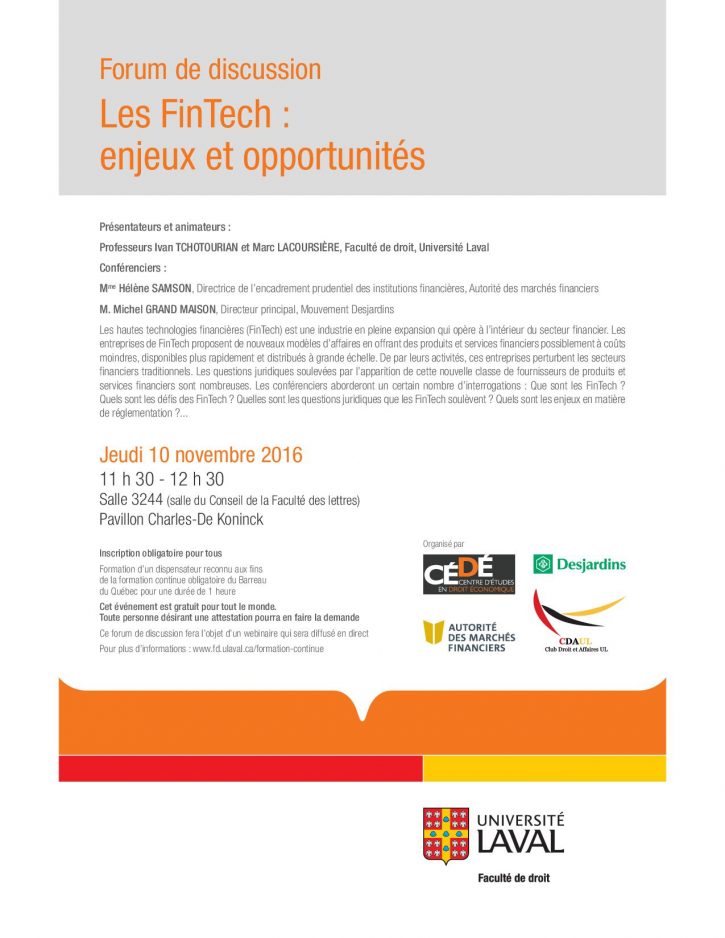
Forum sur les FinTech : à votre agenda
Ivan Tchotourian 25 octobre 2016
Bonjour à toutes et à tous, le CÉDÉ organise le 10 novembre 2016 un très intéressant forum de discussion sur les FinTech (ici). Une belle occasion d’échanger sur un thème qui fait la manchette et qui soulève de belles questions sur les plans réglementaires et de la protection des consommateurs.
Les hautes technologies financières (FinTech) est une industrie en pleine expansion qui opère à l’intérieur du secteur financier. Les entreprises de FinTech proposent de nouveaux modèles d’affaires en offrant des produits et services financiers possiblement à coûts moindres, disponibles plus rapidement et distribués à grande échelle. De par leurs activités, ces entreprises perturbent les secteurs financiers traditionnels. Les questions juridiques soulevées par l’apparition de cette nouvelle classe de fournisseurs de produits et services financiers sont nombreuses. Les conférenciers aborderont un certain nombre d’interrogations : Que sont les FinTech ? Quels sont les défis des FinTech ? Quelles sont les questions juridiques que les FinTech soulèvent ? Quels sont les enjeux en matière de réglementation ?…
N’oubliez pas de vous inscrire (ici) ! Pas de panique toutefois car ce forum fera l’objet d’un webinaire.
À la prochaine…
Ivan Tchotourian
Gouvernance Nouvelles diverses
Dénonciation et banque : un couple !
Ivan Tchotourian 24 octobre 2016
Bel article publié au Financial Times du 21 octobre 2016 : « Want to change banking culture? Back whistleblowers ». Après le scandale Wells Fargo, le journaliste revient sur la réforme de la culture bancaire dans laquelle les programmes de dénonciation ont toute leur place à condition que les dénonciateurs soient protégés.
Morceaux choisis :
Bill Dudley asked a couple of good questions this week, addressing a conference on reforming bank culture at the New York Federal Reserve.
“When people speak up to point out potential conduct issues, how are they treated?” said the Fed president, who spent about 20 years at Goldman Sachs before joining the reserve bank. “Are they held up as examples to emulate, or are they discouraged or even penalised?”
(…) There is a lot that needs to change, says Michael Winston. He is one of four former senior executives who have formed a group called Bank Whistleblowers United, pursuing a mission, they say, of restoring accountability to Wall Street.
(…) “If we want people to come forward, like in the Wells Fargo situation, we need to respect them, not punish them,” he says. “I know a lot of whistleblowers; nobody sees any protection. None.”
À la prochaine…
Ivan Tchotourian
devoirs des administrateurs Gouvernance Nouvelles diverses objectifs de l'entreprise Valeur actionnariale vs. sociétale
Retour sur le devoir fiduciaire : une excuse pour maximiser le retour des actionnaires ?
Ivan Tchotourian 24 octobre 2016
Intéressant ce que relaie le Time. Il y a un des candidats à l’élection présidentielle américaine a invoqué le devoir fiduciaire pour justifier les politiques d’évitement fiscales qu’il a mises en œuvre pendant de nombreuses années : « Donald Trump’s ‘Fiduciary Duty’ Excuse on Taxes Is Just Plain Wrong ». Qu’en penser ? Pour la journaliste Rana Foroohar, la réponse est claire : « The Donald and his surrogates say he has a legal responsibility to minimize tax payments for his shareholders. It’s not a good excuse ».
It’s hard to know what to say to the New York Times’ revelation that Donald Trump lost so much money running various casino and hotel businesses into the ground in the mid-1990s ($916 million to be exact) that he could have avoided paying taxes for a full 18 years as a result (which may account for why he hasn’t voluntarily released his returns—they would make him look like a failure).
But predictably, Trump did have a response – fiduciary duty made me do it. So, how does the excuse stack up? Does Donald Trump, or any taxpayer, have a “fiduciary duty,” or legal responsibility, to maximize his income or minimize his payments on his personal taxes? In a word, no. “His argument is legal nonsense,” says Cornell University corporate and business law professor Lynn Stout,
À la prochaine…
Ivan Tchotourian