Archives
autres publications mission et composition du conseil d'administration
Quand le CA doit penser activiste
Ivan Tchotourian 22 septembre 2015
Selon une étude du cabinet Norton Rose Fulbright, les CA doivent davantage penser comme les activistes. Tel est le sens d’un article publié dans le Financial Post intitulé « Boards should think more like activist investors: Norton Rose Fulbright » (21 septembre 2015).
Directors are doing a better job when it comes to corporate governance, but that may not be enough to keep activist shareholders at bay, according to a white paper published Monday by law firm Norton Rose Fulbright. Boards have to think more like activists and can do so by focusing on value creation at all times, says the paper, which was produced in collaboration with RBC Capital Markets and The Boston Consulting Group. Directors, many of whom are former executive at other companies, should regularly engage with senior managers to “critically examine” strategy development and value creation alternatives.
À la prochaine…
Ivan Tchotourian
mission et composition du conseil d'administration
Et le risque lié à la culture d’entreprise ?
Ivan Tchotourian 20 septembre 2015
Matteo Tonello du The Conference Board a publié le 13 juillet 2015 un très intéressant billet sur le blogue The Harvard Law School Forum on Corporate Governance and Financial Regulation consacré au risque d’appréhension par le CA du risque de culture de l’entreprise : « The Next Frontier for Boards, Oversight of Risk Culture ».
Over the past 15 years expectations for board oversight have skyrocketed. In 2002 the Sarbanes-Oxley Act put the spotlight on board oversight of financial reporting. The 2008 global financial crisis focused regulatory attention on the need to improve board oversight of management’s risk appetite and tolerance. Most recently, in the wake of a number of high-profile personal data breaches, questions are being asked about board oversight of cyber-security, the newest risk threatening companies’ long term success. This post provides a primer on the next frontier for boards: oversight of “risk culture.” (…)
This global regulatory storm has culminated in a series of papers from the Financial Stability Board (FSB), a global regulatory advisory body formed following the onset of the global financial crisis. Its main objective is to provide guidance to national financial sector and securities regulators around the world. In its most recent paper, issued in 2014, the FSB called on national regulators to actively assess the “risk appetite framework” and “risk culture” of systemically important financial institutions (SIFI), including assessing boards’ effectiveness in overseeing their company’s risk culture. The FSB summarized the new expectations of national financial sector regulators as follows:
“…efforts should be made by financial institutions and by supervisors to understand an institution’s culture and how it affects safety and soundness. While various definitions of culture exist, supervisors are focusing on the institution’s norms, attitudes and behaviour related to risk awareness, risk taking and risk management, or the institutions’ risk culture.”
The Financial Reporting Council (FRC), the United Kingdom’s national securities regulator, reacted to the FSB’s recommendations by updating The UK Corporate Governance Code that applies to all UK public companies. Provision C.2.3 of the Code mandates that the board should annually review and report on the effectiveness of their company’s risk management and internal control systems. Specifically, Item 43 in Section 5 of the guidance requires the board, in its annual review of effectiveness, to consider the company’s “willingness to take on risk (its ‘risk appetite’), the desired culture within the company and whether this culture has been embedded.”
The FRC, recognizing that there is little tangible guidance available to boards on how to oversee a company’s culture, stated that, in 2015, the initial year of implementation of the new board oversight requirements, it will focus on “company culture: how best to assess culture and practices and embed good corporate behaviour throughout companies.”
Financial regulators globally, including the SEC, are expected to follow the UK’s lead and significantly increase their focus on board oversight of corporate culture generally, and risk culture in particular. In a global survey conducted by KMPG, 1,500 audit committee members ranked government regulation second among risks that pose the greatest challenge for their company. Oversight of risk culture may be one of those areas of new government regulation.
À la prochaine…
Ivan Tchotourian
autres publications Nouvelles diverses
Publications des journées internationales de la SLC
Ivan Tchotourian 20 septembre 2015
Bonjour à toutes et à tous, les Journées internationales de la Société de législation comparée ont rassemblé des juristes de toutes professions et de tous horizons autour d’une réflexion sur le passé, le présent, et l’avenir du droit comparé. Le succès de ces Journées a été très grand et la SLC en publie les actes, en plusieurs volumes, composés d’un ouvrage général et des travaux des ateliers . L’ouvrage général constitue un témoignage irremplaçable, non seulement de ces journées, mais aussi de l’évolution du droit comparé et son rôle dans notre société.
Pour en savoir plus sur l’ouvrage, cliquez ici.
Pour en savoir plus sur les journées, cliquez ici.
À la prochaine…
Ivan Tchotourian
autres publications normes de marché
Prise en compte des critères ESG : les mythes s’effondrent
Ivan Tchotourian 18 septembre 2015
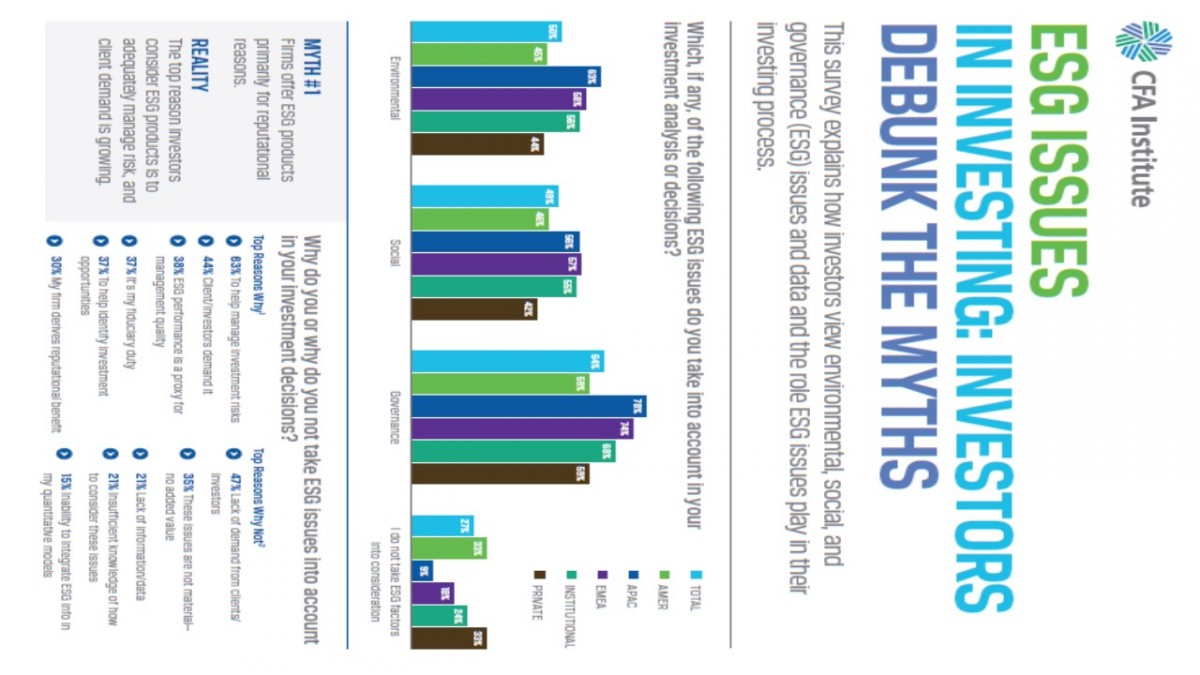
Bonjour à toutes et à tous, intéressante étude publiée à la mi-août par l’IRRC Institute (ESG Issues in Investing: Investors Debunk the Myths) selon laquelle : « Almost Three Quarters of Investment Professionals Use Environmental, Social & Governance Information When Making Investment Décisions. New CFA Institute survey highlights board accountability, human capital and executive compensation as important issues ».
Voici le bilan :
- Risk evaluation: Sixty-three percent of survey respondents said they consider ESG in the investment decision making process to help manage investment risks, 44 percent say that their clients/investors demand it and 38 percent said ESG performance is a proxy for management quality.
- Top three issues in decision-making: Survey respondents ranked board accountability, human capital, and executive compensation as the issues most important to investment analysis and decision-making.
- Regional breakdown: A high proportion of CFA Institute members in the Asia-Pacific region considered ESG issues (78 percent), followed closely by members in the Europe, Middle East, and Africa (EMEA) region (74 percent). Respondents in the Americas region were the least likely to use ESG information in their decision-making process, but, even there, a solid majority (59 percent) do use ESG factors.
- ESG integration in the investment process: Fifty-seven percent of respondents integrate ESG into the whole investment analysis and decision-making process, while 38 percent use best-in-class positive alignment; 36 percent use ESG analysis for exclusionary screening.
- ESG disclosures: Sixty-one percent of survey respondents agreed that public companies should be required to report at least annually on a cohesive set of sustainability indicators in accordance with the most up-to-date reporting framework. In addition, 69 percent of these respondents say ESG disclosures should be subject to independent verification. Furthermore, of these, 44 percent believe that verification at a high level of assurance, similar to an audit, is necessary. Another 46 percent believe limited verification, or a lower level of assurance, is necessary. When this group was asked how much should be spent on independent verification, responses varied from 10 percent to 100 percent of the cost of an audit of financial statements.
À la prochaine…
Ivan Tchotourian
conférences
Un symposium pour un devoir de diligence accru en Suisse
Ivan Tchotourian 18 septembre 2015
L’initiative multinationales responsables lancée en avril 2015 qui prévoit un devoir de diligence pour les entreprises suisses afin que celles-ci incorporent de façon obligatoire le respect des droits humains et des standards environnementaux dans leurs relations d’affaires organise un symposium en décembre 2015. Une extension de la responsabilité des entreprises en terme de dommages et intérêts dans le cas de violations des droits humains ou de dégâts environnementaux commis par leurs filiales est également prévue, selon le modèle de la responsabilité de l’employeur.
Le symposium du 2 décembre 2015 (13 h – 18 h) verra la présentation du texte de l’initiative dans le détail. Des juristes de domaines variés discuteront ensuite des effets et de la mise en œuvre de l’initiative.
Accéder au programme ici.
À la prochaine…
Ivan Tchotourian
conférences
Colloque franco-canadien organisé par le CÉDÉ
Ivan Tchotourian 18 septembre 2015
Le CÉDÉ organise en collaboration avec l’Université Cergy-Pontoise un colloque intitulé « La criminalité économique et ses incidences sur la gouvernance de l’entreprise ». Cette journée d’étude internationale aura lieu le 14 octobre 2015 dans la salle Jean-Paul Tardif. La particularité de cette journée est que nous accueillerons, en plus des experts venus de France, la promotion 2015-2016 du Master 2 de droit pénal et financier de l’université Cergy-Pontoise. Bienvenu à la promotion du Master qui découvrira par la même le campus de l’Université Laval !
La criminalité économique, qui se manifeste notamment par la fraude, les détournements de fonds, la corruption et le blanchiment d’argent, est un sujet d’actualité qui interpelle les juristes de droit des affaires. La journée d’étude franco-canadienne se propose d’étudier les conséquences de cette forme particulière de criminalité sur la gouvernance d’entreprise. Ces conséquences seront présentées en deux axes.
Pour en savoir plus, je vous laisse consulter le programme provisoire (quasi-définitif) : ici.
Rendez-vous sur la page de la faculté de droit pour vous inscrire : ici.
À la prochaine…
Ivan Tchotourian
mission et composition du conseil d'administration
Une féminisation toujours trop faible
Ivan Tchotourian 17 septembre 2015
Le Conference Board a publié sur son blogue un intéressant article établissant que la féminisation dans la position haut management demeure faible. La comparaison est pertinente et donne idée précise du paysage…
Despite the intense public policy debate on the diversity of business leadership, women continue to be under-represented in management positions, according to research conducted by The Conference Board in collaboration with Bloomberg and GRI. Data for 2014 show women accounted for only 22 percent of management positions among S&P Global 1200 companies, a figure which remains unchanged from 2013. The analysis by region suggests companies in Asia-Pacific and Latin America showed some improvement. For instance, 18 percent of management positions among companies in Asia-Pacific in 2014 were held by women, up from only 12 percent in 2013. Among companies in Latin America, the share of women in management was 19 percent, up from 15 percent in 2013. While the increases in these two regions are notable, rates remain well below the medians of 23 percent and 22 percent reported by companies in North America and Europe, respectively.
À la prochaine…
Ivan Tchotourian