Divulgation Gouvernance parties prenantes
Salariés : comment mieux les protéger ?
Ivan Tchotourian 10 janvier 2019 Ivan Tchotourian
Bonjour à toutes et à tous, les salarié font l’objet d’une attention dans le cadre de ce billet : « Si les travailleurs sont un atout – comment les entreprises les protègent-elles ? » (Shannon Rohan, EqualTimes, 7 octobre 2016).
Pourquoi les entreprises restent-elles donc toujours aussi silencieuses concernant l’immense majorité des travailleuses et travailleurs impliqués dans leurs activités ?
Une raison pour cela est que personne ne leur exige de fournir une information de meilleure qualité ? Si nous ne la leur demandons pas, elles ne nous la fourniront pas. Quand bien même la divulgation des émoluments des cadres s’est sensiblement améliorée suite au tollé suscité par la rémunération excessive des chefs d’entreprise, trop peu d’attention a été accordée aux politiques salariales des entreprises concernant le reste de leurs effectifs.
Cette négligence peut être interprétée comme une acceptation d’un raisonnement très répandu au sein des conseils d’administration qui voudrait que les meilleurs candidats aux postes exécutifs requièrent une rémunération compétitive (autrement dit exorbitante) et que cette compensation représente un investissement dans l’entreprise. Les travailleurs, en revanche, sont considérés comme une charge pour l’entreprise et partant un poids sur les bénéfices.
Cependant, un groupe croissant d’investisseurs institutionnels tentent de modifier ce discours en appelant mondialement les entreprises à garantir une transparence et une information accrues sur leurs pratiques et politiques en matière de travail.
Ici au Canada, je participe à un programme appelé Valuing Decent Work (accorder de l’importance au travail décent). Avec le soutien de l’Atkinson Foundation, nous mobilisons les voix des investisseurs au Canada pour amplifier l’appel en faveur de la diffusion par les entreprises d’une information de meilleure qualité concernant leurs approches en matière de travail décent.
Notre rapport conclut qu’une opportunité unique se présente aux investisseurs de tenir les entreprises responsables et d’améliorer la qualité de l’information disponible concernant les pratiques de travail décent des entreprises.
Les entreprises doivent à leurs investisseurs de démontrer comment elles protègent, cultivent et investissent dans cet atout crucial que sont leurs travailleurs.
À la prochaine…
Ivan
Nouvelles diverses
Une RSE et des visages nouveaux
Ivan Tchotourian 4 janvier 2019 Ivan Tchotourian
Dans Fortune, je viens d’apprendre que la RSE prend de nouveaux visages et que les entreprises doivent donc s’adapter à de nouvelles problématiques. Pour en savoir plus, je vous conseille la lecture de l’article suivant : « Corporate Responsibility Is Taking On a New Meaning » (2 janvier 2019).
Doing the right thing in business is no longer synonymous with philanthropy. It now means investing in your people, future talent, environmental impact, and long term business priorities. In fact, in its newly released 2018 company rankings, JUST Capital emphasized how “just” companies are also very business-minded. Over the course of the year, companies ranked by JUST Capital consistently outperformed those not ranked. The JUST Capital ranking looks at what matters to Americans when it comes to corporate responsibility. While it was no surprise many of the attributes found in JUST 100 companies were also consistently talked about in 2018—equal pay, flexible work hours, a focus on diversity, a good showing of female leadership—what I found most interesting is what isn’t necessarily considered of top concern now.
Quelles sont les nouvelles orientations des entreprises en matière de RSE ?
- Formation des salariés
- Transparence
- Sécurité des données
- Engagement communautaire
À la prochaine…
Ivan
finance sociale et investissement responsable Gouvernance objectifs de l'entreprise Valeur actionnariale vs. sociétale
Beyond the bottom line: should business put purpose before profit?
Ivan Tchotourian 4 janvier 2019
Dans le Financial Times, Andrew Edgecliffe-Johnson propose un article ô combien enrichissant montrant que les choses commencent à changer en matière de gouvernance d’entreprise : « For 50 years, companies have been told to put shareholders first. Now even their largest investors are challenging that consensus ». L,article est intitulé « Beyond the bottom line: should business put purpose before profit? » (4 janvier 2019) et je vous le recommande chaudement.
In sum, the purpose-first movement is still far from ubiquitous and lacking in reliable data, but is the pursuit of something beyond profit worse than Friedman’s singular focus on shareholder returns? Encouraging companies to have a clear mission, consider their communities and steer their innovative impulses to good ends may not add up to systemic change, but it is surely better than the alternative.Critics such as Giridharadas would rather society concentrate on restoring politics as the forum through which we address its challenges. But for as long as politicians are viewed with more suspicion than chief executives and investors, the purposeful capitalists may be our best hope.Consumers, employees and campaigners are already learning how effective they can be in pushing companies to balance other stakeholders’ concerns with their returns to shareholders. Companies, in turn, have discovered that doing so can improve their reputations, persuade investors that they have a sustainable strategy and, ultimately, benefit their bottom line.When corporate America is paying chief executives 168 times as much as the median employee, steering the windfall from a historic tax cut to options-boosting buybacks and consolidating into ever larger groups, executives claiming to be solving society’s ills can expect pushback.The pursuit of purpose will not end the questions over how much chief executives should earn, what wages and taxes companies should pay or how much corporate power society will tolerate. Nor will investors stop judging chief executives by their share prices. But 50 years of putting shareholders first left corporations little trusted by non-shareholders and many are ready to try something different.As companies’ self-interest converges with the interests of other stakeholders, those who would improve the world have a chance to get some of the world’s most powerful instruments for change onside. They should grasp the opportunity business’s moral money moment has given them.
À la prochaine…
Ivan
normes de droit responsabilisation à l'échelle internationale
La fiscalité des GAFA va-t-elle être repensée par l’UE ?
Ivan Tchotourian 4 janvier 2019 Ivan Tchotourian
Alors que la fiscalité des GAFA soulève de nombreuses discussions (discussions qui montrent que la RSE est loin d’avoir intégrée un volet fiscalité !), voici une nouvelle qui se doit d’être relayée : « EU Commission pushes plan to tax internet companies » (euobserver, 3 janvier 2019).
The European Commission is pushing ahead with plans to end unanimity on tax, asking member states to respond before 17 January to a consultation on producing a plan of action in the first quarter of 2019, reports the Irish Times. EU countries have so far failed to agree on a joint digital sales tax on multinational internet giants, as individual states plan national taxes on such companies.
À la prochaine…
Ivan
engagement et activisme actionnarial Gouvernance
Activisme : quel bilan en 2018 ?
Ivan Tchotourian 4 janvier 2019 Ivan Tchotourian
Bonjour à toutes et à tous, MM. Lipton et Podolsky publient un bel article sur le blogue Harvard Law School Forum on Corporate Governance and Financial Regulation intitulé : « Activism: The State of Play at Year-End 2018 ».
As we noted [in 2018], the threat of activism continues to be high, and has become a global phenomenon. The conclusion of a volatile and dynamic 2018 prompts a brief update of the state of play.
- Activist assets under management remain at elevated levels, encouraging continued attacks on large successful companies in the U.S. and abroad. In many cases, activists have been taking advantage of recent stock market declines to achieve attractive entry points for new positions. These trends have been highlighted in several recent media reports, including in The Wall Street Journal and Bloomberg.
- While the robust M&A environment of much of 2018 has recently subsided, deal-related activism remains prevalent, with activists instigating deal activity, challenging announced transactions (e.g., the “bumpitrage” strategy of pressing for a price increase) and/or pressuring the target into a merger or a private equity deal with the activist itself.
- “Short” activists, who seek to profit from a decline in the target’s market value, remain highly aggressive in both the equity and corporate debt markets. In debt markets, we have also recently seen a rise in “default activism,” where investors purchase debt on the theory that a borrower is already in default and then actively seek to enforce that default in a manner by which they stand to profit.
- Elliott Management was the most active and in many cases aggressive activist of 2018. The Wall Street Journal noted that Elliott has publicly targeted 24 companies in 2018, with Icahn and Starboard runners-up with nine public targets each. The New Yorker published a lengthy profile of Paul Singer and Elliott in August, “Paul Singer, Doomsday Investor”. “Singer has excelled in this field in part because of a canny ability to discern his opponents’ weaknesses and a seeming imperviousness to public disapproval.”
- Enhanced ESG disclosure remains a topic of great interest to institutional investors and the corporate governance community. In October, two prominent business law professors, supported by investors and other entities with over $5 trillion in assets under management, filed a petition for rulemaking calling for the SEC to “develop a comprehensive framework requiring issuers to disclose identified environmental, social, and governance (ESG) aspects of each public-reporting company’s operations.” In November, the Embankment Project of the Coalition for Inclusive Capitalism issued its report outlining proposed ways to measure long-term sustainable value creation beyond financial results. And earlier this month, ESG disclosure was the subject of a lively discussion at a meeting of the SEC’s Investor Advisory Committee, with various views expressed regarding the merits of regulatory efforts versus private ordering in this area.
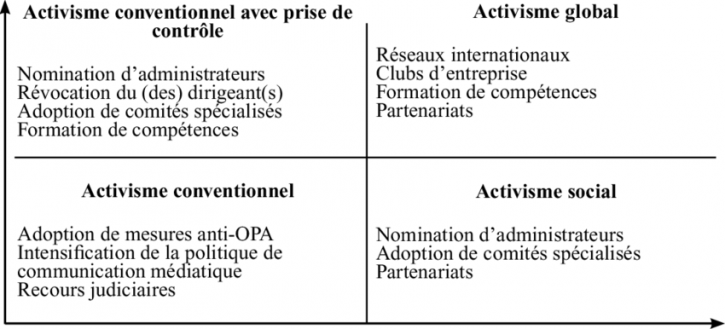
Merci à Jacques Grisé de cette information relayée sur son blogue (ici). Je lui ai emprunté le tableau que vous avez ci-dessus !
À la prochaine…
Ivan
Gouvernance Normes d'encadrement Nouvelles diverses
« La gouvernance d’entreprise : mise en œuvre et nouveaux enjeux » : rapports de recherche
Ivan Tchotourian 18 décembre 2018 Ivan Tchotourian
Depuis 2014, la Mission de recherche Droit et Justice et la Direction des affaires civiles et du Sceau du ministère de la Justice (DACS) se sont intéressées aux codes de gouvernance mis en œuvre par les entreprises. Quatre recherches sur ce thème ont été présentées le 16 novembre à Paris. Les quatre rapports de recherche financés par la Mission de recherche Droit et Justice qui ont fait l’objet d’une restitution lors de cette journée d’étude :
Pour en savoir plus, cliquez ici.
À la prochaine…
Ivan
normes de droit Nouvelles diverses responsabilisation à l'échelle internationale
Le Modern Slavery Act entre en vigueur au 1er janvier 2019
Ivan Tchotourian 18 décembre 2018 Ivan Tchotourian
En Australie, le Modern Slavery Act 2018 (No. 153, 2018) An Act to require some entities to report on the risks of modern slavery in their operations and supply chains and actions to address those risks, and for related purposes entre en vigueur dans quelques jours… Gare à vous multinationales, le droit de la RSE est en marche !
Pour en savoir plus, rendez-vous à ce lien : https://www.legislation.gov.au/Details/C2018A00153/Html/Text
À la prochaine…
Ivan