Gouvernance Normes d'encadrement responsabilisation à l'échelle internationale Structures juridiques
IFA : quelle gouvernance des filiales d’un groupe ?
Ivan Tchotourian 11 juillet 2016
L’Institut français des administrateurs de sociétés vient de publier un document de travail sur la gouvernance des filiales d’un groupe intitulé : « Gouvernance des filiales d’un groupe ». À l’ère des multinationales et des poupées russes, ce guide sera assurément un document fort utile.
La gouvernance des groupes s’inscrit à la fois dans une logique d’intégration de plus en plus développée et dans un contexte de plus en plus complexe : multiplication des réglementations dans les différents pays dans lesquels les entreprises sont établies, demande croissante de la société civile de prise en compte des impacts sociaux et environnementaux des activités des entreprises, responsabilité pénale des multinationales ou entreprises transnationales.
La gouvernance d’une entreprise ne se limite pas au bon fonctionnement de son conseil d’administration, elle englobe également la gouvernance de l’ensemble des filiales, ce que l’on peut résumer à la « gouvernance interne » : son organisation, ses politiques et procédures ; elle s’inscrit aussi dans la culture du groupe.
Au sein d’un groupe il s’agit de faire une synthèse harmonieuse des intérêts de la société mère et des différentes filiales et participations, et notamment de faire en sorte que la vie sociale des filiales soit réelle et apporte un vrai plus au bon fonctionnement du groupe et à sa performance.
Le document formule des recommandations pour une bonne gouvernance des groupes, et pour accompagner l’administrateur siégeant dans les filiales de ces groupes.
À la prochaine…
Ivan Tchotourian
engagement et activisme actionnarial mission et composition du conseil d'administration normes de droit
Vers un tremblement de terre en Grande-Bretagne ?
Ivan Tchotourian 11 juillet 2016
May expressed discontent with the current model of corporate governance used by FTSE companies and in particular the effectiveness of supposedly independent non-executive directors. ‘In practice, they are often drawn from the same narrow social and professional circles as the executive team and the scrutiny they provide is often limited,’ she said. So, she suggests, workers and even consumers should be given a seat at the table.
May wrote she wants to tackle the ‘unhealthy and growing gap between what these companies pay their workers and what they pay their bosses.’ Specifically she wants to make shareholder votes on corporate pay packages binding instead of advisory and ‘simplify the way bonuses are paid so that the bosses’ incentives are better aligned with the long-term interests of the company.’
À la prochaine…
Ivan Tchotourian
mission et composition du conseil d'administration
Féminisation des CA : pas une bonne nouvelle !
Ivan Tchotourian 9 juillet 2016
Impertinent ? L’article de Kim Elsesser publié sur Forbes et intitulé « The Truth About Women’s Impact On Corporate Boards (It’s Not Good News) » présente une étude (plutôt critique !) sur la féminisation des CA.
Greater profits, greater CEO pay and enhanced problem-solving are just a few of the claimed advantages of increasing the number of women on a company’s board of directors. Could it really be true that merely adding a few women to the board could bring such powerful change? Alice Eagly, professor of psychology and management at Northwestern, and one of the most renowned researchers on female leaders, delved into the academic research on the topic She summarized what social scientists had learned about women’s impact on corporate boards. Let’s just say, it doesn’t look good.
À la prochaine…
Ivan Tchotourian
engagement et activisme actionnarial
2016 : bilan des propositions actionnariales
Ivan Tchotourian 9 juillet 2016
Sur son blogue, Jacques Grisé (ici) vient de nous informe de cet article, publié par Elizabeth Ising (associée de la firme Gibson, Dunn & Crutcher ) paru sur le forum de Harvard Law School : « Shareholder Proposal Developments During the 2016 Proxy Season ».
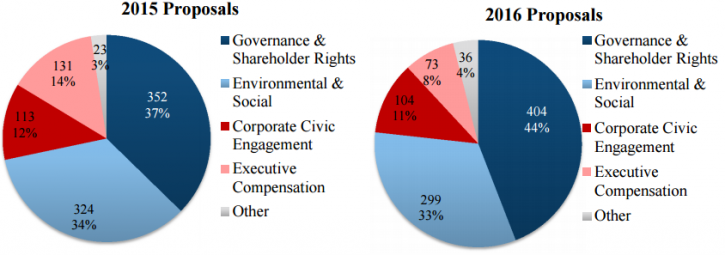
Ci-dessus, vous trouverez les thèmes qui ont eu l’intérêt des actionnaires…
Fidèle aux thématiques de ce blogue, qu’apprend-t-on en matière environnementale ?
- Second Most Common Category of Proposals: Proposals concerning environmental and social matters remained a frequent shareholder proposal topic in 2016, with approximately 299 proposals submitted for 2016 meetings
- Only six environmental and social proposals have received a majority of votes cast at 2016 meetings:
- A proposal requesting a report on methane emissions submitted to WPX Energy, Inc. received 50.8% of votes cast
- A proposal requesting a report on gender pay equity submitted to eBay Inc. received 51.2% of votes cast
- A proposal requesting adoption of a policy to enhance board diversity submitted to Joy Global Inc. received 52.4% of votes cast
- A proposal requesting amendments to the EEOC policy to prohibit discrimination based on sexual orientation and gender identity submitted to J.B. Hunt Transport Services, Inc. received 54.7% of votes cast
- A proposal requesting a sustainability report submitted to CLARCOR Inc. received 60.8% of votes cast
- A proposal commending Kellogg Co. for animal welfare improvements in its supply chain (which the company recommended voting “for”) received 98.2% of votes cast
À la prochaine…
Ivan Tchotourian
Gouvernance Normes d'encadrement Structures juridiques
Gouvernance des banques : une analyse de l’ECGI
Ivan Tchotourian 9 juillet 2016
Excellent Law Working Paper de l’ECGI (No. 316/2016) de John Armour, Dan Awrey, Paul L. Davies, Luca Enriques, Jeffrey N. Gordon, Colin Mayer et Jennifer Payne consacré à la gouvernance d’entreprise des banques : « Bank Governance ».
Voici le résumé :
According to a common narrative, in addition to inadequate capital and liquidity, the failure of banks in the financial crisis also reflected their poor governance. By governance we mean broadly the oversight that comes from banks’ own shareholders and other stakeholders of the way in which they are run.
The problem of bank governance stems from the way in which banks are financed and regulated, from the externalities bank failures produce, and from the nature of their assets. In the period leading up to the financial crisis, it was believed that regulation would cause banks to internalize the costs of their activities, meaning that what maximized bank shareholders’ returns would also be in the interests of society.
Consequently large banks used the same governance tools as non-financial companies to minimize shareholder-management agency costs, namely independent boards, shareholder rights, the shareholder primacy norm, the threat of takeovers, and equity-based executive compensation. Unfortunately, such tools had the adverse effect of encouraging bank managers to take excessive risks: as we describe in this chapter, banks that had the most ‘pro-shareholder’ boards and the closest alignment between executive returns and the stock price were those which took the most risks prior to, and suffered the greatest losses during, the crisis.
Consequently, a significant rethink about the way in which banks are governed is required. The structure and function of bank boards, the compensation of bank executives and the function of risk management within organizations needs careful crafting if governance reforms are to address not exacerbate bank failures.
À la prochaine…
Ivan Tchotourian
engagement et activisme actionnarial état actionnaire normes de droit
Actionnaires v. État actionnaire : exemple du Brésil
Ivan Tchotourian 9 juillet 2016
Le blog de l’Université d’Oxford publie un très récent billet analysant sur le dilemme et la position délicate dans laquelle peut être placé l’État actionnaire : « Exercise of Shareholder Control Over a State Owned Enterprise – Comments on Comissão de Valores Mobiliários’s decision in the Eletrobras case » (par le professeur Mario Engler Pinto Junior).
The Comissão de Valores Mobiliários (CVM), the Brazilian equivalent of the SEC, has recently imposed sanctions on the Federal Government for actions taken as the controlling shareholder of the public company Eletrobras. More precisely, the sanctions were imposed on the Federal Government for voting in a general meeting to grant approval of an Elecrobras significant transaction. CVM considered that the Federal Government had a conflict of interest and should have abstained from voting in a shareholders’ meeting called to approve the renewal of the concession contract held by Eletrobras and its subsidiaries for electrical power generation.
In Brazil, the Federal Government is also the public authority responsible for regulating the electrical sector. According to CVM, the renewal of the concession contract for electrical power generation was a related party transaction that could bring indirect economic benefits to the Federal Government.
My paper criticizes CVM’s approach, arguing that the contract renewal was a legitimate public policy decision in the context of the electrical sector as a whole.
À la prochaine…
Ivan Tchotourian
Nouvelles diverses
ESG : un exercise de « box-ticking »?
Julie Bernard8 juillet 2016
C’est la question à laquelle tente de répondre Marianne Harper Gow de chez Baillie Gifford’s dans un article fort intéressant intitulé : « Has ESG morphed to become just a box-ticking exercise? ».
As more groups move to include ESG factors within their fund strategies, Baillie Gifford’s director of corporate governance Marianne Harper Gow argues analysis in this area is too ‘simplistic’ and many processes are undermining the research effort
Selon l’auteur de l’article, l’approche parfois trop simpliste de l’évaluation environnementale, sociale et de gouvernance (ESG) des portefeuilles va complètement à l’encontre de la philosophie, la rigueur et la robustesse du processus de recherche et d’engagement qui devraient faire partie intégrante des prises de décisions en ce qui concerne les investissements et les placements. De plus, selon Gow, la grande variété d’opinions à l’égard ce qui est, ou n’est pas, sous la bannière ESG est sans doute une des raisons pour laquelle, malgré des décennies de discussion et d’intérêt pour l’ESG et l’investissement responsable, il n’y a toujours pas de classement des performances crédibles et largement utilisées qui a vu le jour. Bref, il serait possible de faire un résumé de cet article, mais puisqu’il est bon dans sa totalité et qu’il est plutôt court, je vous recommande fortement d’y jeter un coup d’œil.
Bonne lecture
Julie Bernard, MAP, Adm.A
Étudiante au doctorat (PhD) en sciences de l’administration (Management)
Faculté des sciences de l’administration
Université Laval