Archives
autres publications normes de droit
Les devoirs fiduciaires ouverts à l’ISR
Ivan Tchotourian 15 septembre 2015
Le programme des Nations unies pour l’environnement a publié dans le cadre de ses travaux Inquiry into the Design of a Sustainable Financial System une série de rapports. L’un d’eux nous intéresse tout particulièrement. Il s’agit du rapport « The Fiduciary Duty in the 21st Century » qui explore le contenu des devoirs fiduciaires de manière comparative et qui a démontré qu’il n’y a aucun obstacle pour les fonds d’investissement à investir les champs environnementaux, sociaux et de gouvernance.
Dans ce rapport, les préconisations suivantes sont faites…
In particular, policymakers and regulators should:
Clarify that fduciary duty requires investors to take account of ESG issues in their investment processes, in their active ownership activities, and in their public policy engagement
Strengthen implementation of legislation and codes, clarifying that these refer to ESG issues, and require investor transparency on all aspects of ESG integration, supported by enhanced corporate reporting on ESG issues
Clarify the expectations of trustees’ competence and skill and support the development of guidance on investor implementation processes, including investment beliefs, long- term mandates, integrated reporting and performance
Support efforts to harmonise legislation and policy instruments on responsible investment globally, with an international statement or agreement on the duties that fduciaries owe to their benefciaries. This statement should reinforce the core duties of loyalty and prudence, and should stress that investors must pay attention to long-term investment value drivers, including ESG issues, in their investment processes, in their active ownership activities, and in their public policy engagement
À la prochaine…
Ivan Tchotourian
normes de droit
La conformité bientôt sanctionnée en France !
Ivan Tchotourian 15 septembre 2015
Bonsoir à toutes et à tous, en voilà une nouvelle venue de France (plus précisément du journal Les Échos en date du 10 septembre 2015 : « Conformité : les sociétés bientôt sous surveillance ? ») : un projet de loi prévoit la création d’une agence de lutte contre la corruption chargée de contrôler les politiques de prévention mises en place dans les entreprises.
C’est un grand vide juridique que le gouvernement cherche aujourd’hui à combler. En dotant le projet de loi sur « la transparence de la vie économique » – qui devrait être présenté au Parlement à l’automne – d’un volet anticorruption, l’exécutif compte bien obliger les entreprises françaises à mettre en place des programmes de conformité. « Actuellement, il y a un écart important entre quelques multinationales soumises à des droits étrangers, notamment anglo-saxons, qui ont dû mettre en place de tels outils de prévention, et les entreprises dont l’activité est essentiellement en France qui, parce qu’elles n’y sont pas obligées, sont en retard en matière de lutte contre la corruption », assure Jonathan Mattout, avocat associé chez Herbert Smith Freehills.
À la prochaine…
Ivan Tchotourian
mission et composition du conseil d'administration
Mission du CA vis-à-vis du président
Ivan Tchotourian 14 septembre 2015
Karen Higginbottom offre un bel article dans le magazine Forbes intitulé « The Role Of The Board In Appointing And Dismissing The CEO ». À cette occasion, l’auteure revient sur l’un des rôles les plus importants du conseil d’administration : nommer et révoquer le président du conseil (mission sur laquelle le droit et les codes de gouvernance ne précisent peu de choses).
On July 8 this year, Barclays announced that Anthony Jenkins, who had been brought into the bank as chief executive three years before to instigate a culture change was being sacked. The non-executive directors led by Sir Michael Rake, deputy Chairman and senior independent director explained that “new leadership was required to accelerate the pace of executive going forward and that John McFarlane was ideally qualified in this respect until a permanent successor was appointed.” Barclays denied that Jenkins’s sacking signaled any major change in strategy.
The whole incident brings into question the role of the board and Chairman (and on rare occasions, Chairwoman) in selecting and dismissing the CEO. The U.K. Corporate Governance Code sets out a code of conduct for the Chairman and non-executive directors of publicly listed companies in the UK. However, this code isn’t legally binding and is based on a “comply or explain” approach. The code by the Financial Reporting Council states that the board should “set the company’s strategic aims, ensure that the necessary financial and human resources are in place for the company to meet its objectives and review management performance.”
The most important job of the board is to decide whether a CEO’s time is up or not, remarks Andrew Campbell, director at Ashridge strategic management center. “Inevitably, one goes down a slippery slope as you have more discussions with directors as to whether the time is right for them to go and somebody calls a vote of no confidence and you either vote for or against the person.
À la prochaine…
Ivan Tchotourian
engagement et activisme actionnarial
The Role of Shareholders in Addressing the Governance Challenges
Ivan Tchotourian 14 septembre 2015
Très intéressante cette allocution d’Howard Wetston, président de la CVMO prononcée dans le cadre d’une conférence à la Coalition canadienne pour une saine gestion des entreprises : « The Role of Shareholders in Addressing the Governance Challenges » (10 juin 2015).
As I indicated, I believe institutional investors need to be actively engaged in addressing the governance challenges that our public companies face today.
In my opinion, institutional investors should proactively engage with issuers on governance issues. This will allow issuers and investors to determine the appropriate governance practices for specific issuers or sectors. It will also allow regulators to focus on areas where voluntary progress is not occurring or feasible.
In my view, there are at least three important challenges that we face today:
- the debate over shareholder activism and its long-term impact on our public companies;
- the concern about executive compensation practices; and
- increasing gender diversity on the boards of public companies
À la prochaine…
Ivan Tchotourian
Normes d'encadrement responsabilisation à l'échelle internationale
Responsabilité sociétale et due diligence : un couple bientôt marié
Ivan Tchotourian 14 septembre 2015
Bonjour à toutes et à tous, il faut s’y faire : les déclarations sur la responsabilité sociale des entreprises ne sont plus de simples formulations sans importance. Des risques juridiques sont associés à la signature de tels documents. Un article tiré du Financial Post (« Why corporate social responsibility is now part of due diligence ») traite du potentiel grandissant de recours collectifs en matière de droits de l’homme liés à la responsabilité sociétale et de valeurs mobilières ainsi que des nouvelles lois canadiennes.
Morceaux choisis :
The importance of CSR for mining companies has changed rapidly. The government of Canada last year announced an “enhanced” CSR strategy that threatens to cut off diplomatic support to Canadian companies with operations overseas who fail to comply with some recognized international standards. We’ve also seen the RCMP and prosecutors bring charge Canadian companies with violations of anti-corruption laws by allegedly bribing foreign officials at overseas operations.
But aside from government actions, mining companies are also under an increasing risk of private lawsuits. There are at least three of these cases before the courts, and all are at relatively early stages. Toronto-based Hudbay Minerals Inc. has been sued in Ontario on allegations that security personal assaulted women at its mine in Guatemala. Vancouver-based Tahoe Resources Inc. was named in a suit that alleges the plaintiffs were shot at a protest near its mine in Guatemala. Three plaintiffs are suing Vancouver-based Nevsun Resources Ltd., alleging human rights violations at the company’s Bisha gold mine in, as it is described in court records, “the rogue and essentially lawless state of Eritrea.”
None of those cases have advanced to trial and no allegations have been proven in court.
Companies may have a complete defence to any allegations. Even so, the issue should be whether companies are exposing themselves to potential claims by not keeping an eye on the CSR ball. So far, the track record shows that plaintiff-side counsel are keen to bring human rights suits where they see the opportunity.
It’s not hard to picture how potential claims could expand beyond human rights and into hard dollars. If a company’s exposure to a human rights claim hits its stock, you can see how that might trigger a securities class action in which investors allege management made misstatements about the situation.
À la prochaine…
Ivan Tchotourian
conférences
Le SASE s’organise
Ivan Tchotourian 14 septembre 2015
La Society for the Advancement of Socio-Economics dont je suis membre tiendra son colloque annuel du 24 au 26 juin 2016 à l’University of California, Berkeley. Le thème en sera : « Moral Economies, Economic Moralities ».
The 2016 conference theme, « Moral Economies, Economic Moralities, » is an opportunity to explore the relationship between economy and morality from a variety of disciplinary and methodological perspectives, reaching back to SASE’s origins and moving forward into new territories.. While preference will be given to proposals linked to the overarching conference theme, Mini-Conferences on other SASE-related themes will also be considered.
Mini-Conferences are an exciting way to stimulate discussions on topics not directly covered by the SASE Networks. They can and do lead to international research initiatives, publications, and in some cases the establishment of ongoing SASE Networks.
Pour en savoir plus, cliquez ici.
À la prochaine…
Ivan Tchotourian
autres publications mission et composition du conseil d'administration normes de marché
Femmes et CA : les statistiques canadiennes qui tuent !
Ivan Tchotourian 13 septembre 2015
Depuis le 31 décembre 2014, les émetteurs des provinces participantes, à l’exception des émetteurs de la TSX croissance et des fonds d’investissement, sont assujettis à de nouvelles exigences en matière de divulgation de la représentation des femmes dans les conseils d’administration et les postes de cadres supérieurs. Or, que nous apprend la première année d’application du dispositif ?
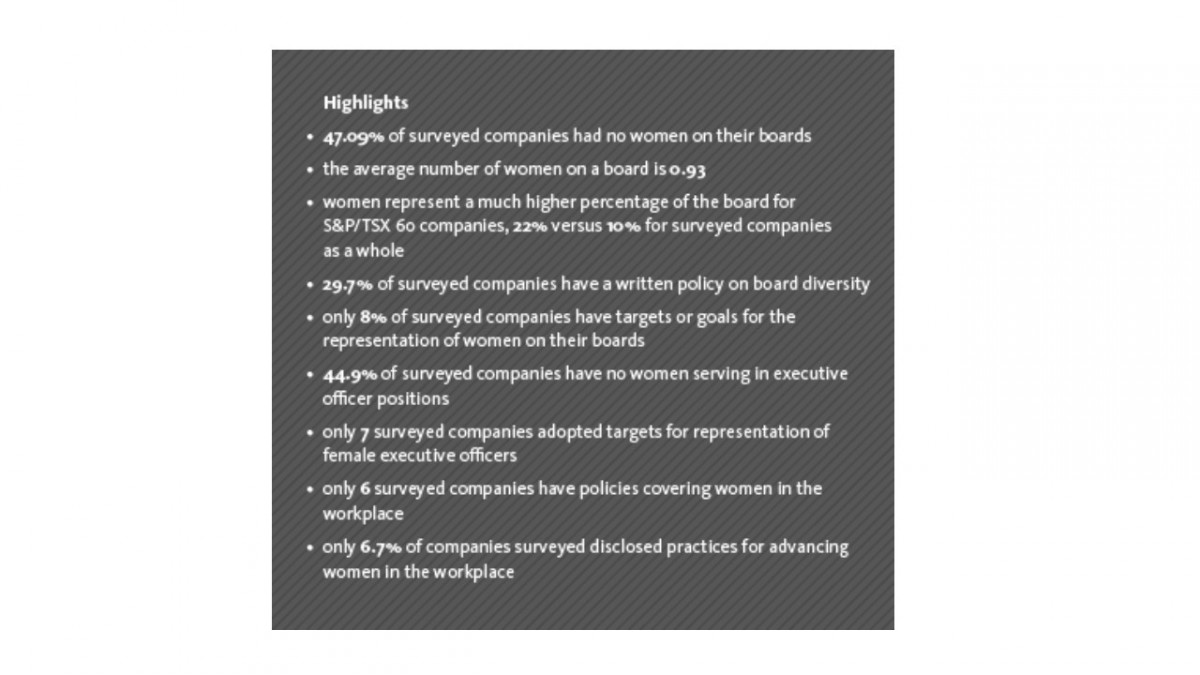
Le cabinet d’avocats Osler vient de publier les résultats d’une étude au bilan peu glorieux : « Le portrait global est décevant » pouvons-nous lire (ici). Vous trouverez en image ci-dessus un résumé de l’étude.
Cette première année d’application des nouvelles exigences en matière de divulgation reflète d’importants exemples de non-conformité, la faible représentation des femmes dans les conseils d’administration et les postes de cadres au sein d’entreprises cotées à la principale Bourse canadienne, et la quasi-inexistence d’objectifs ou de cibles à atteindre en ce qui a trait au nombre de femmes cadres supérieures.
Pour accéder au rapport « Diversity Disclosure Practices » : cliquez ici.
À la prochaine…
Ivan Tchotourian